|
They began in 1963 as Al and the Silvertones in Winnipeg, Canada. In their early days, they were heavily influenced by British musicians. They cut a few local singles, and eventually became known as Chad Allan and the Expressions, which they remained until 1965, when Chad Allan left the line-up. It was about then that an American label, Scepter, laid plans to release some of their records in the United States. As a promotional gimmick, a contest was held in which people sent in suggestions for a new group name. Meanwhile, their version of a Johnny Kidd song, "Shakin' All Over," was issued as a 45, with the artist listed simply as "Guess Who?" Before a winner could be chosen in the competition, "Shakin' All Over" became a U.S. hit, establishing the band down under as the Guess Who. The fellows figured that name was as attention-getting as any, and decided to keep it. They then began extensive American tours, starting in the summer of 1965. In the fall of 1966, the quartet got its own television show, "Let's Go," which ran for two years on the Canadian network. By that point, the group consisted of lead singer Burton Cummings, lead guitarist Randy Bachman, bass player Jim Kale, and Gerry Patterson on drums.
In 1968, after recording a premium disc for Coca-Cola, the Guess Who met Jack Richardson, who signed them to his Nimbus 9 label. He became their producer, and got them U.S. distribution through RCA Records. In 1969, along came the album Wheatfield Soul, and from it, a tune called "These Eyes." It became a million-seller -- their first of four such singles in a row. The second Guess Who album, Canned Wheat, contained three more Guess Who classics. "Laughing," another song in the same bag as "These Eyes," was coupled on a 45 with "Undun," and both sides became hits. Also off the same album: "No Time," which went top five in February 1970. And then came "American Woman."
"'American Woman' was also controversial. The popular misconception was that it was a chauvinistic tune, which was anything but the case. The fact was, we came from a very strait-laced, conservative, laid-back country, and all of a sudden, there we were in Chicago, Detroit, New York -- all these horrendously large places with their big city problems. After that one particularly grinding tour, it was just a real treat to go home and see the girls we had grown up with. Also, the war was going on, and that was terribly unpopular. We didn't have a draft system in Canada, and we were grateful for that. A lot of people called it anti-American, but it wasn't really. We weren't anti-anything. John Lennon once said that the meanings of all songs come after they are recorded. Someone else has to interpret them." "American Woman" broke in the U.S. late in March 1970. It spent three weeks at number one in May, fifteen weeks on the charts. In June 1970, Randy Bachman quit the group and later formed his own outfit, Bachman-Turner Overdrive. He was replaced by Greg Leskiw and Kurt Winter; Kurt being the author of "Hand Me Down World," the next Guess Who hit. Over the next few years, a number of people floated in and out of the band, and the hits continued. Among the more successful singles were "Share the Land" (1970); "Albert Flasher" and "Rain Dance" (1971); "Star Baby," "Clap for the Wolfman" and "Dancin' Fool" (1974). After another year, Burton Cummings left the group in order to launch his solo career. He had his own hit in 1976 -- a Top 10 tune called "Stand Tall."
No comments so far, be the first to comment.  |


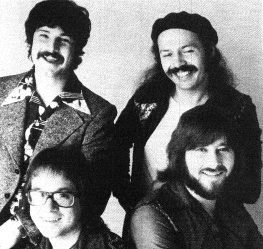
 or more than a decade, despite major personnel changes, the Guess Who remained one of the world's most popular rock bands.
 Reader's Comments

