|
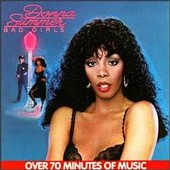
Born LaDonna Andrea Gaines, Donna Summer was easily the most important artist to emerge from the seventies disco craze. She was called The Queen of Disco, a title she came to resent. "I do not consider myself a disco artist," she said. "I am a singer who has done disco songs. Despite the way it may have seemed to the public, I have always been rock-oriented. For me, Bad Girls is far more rock than disco."
Bad Girls, Donna's most ambitious album, was also her best seller and final new release of the seventies. It was a "concept" album, as was the earlier Once Upon a Time. On this double set, though, the design was clearly different. Instead of being a Cinderella story, the theme was "romantic reflection." It was much more loosely constructed and, as such, left lots of room for experimentation. In its sweep of fifteen songs -- eight of which Donna had a hand in writing -- she and her producers -- Giorgio Moroder and Pete Bellotte, embraced new stylistic ground. The funky, get-on-up beat of disco still reigned supreme, but in many of the tunes there was a lusty rock'n'roll bite. "Hot Stuff" certainly had it, and there was also the title track -- the most popular cut pulled from the album as a single. Donna's steamy vocal -- a hooker's chant -- taunted, teased, and cajoled over a swirling synthesizer track. Donna was once asked about the inspiration behind "Bad Girls." "I was in my office in the old Casablanca building," she said. "I sent my secretary to do something, and the police stopped her on Sunset Boulevard. She was dressed in business attire, but they were trying to pick her up. That ticked me off. I pondered why that would happen to innocent people -- and then I developed compassion for the girls, working on the street." And the "toot-toot, beep-beep" at the end of the track? "I figured, what do guys do when they pick up girls? I had to emulate them tooting their horns." In July 1979, "Bad Girls" bounded to the top of the charts. Both the album and the single were number one simultaneously, week after week after week. And then Donna Summer became a born-again Christian.
"I started crying like a baby. All the stuff that had been keeping me so tense got released. I've gone down the wrong paths, had the life of sin and decadence, but I'm different now. It was the most wonderful experience of my life." And there were more surprises. In January 1980, after selling more than twenty million records, Donna sued her label, charging "undue influence, misrepresentation, and fraud." Two weeks later, Casablanca president Neil Bogart resigned, freeing her to sign with some other company. She chose Geffen, and a few months after that, released her first new album of the eighties, The Wanderer. This album included her first born-again Christian song, "I Believe in Jesus," and the title track became a strong-selling single. Also that year, Donna married Bruce Sudano, lead singer of the Brooklyn Dreams, with whom she recorded "Heaven Knows," and the couple had a daughter, Brook Lyn. In 1983, Donna had her biggest hit album since Bad Girls with She Works Hard for the Money, which yielded a massive hit single in the title track, a video for which was played heavily on MTV. Her 1989 album Another Place and Time was produced by the British team of Stock, Aitken, and Waterman, who brought Donna back to the Top 10 singles chart with "This Time I Know It's for Real." Donna's recording success declined in the 1990s, after she embraced Christianity and released songs like "I Believe in Jesus." It was around this time that rumors began circulating that Donna had said the emerging AIDS epidemic was God's revenge on homosexuals for living a blasphemous lifestyle. Donna denied the rumors, but her large audience of gays dwindled. Her last studio album, Crayons in 2008, produced three dance club hits with "I'm a Fire," "Stamp Your Feet" and "Fame." Her last hit was the 2010 single "To Paris With Love." As of 1995 she had earned 11 gold and two platinum singles, and eight gold and three platinum albums. "I have miles to go before I sleep," said Donna, who became the most successful female hitmaker of the seventies. "I've really only started to say what I want to say. I've paid a lot of dues. The years have not been easy. There's so much I want to do. I'm going to try to branch out even more. I don't want to stay with any one thing. I like to think of myself as a beautiful plant that changes -- grows leaves, loses them, and every day looks different. I want to have an image follow me, not have me follow the image. "I'm a normal human being who can sing a lot of kinds of songs. I can be classy and versatile. Besides, when you start out whispering, the only way is up." Throughout her remarkable career, Donna sold more than 130 million records worldwide and won five Grammy Awards, six American Music Awards and was the first African-American woman to be nominated for an MTV Video Music Award, for "She Works Hard for the Money." Donna Summer died of cancer in Naples, Florida on May 17, 2012. She was 63.
No comments so far, be the first to comment.  |




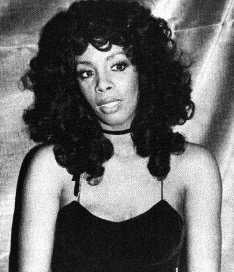
 ime magazine described Donna Summer's first hit, "Love to Love You Baby," as a "marathon of twenty-two orgasms. The lyrics are stunningly simple," they wrote, "mostly five words, repeated twenty-eight times. Her message is best conveyed in grunts and groans and languishing moans." Yet she was a woman who, after performances, wouldn't go anywhere until every last speck of glitter was removed from her eyelids. "I don't want to look like a hooker," she said.
 Reader's Comments

