
   |

The Cars
Elektra 135
Released: May 1978
Chart Peak: #18
Weeks Charted: 139
Certified Platinum: 12/27/78


 The first sound you hear on "Just What I Needed," the single from the Cars' debut album, is the repeated thump of bass notes against the short, metallic slash of guitar. It's a magnificent noise: loud, elemental and relentless. But the Cars -- the best band to come out of Boston since J. Geils -- aren't interested in simply travelling the interstates of rock & roll. They'll go there for the rush, but they prefer the stop-and-go quirks of two lanes. Before "Just What I Needed" is over, guitarist Elliot Easton has burned rubber making a U-turn with his solo, and Greg Hawkes' synthesizer has double-clutched the melody. Leader Ric Ocasek once sang that he lived on "emotion and comic relief," and it's in this tension of opposites that he and his group find relief (comic or otherwise) between the desire for frontal assault and the preference for oblique strategies. This is the organizing principle behind not only the single but the entire LP, which is almost evenly divided between pop songs and pretentious attempts at art.
The pop songs are wonderful. (Besides "Just What I Needed," they include "My Best Friend's Girl" and "You're All I've Got Tonight.") Easy and eccentric at the same time, all are potential hits. The melodies whoosh out as if on casters, custom-built for the interlocked but constantly shifting blocks of rhythm, while Ocasek's lyrics explode in telegraphic bursts of images and attacks ("You always knew to wear it well/You look so fancy I can tell"). Neither Ocasek nor bassist Ben Orr have striking voices, but by playing off the former's distant, near-mechanical phrasing against the latter's sweet-and-low delivery, the band achieves real emotional flexibility.
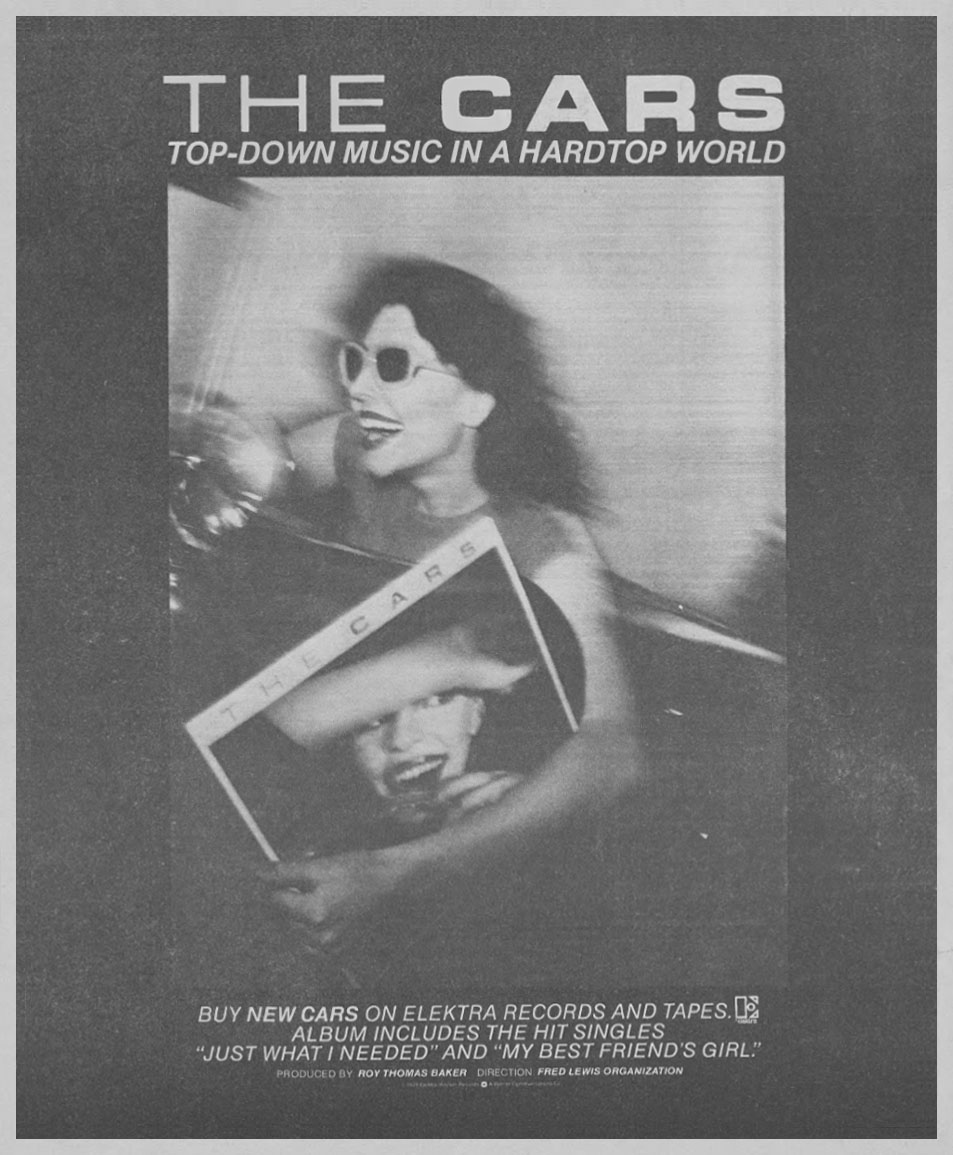 Click image for larger view. |
- Kit Rachlis, Rolling Stone, 9-21-78.
This is a very interesting debut LP. The vocals and pacing of the band recall such new wave acts as Television and Talking Heads. And then Roy Thomas Baker's production rolls over this plaintive-tentative sound with Queen's megaforce. It could have sounded grotesque but somehow it works. It creates an interesting tension in the music. Similarly, chords bounce against riffs, and sweet vocal harmonies back a Jonathan Richman-like stiffness. What this five-man band has achieved (with Baker's very able production) is a synthesis of new wave ideas with a commercial pop veneer. Best cuts: "Good Times Roll," "Don't Cha Stop," "I'm In Touch With Your World," "All Mixed Up."
- Billboard, 1978.
Ocasek writes catchy, hardheaded-to-coldhearted songs eased by wryly rhaphsodic touches, the playing is tight and tough, and it all sounds wonderful on the radio. But though on a cut-by-cut basis Roy Thomas Baker's production adds as much as it distracts, here's hoping the records get rawer. That accentuated detachment may feel like a Roxy Music move in the first flush of studio infatuation, but schlock it up a little and this band really could turn into an American Queen. B+
- Robert Christgau, Christgau's Record Guide, 1981.
Come and cruise. The beat is matched to the patter of tires on blacktop -- chromium plated hubcaps and all! Said to be the ideal music for driving, this debut album thrusts on track by track with its clean-cut rock. The best argument yet for in-car CD players. (Criticisms of The Cars' music as being too clinical and mechanical were only heard later.)
The electric guitar fairly crackles out of the speakers, the handclaps equally compact and clear in the intro to "My Best Friend's Girl"; as the song progresses the sound loses some of this vivid quality as the dynamic range drops. CD sound is slightly hissy and soft when the music is complex but this earlier taping lacks the intense qualities of 1984's Heartbeat City. Roy Thomas Baker engineers space and depth into The Cars' sound without compromising their punchy delivery too much. "Moving In Stereo" does just that and is a knock-out track when heard with the solidity and stereo focus of CD.
- David Prakel, Rock 'n' Roll on Compact Disc, 1987.
On the heels of the new wave, the Cars' debut album was a mechanized rock delight, its music spare and precise, yet undeniably catchy, with sly references to the Beatles and Tommy James and the Shondells. Vocalists Ric Ocasek and Ben Orr sounded oddily dispassionate, as if they were singing in a foreign language. But that didn't stop "Just What I Needed," "My Best Friend's Girl," and "Good Times Roll" from becoming modest hits. * * * *
- William Ruhlmann, The All-Music Guide to Rock, 1995.
The Cars' debut remains the group's finest album. Kicking off with "Let the Good Times Roll," "My Best Friend's Girl" and "Just What I Needed," the album sounds more like a greatest hits collection than a debut. Before long, its teflon production became state-of-the-art for sonic wannabes. * * * *
- Mike Joiner, Musichound Rock: The Essential Album Guide, 1996.
This exceptional debut from a groundbreaking Boston band combines slick new wave with cheeky rock via beautifully stylized, catchy nuggets with wheezing synths, super-sized vocals, killer hooks and quirky lyrics that shake it up crossed with a truckload of personality. Illustrating why Ric Ocasek is a great producer, this superior effort also features Elliot Easton's tasty guitar work -- if the bass lines don't get your ass out of the chair, you're dead. * * * *
- Zagat Survey Music Guide - 1,000 Top Albums of All Time, 2003.
"We used to joke that the first album should be called The Cars' Greatest Hits," said lead guitarist Elliot Easton. The Cars' 1978 debut was arty and punchy enough to be part of Boston's New Wave scene and yet so catchy that nearly every track -- "My Best Friend's Girl," "Just What I Needed," -- landed on the radio.
The Cars was chosen as the 282nd greatest album of all time by the editors of Rolling Stone magazine in Dec. 2003.
- Rolling Stone, 12/11/03.
 Further reading on Super Seventies RockSite!: Book Review: |
Against a backdrop of the likes of The Sex Pistols failing to make an impact on the US mainstream as they had done in Britain, this self-titled set captured some of the essence of punk but presented a more radio-friendly sound that was pleasing to programmers.
The album's first three tracks alone, "Good Times Roll," "My Best Friend's Girl" and "Just What I Needed," remain FM rock staples as well as career highlights for the Boston band whose label Elektra hooked them up with Queen producer Roy Thomas Baker to make this debut. Baker would go on to produce their next three albums as well. His Queen-like mark is evident throughout the album, which was recorded in London in early 1978, as is frontman Ric Ocasek's ability to write one catchy hook after another.
Released in May 1978, the album was an archetype slow-burner, taking another 10 months to reach its peak position of Number 18 in the US chart. By that time The Cars had been named as Rolling Stone's new band of the year and had been nominated for a Grammy in the new artist category. The album went on to accumulate a chart run of 139 weeks.
As of 2004, The Cars was the #28 best-selling album of the 70s.
- Hamish Champ, The 100 Best-Selling Albums of the 70s, 2004.
The Cars pulled in at the dawn of that often justifiably maligned genre known as new wave with songwriting acumen, superlative musicianship, and a unique visual "appeal" equaled at the time only by Blondie. With this, their debut LP, they created a gold-plated pop masterpiece dressed up in new wave duds.
The listener, beckoned to on the cover by a deliriously happy model giddily losing control of the wheel of a car (clever, boys), is swept up by the opening mission statement "Good Times Roll"; from there the album hurtles from one new wave gem to the next. Though The Cars would have more chart success with later singles, the track listing on the debut reads like a best-of collection. Radio hits like "My Best Friend's Girl" and "Just What I Needed" sit next to fan favorites like "Bye Bye Love" and "All Mixed Up." Ric Ocasek's songs run the gamut, shifting moods and tempos from the infectious pop of "My Best Friend's Girl" to weirder-sounding ditties like "I'm In Touch With Your World," which employs a variety of sound efects that would be at home in a Looney Tunes cartoon, and the 'luded out crawl of "Moving In Stereo." Guitarist Elliot Easton is the unsung hero, littering songs like "Bye Bye Love" with staggeringly good fills. Little wonder that this million-selling album went on to spend 139 weeks on the U.S. Billboard charts.
A superbly stylized mash of influences (from Velvet Underground to David Bowie) filtered through unabashed radio-ready pop, The Cars' debut is an introductory handbook to new wave that sounds great nearly three decades later.
- Jaime Welton, 1001 Albums You Must Hear Before You Die, 2005.
"We used to joke that the first album should be called The Cars' Greatest Hits," said guitarist Elliot Easton. Their debut was arty and punchy enough to be New Wave, and yet so catchy that many tracks ("My Best Friend's Girl," "Just What I Needed") landed on the radio.
The Cars was chosen as the 353rd greatest album of all time in a Rolling Stone magazine poll of artists, producers, critics and music industry figures in Oct. 2020.
- Rolling Stone, 10/20.
 Reader's Comments
No comments so far, be the first to comment.
 Buying Options





