
   |

Stampede
The Doobie Brothers
Warner 2835
Released: May 1975
Chart Peak: #4
Weeks Charted: 25
Certified Gold: 5/28/95


 Stampede, the Doobie Brothers' fifth album, finds the San Jose guitar band continuing to develop their style. One cut, a remake of Kim Weston's Holland-Dozier-Holland hit "Take Me in Your Arms," accomplishes the unprecedented feat of making a Bay Area rock band sound soulful. Even better, the song, despite Tom Johnston's Marvin Gaye-ish vocal and all the Motown trimmings (baritone sax on the bottom, darting strings on the top), ends up sounding like no one so much as the Doobie Brothers.
 Click image for larger view. |
But a style does not a vision make -- or at least not a challenging vision. Lyrically, this band still seems plagued by the spirit of groovy vibrations that made "Listen to the Music" an endurance test for case-hardened cynics. "Neal's Fandango" bumbles along to couplets like "On the hills above Santa Cruz/In the place where I spent my youth," which doesn't even rhyme, much less scintillate.
- Jim Miller, Rolling Stone, 7-3-75.
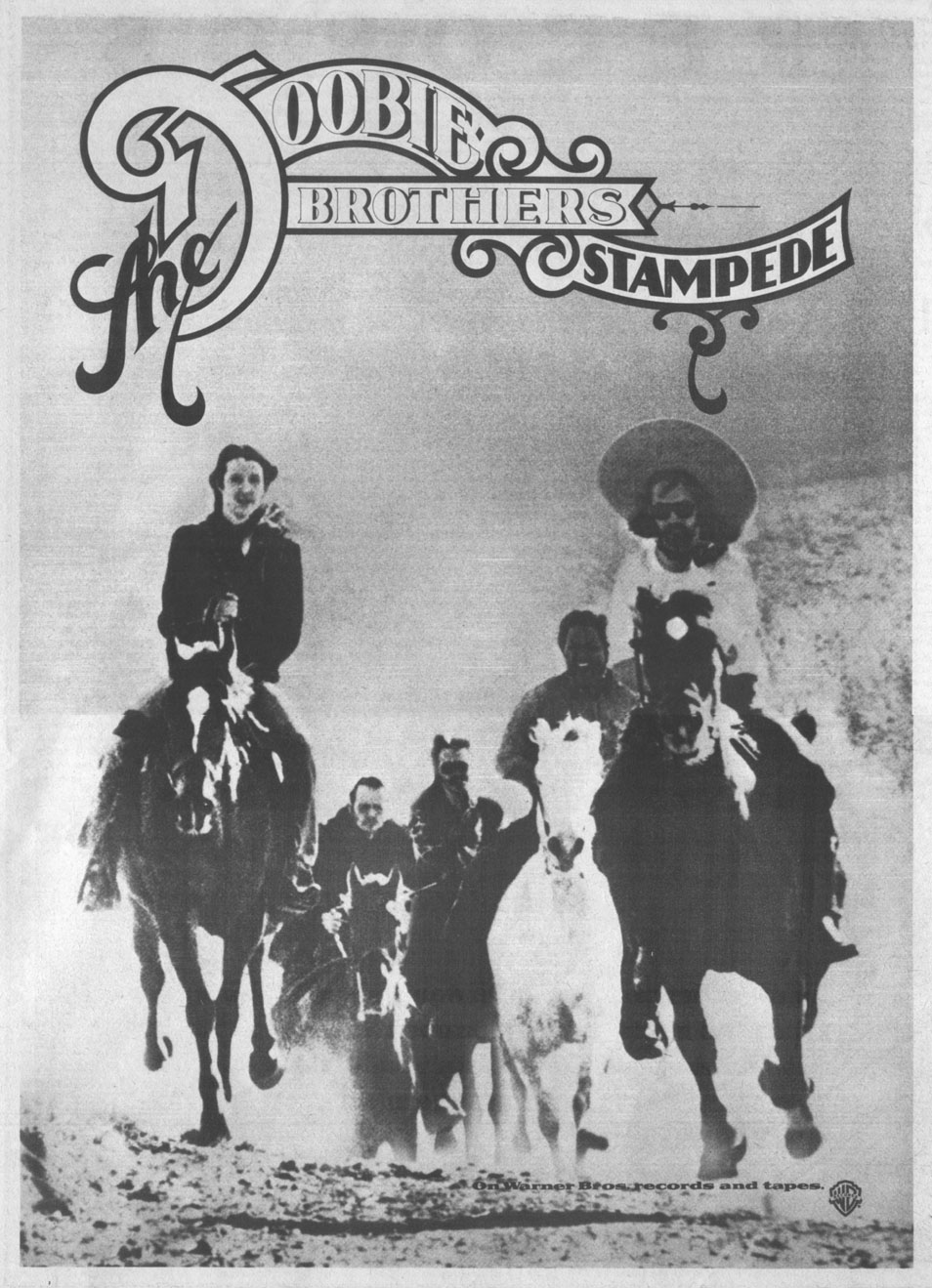
The jacket pictures show the Doobie Brothers riding horses, and that works with the amorphous, thick-waisted sound of this to remind me of the old Pogo line about a camel being a horse designed by a committee. Like most Doobie Brothers albums, this one sounds like the work of a committee, and I don't think I approve of even the idea of committees. Committees are essentially political, and the very first song climaxes in the line, "She's got the power, rock and roll," which sounds to me like a attempt by a committee to tell a crowd what the committee thinks the crowd wants to hear. Committees are always compromising, angling toward acceptably low denominators, and few committees could hope to be thought of as stylish; so far the description fits the Doobies pretty snugly. What committees do mostly is bore people, and, regrettably, the analogy with this album continues to hold. If you play anything, try picking along with "Texas Lullaby"; if you make it to the end, you have the kind of boredom threshold that makes you ripe to be tapped by the town fathers for helping plan the next big project aimed at making your burg even duller than it is now.
- Noel Coppage, Stereo Review, 9/75.
Not much doubt that this is headed for the top of the charts, for the Doobies have developed into one of our true supergroups. The sound they produce is a good-time feel which might be termed the California Music of the '70s, much like the Beach Boys' distinctive sound of the '60s. Not that the Doobies deal with any specific West Coast phenomena, but it's a unique sound that seems appropriate to California. Here we get a variety, from "China Grove" type rock, with flowing guitars and harmonies, to more simplistic rock/soul, to covers of Motown hits, to production ballads. Use of horns, strings and backup voices does not interfere with the basic group sound. There's even a good, country blues cut in the vein of "Black Water." Musically, the LP works better than anything the six have come up with in the past. Commercially, it comes at the high point in their career. Best cuts: "Sweet Maxine," "Texas Lullaby," "Take Me In Your Arms," "I Cheat The Hangman," "Rainy Day Crossroad Blues."
- Billboard, 1975.
With the addition of ex-Steely Dan guitarist Jeff "Skunk" Baxter, the Doobie Brothers became a more musically ambitious and accomplished band, without sacrificing their capability to rock & roll. However, Stampede suffers from the same flaw as What Were Once Vices -- a lack of consistent material. * *
- Stephen Thomas Erlewine, The All-Music Guide to Rock, 1995.
 Reader's Comments
jobb
out the both of urs, steve and jim; all it is and ever needs 2 b: neal's fandango
Chuck Sparks (Nov. 2023)
Just picked up this album, remembered I didn't like it much as a kid in 75, but it's a very good record. Their albums were all underrated, and I never got where they were going with the more album oriented sound. But I get it now. They abandoned the AOR sound on the next album Taking It To the Streets, with the addition of Michael McDonald.
superseventies (Moderator) (Nov. 2023)
It is a good album overall but I think the song sequencing could have been better, try it like this:
1. "Take Me In Your Arms (Rock Me a Little While)"
2. "I Cheat The Hangman"
3. "Précis"
4. "Rainy Day Crossroad Blues"
5. "I Been Workin' On You"
6. "Double Dealin' Four Flusher"
7. "Sweet Maxine"
8. "Neal's Fandango"
9. "Slat Key Soquel Rag"
Chuck Sparks (Nov. 2023)
I liked their instrumentals, but this was considered a disaster at the time. You're right about the song order.
superseventies (Moderator) (Nov. 2023)
This was a definite improvement over the previous album (What Were Once Vices...), I only liked six songs on that one. Maybe the drugs were really kicking in by '74, lol.
They could've felt they'd fallen into a rut and that's why they recruited McDonald into the band, their bigger than ever success with him speaks for itself (although I don't think Johnston particularly appreciated it at the time).
 Buying Options





