
   |

Hunky Dory
David Bowie
RCA 4623
Released: April 1972
Chart Peak: #93
Weeks Charted: 16
 Hunky Dory not only represents David Bowie's most engaging album musically, but also finds him once more writing literally enough to let the listener examine his ideas comfortably, without having to withstand a barrage of seemingly impregnable verbiage before getting at an idea -- only in "The Bewlay Brothers" does he succumb to the temptation to grant his poetic faculties completely free rain, and there with unexpectedly frustrating results.
While compiling material for this album Dave's thoughts apparently turned frequently to the imminence of the birth of his first sone, Zowie, which preoccupation is reflected in the album's two obvious candidates for release as a single, "Oh! You Pretty Things" and "Kooks." The former, which was a hit in England for Herman's Hermits, intimates that homo superior -- the superman race -- is about to emerge, implicitly in the form of the wee Bowie. "Kooks," which is even catchier, finds Dave urging the infant to stick around with his folks, shameless aberrants though they may be, with such lines as, "Don't pick fights with the bullies or the cads/ 'Cause I'm not much at punching other people's Dads," revealing remarkable self-candor on Papa's part.
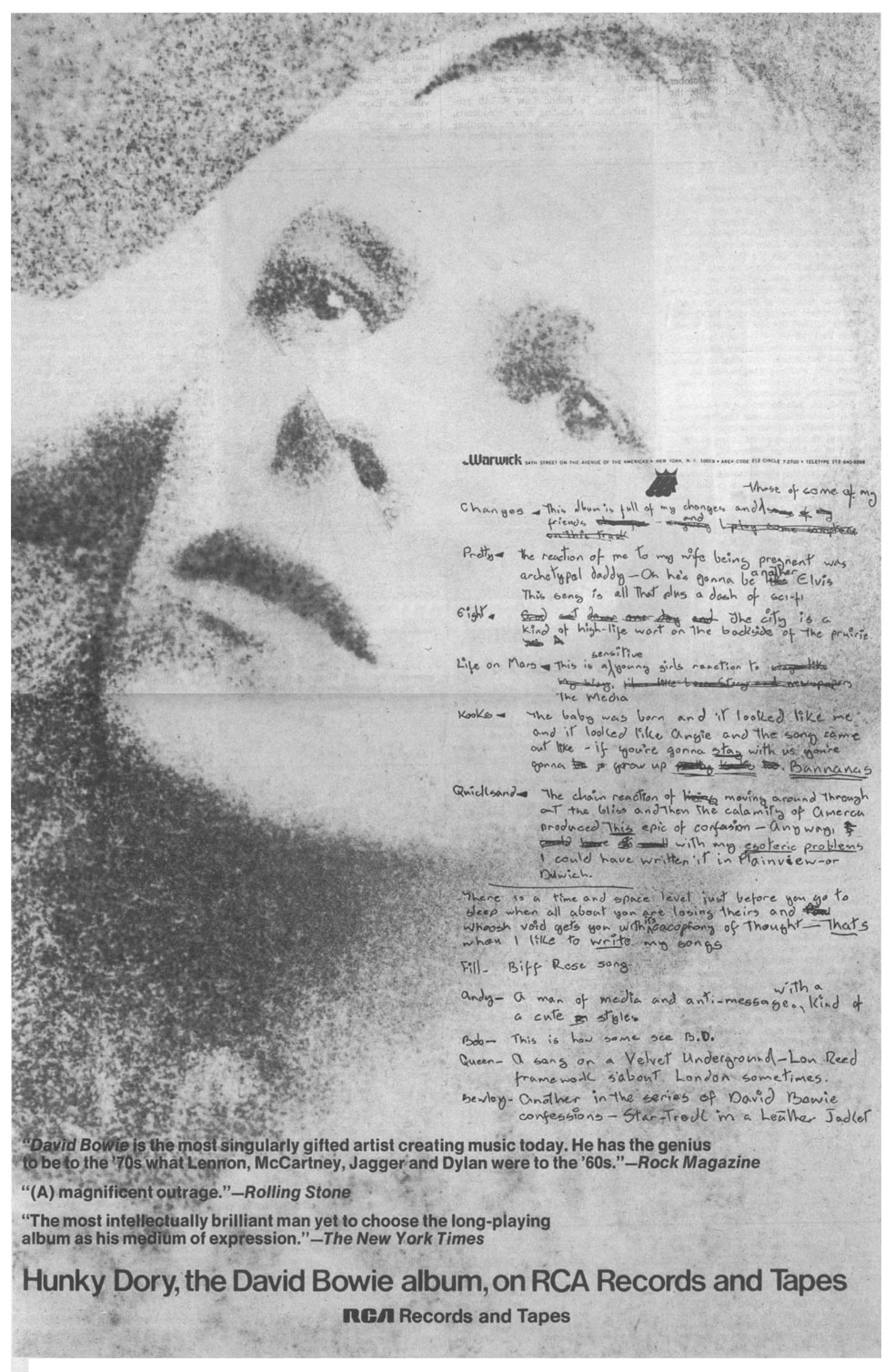 Click image for larger view. |
"Changes" has an irresistible stuttered chorus sung by dozens of overdubbed Daves alternating with faintly Newley-ishly-delivered verses that may be construed as a young man's attempt to reckin how he'll react when it's his time to be on the maligned side of the generation schism. '
"Quicksand," a melodically lovely affair that boasts superb singing from Dave and a beautiful guitar motif from Mick Ronson, also speaks of confusion. Through two verses it's typical erratic Bowie -- a flaccid, strained image in the same breath with an extremely effective one (as in "I'm the twisted name on Garbo's eyes/ I'm living proof of Churchill's lies"), until in the third it abruptly becomes clear and controlled as it betrays the paradoxes the Bowie intellect finds most troubling:
- I'm not a prophet or a stone age man
- Just a mortal with potential of a superman
- I'm tethered to the logic of homo sapien
- Can't take my eyes from the great salvation
- Of bullshit faith...
- Just a mortal with potential of a superman
Then Dave falters momentarily with two tunes that suggest Lewis Segal and other astute Bowie-watchers that the lad's tongue may be less firmly against his cheek than originally suspected when he suggests that he is in the vanguard of, and therefore a qualified commentator on, hip and avant-garde goings-on -- both "Andy Warhol," whose only notable feature is its extraordinary all-acoustic guitar accompaniment, and "Song For Bob Dylan" impress even these unastute ears as self-indulgent and trivial.
"Queen Bitch," though, with a vocal right out of Lou Reed and an arrangement right out of the Velvet Underground and a theme right out of the novel of the same name, is fascinating and scandalous, describing a "swishy... Queen" successfully hustling the singer's boyfriend. And after all this reviewer did to portray Dave as a clean-cut normal in these pages!
"The Bewlay Brothers" sounds like something that got left off The Man Who Sold because it wasn't loud enough. Musically it's quiet and barren and sinister, lyrically virtually impenetrable -- a stream-of-consciousness stream of strange and (seemingly) unrelated imagery -- and it closes with several repetitions of chilling chorus sing an a broad Cockney accent, which, if it's any help, David usually invokes when he's attempting to communicate something about the impossibility of ever completely transcending the mundane circumstances of one's birth.
And there you have it. With his affection for using intriguing and unusual themes in musical settings that most rock "artists" would dismiss with a quick fart as old-fashioned and uncool, he's definitely an original, is David Bowie, and as such will induce us homo superior elitist rock critics to race about like a chicken with its head lopped off when he learns that he's a couple of pretentious tendencies he'd do handsomely to curtail through the composition of an album's-worth of material. Until that time, Hunky Dory will suffice hunky-dorily.
- John Mendelsohn, Rolling Stone, 1-6-72.
Bonus Reviews!
David Bowie is a veteran performer, but relatively few have paid much attention to him because he's always been so -- er -- avant. Also outrageous. This album features not only a toned-down Bowie, with strings in the background, but possibly even a Bowie grabbing for stardom. How else to explain such a bland, soft-rock lullaby to hippie kids as "Kooks" (which, sure enough, got on the old radio) or such self-indulgent tripe as "Song for Bob Dylan" (making the then-obligatory plea to the Father Figure to get the family together)? For the old Bowie fans, all seven or eight of them, there is one full-scale avant-garde anthem, "The Bewely Brothers," of which the most we ordinary mortals can expect to absorb is an occasional puzzling snatch of the lyric like "the grim face on the cathedral floor." In addition to this tendency to go from one extreme to the other, Bowie still doesn't have any personal singing style to speak of. He's a good mimic, too good for his own good. Yet the heart of the album is worth a listen, especially "Changes," with its catch stuttering chorus, and "Quicksand," with a lovely melody and lyrics nether trite nor impossible. And through most of it, the production is fine, with tasteful but sophisticated studio manipulations. The album won't make Bowie a pop star, but it should expose him to a much broader audience -- every member of which will conclude he's an interesting character. Not always entertaining, but interesting.
- Noel Coppage, Stereo Review, 8/72.
The mercurial British singer-composer, best known for his "Space Oddity" voyage, is back and not a minute too soon. Despite the title, everything is not "hunky dory" in David Bowie's world. In his head maybe, but not necessarily in what surrounds him. So he casts a look about; and if that look is askance, who can blame David? His earlier recordings -- on Deram and Mercury -- were generally chilling and mind engaging. But Hunky Dory goes out beyond that. "Turn and face the strange," David advises on "Changes," the very first tune on the record, and that's good advice. If you go with Bowie, he'll take you down corridors and introduce you to some shadows. Bowie alternates between a rock-edged style and something of the music hall flair, but his approach to each subject is always right -- even if curiously so. "Oh You Pretty Things" was a hit in England for Peter Noone, but there is nothing hermetic about Bowie's own rendition of it. Hermetic maybe, but not hermitic. Fellow artists are not spared -- listen to "Fill Your Heart Andy Warhol" and "Song For Bob Dylan" -- and there are a few words for other hustlers too ("Queen Bitch"). "Life On Mars?" and "Quicksand" are two more visions of a hellish state. If you're easily disturbed, you may reject this LP. If you're just plain disturbed, you'll love it. And if you're somewhere in between, chances are you'll recognize that David Bowie is an uncompromising, adventurous and multi-faceted artist.
- Ed Kelleher, Circus, 1/72.
The British composer/performer comes up with a heavy debut for RCA, loaded with the kind of Top 40 and FM appeal that should break him through big on the charts. Along with vocals, Bowie plays piano, sax and guitar. Strong material, his own, for programming include "Changes," "Oh You Pretty Things," and "Life On Mars." His "Andy Warhol" material is also a standout.
- Billboard, 1972.
Don't be deceived by the introverted way that David Bowie approaches his material -- there's a mind at work here, as there has been for the last few years, largely unrecognized. Try "Kooks" and "Queen Bitch" as a mirror to examine the mind and ideas of Mr. Bowie.
- Hit Parader, 5/72.
After two overwrought excursions on Mercury [later released on RCA] this ambitious, brainy, imaginative singer-composer has created an album that rewards the concentration it demands instead of making you wish you'd gone on with the vacuuming. Not that he combines the passion and compassion of Dylan (subject of one song) with the full-witted vision of Warhol (subject of a better one) just yet. But he has a nice feeling for weirdos, himself included. A-
- Robert Christgau, Christgau's Record Guide, 1981.
This was David Bowie's first big album, though nobody knew it at the time except the artist himself. "I'm going to be huge," he was quoted as saying, "and it's quite frightening in a way because I know that when I reach my peak and it's time for me to be brought down, it will be with a bump!"
Wrong on almost all counts. Huge his popularity became, but not until the release of his next album, The Rise and Fall of Ziggy Stardust and the Spiders From Mars, and when it did arrive it was enduring.
Hunky Dory first charted in April 1972 in the United States. It was only a moderate success and generated no hit singles. In Britain it did not enter until September, two months after Ziggy started his interplanetary rule. As 1972 turned to '73 Bowie's career gathered momentum, sucking three earlier albums into the US list and two into the UK rolls. Hunky Dory found itself a bigger hit than ever when "Life On Mars" soared to number three in the UK top forty. The album ascended to three itself and enjoyed a chart run of over a year.
With its half-spoken, half-sung delivery, its false ending and its changes of texture, "Life On Mars" was one of David's most exciting and unexpected successes. In 1986 BBC Radio 1 listeners chose it their favourite Bowie track of all time.
"Changes," the lead-off cut, was another standout. Three years later this anthemic tune went to number one in Britain as part of a maxi-single led by the re-issued Space Oddity. It loaned its own name to the titles of the subsequent retrospectives Changesonebowie (1976) and Changestwobowie (1981).
In 1973 David's Pin-Ups would salute favourite old songs. Side two of Hunky Dory paid tribute to people, "Fill Your Heart" was a Biff Rose song so faithfully performed it stirred memories of Rose himself, even of that singer-songwriter's few seconds in history, "What's Gnawing At Me." "Andy Warhol" hailed the New York cult figure with such determination the track retains Bowie's correction over the talkback of someone else's mispronunciation of "Warhol."
"Song For Bob Dylan" made its subject obvious. "Queen Bitch" was clearly a Lou Reed/Velvet Underground tribute, preceding Ziggy's homage "Suffragette City." The final selection, "The Bewlay Brothers," is the longest on the album and obviously of importance to its author, who named a publishing company after it, but mortal men seem unable to divine its significance.
In 1987, Hunky Dory was chosen by a panel of rock critics and music broadcasters as the #58 rock album of all time. Vinyl collectors know that early copies of the LP with a hand-scrawled title are worth many times the value of the standard edition.
- Paul Gambaccini, The Top 100 Rock 'n' Roll Albums of All Time, Harmony Books, 1987.
Hunky Dory came from Bowie's first recorded sessions with the then un-named Spiders from Mars (Ronson, Woodmansey and Bolder). Rick Wakeman helped out with piano. While at the time the album was critically well-received it was not a big seller until after Ziggy had broken. Mysteriously oblique, primed, a portent and compellingly commercial -- Hunky Dory is all these things and survives the test of time better than many Bowie albums, especially the track "The Bewlay Brothers" exploring Bowie's ambiguous relationship with his brother.
Compact disc has breathed new life into these songs. Though the recording suffers from hiss and tape inadequacies, by today's standards in terms of sheer presence it is a winner. Bowie's voice is emphatically natural while the studio talkback intro to "Andy Warhol," in particular the quiet strumming and inadvertent knocking of the body of Bowie's acoustic guitar, has a striking realism. The heavier production numbers are less successful.
Without mentioning the fact on the sleeve, the segued tracks 2 and 6 use CD Index points -- one of the few rock CDs so to do.
- David Prakel, Rock 'n' Roll on Compact Disc, 1987.
The Thin White Duke as accessible pop star with influences obvious. The Beatles echo through "Oh! You Pretty Things," Lou Reed in "Queen Bitch," and Bob Dylan (including some precise vocal mannerisms) on "Song for Bob Dylan." Best of all is the early seventies teen anthem "Changes," which opens the album with a nod to the Who. Pop music for the seminally weird. In the words of Robert Christgau, "This ambitious, brainy, imaginative singer/composer has created an album that rewards the concentration it demands instead of making you wish you'd gone on with the vacuuming." Hunky Dory foreshadows Bowie's sci-fi world and total image reconstructions that were to frame some of the more interesting music of a generally uninteresting decade. This fine-sounding CD also includes four strong bonus tracks, the best of which is the previously unreleased "Bombers." B+
- Bill Shapiro, Rock & Roll Review: A Guide to Good Rock on CD, 1991.
This followup to The Man Who Sold the World found Bowie lightening his sound considerably. Some of his most memorable songs are found on this classic: the catchy pop classic "Changes" (a theme song of sorts), the beautifully expansive "Life on Mars," the moody dynamics of "Quicksand," "The Bewlay Brothers," and "Oh, You Pretty Things." * * * * *
- Rick Clark, The All-Music Guide to Rock, 1995.
Like Young Americans, Hunky Dory was a moving affair, with meditative melodies and lush string arrangements for "Changes," "Oh, You Pretty Things" and "Life On Mars?" * * * *
- Aidin Vaziri, Musichound Rock: The Essential Album Guide, 1996.
Hunky Dory found Bowie lodged between his initial folk phase and the persona he would soon become. For this reason, it's probably his best album -- although surely with an artist like Bowie, whose career has spanned decades and who's dabbled with multiple musical styles, "best" is a relative term. In many ways, it was also his most personal work. Although as an artist Bowie would seldom be accused of earnestness, preferring instead to survive on mystique, performances like "Changes" and "Quicksand" were powerful and convincing. Most importantly, Hunky Dory established Bowie as a legitimate long-term talent as opposed to a mere oddity. Bowie, of course, proved eminently capable of handling the fame and adoration while still creating idiosyncratic albums throughout the remainder of the decade. In this sense, Hunky Dory can be seen as a catalyst for one of the most enduring careers in rock.
Hunky Dory was voted the 47th greatest album of all time in a VH1 poll of over 700 musicians, songwriters, disc jockeys, radio programmers, and critics in 2003.
- Joe S. Harrington, VH1's 100 Greatest Albums, 2003.
Bowie, then twenty-four, arrived at the Hunky Dory cover shoot with a Marlene Dietrich photo book: a perfect metaphor for this album's visionary blend of gay camp, flashy rock guitar and saloon-piano balladry. Bowie marked the polar ends of his artistic ambitions in tribute songs to Bob Dylan and Andy Warhol; in songs such as "Oh! You Pretty Things" and "Changes," he shows that he is already his own man, with a new pop sound that seems just as modern today as it was then. On "Life on Mars?," he sings to all the weirdos like himself who feel like aliens on Earth. Soon an army of kids would remake themselves in his spangled image, proving his point.
Hunky Dory was chosen as the 107th greatest album of all time by the editors of Rolling Stone magazine in Dec. 2003.
- Rolling Stone, 12/11/03.
A hard-rock concept album about a shaven-headed transvestite failed to make David Bowie a star. So New Musical Express's "thinking man's Marc Bolan" followed The Man Who Sold The World with a toybox of acoustic oddities, tributes to heroes, and surrealism.
Amazingly, that did not do the trick either and 1969's "Space Oddity" was increasingly looking like a one-hit wonder. So Bowie claimed to be gay, reveled in the ensuing publicity, wrote songs about a spaceman, and became the decade's most influential musician.
At which point, finally, people turned on by Ziggy Stardust bought that toybox -- Hunky Dory. They found an album endearingly affected -- I can be Dylan, Lou Reed, and Syd Barrett all at once! -- but packed with evidence of a songwriter easing into first gear. It also marks the emergence proper of Camp David, with exquisite gems such as "Queen Bitch." Bowie arrived at the photoshoot for the cover clutching a Marlene Dietrich photobook, and the tinted portrait definitely has something of a faded movie queen about it.
The temporarily calming effect of a wife and baby led to family snapshots like "Kooks," making this Bowie's most human album. But it has harder moments, notably "Andy Warhol" (which appalled its namesake). And for three cuts the album soars. "Quicksand" was inspired by America's "bliss and calamity" but is a beautiful ballad, not a fractured rocker, while "The Bewlay Brothers" is a bewitching portrait of mental illness.
Best of all, "Life on Mars?" -- which sprang from Bowie being commissioned to write lyrics for the song that became "My Way" -- sounds like nothing on Earth.
- Joel McIver, 1001 Albums You Must Hear Before You Die, 2005.
When David Bowie began writings songs for Hunky Dory in 1970, he had little to show for his six years in the music industry. After his first three albums tanked, the 23-year-old didn't have a label deal. His one hit -- 1969's "Space Oddity" -- was seen as a novelty song created to cash in on the mania surrounding the first moon landing. But in January 1971, Bowie arrived in the United States for a three-week promotional tour -- a journey that broadened his universe and inspired his first great record. "The whole Hunky Dory album reflected my newfound enthusiasm for this new continent that had been opened up to me," Bowie said in 1999. "That was the first time a real outside situation affected me so 100 percent that it changed my way of writing and the way I look at things."
Traveling by bus from Washington, D.C., to California, Bowie fell in love with the country and was inspired to pen tributes to some of its most iconic artists ("Andy Warhol," "Song for Bob Dylan" and the Lou Reed tribute "Queen Bitch"). Inspired by folk-rock artists that were dominating the charts, Bowie began composing pretty acoustic tunes with surreal lyrics like "Mickey Mouse has grown up a cow," from "Life on Mars?" "When we were rehearsing songs for Hunky Dory, David was playing by himself at folk clubs in London to, like, 50 people," says Hunky Dory bassist Trevor Holder, who also played on Ziggy Stardust and Aladdin Sane. "He had long hair and looked like a folkie."
Bowie spent at least six months perfecting the songs. By the time he hit London's Trident Studios in the sumer of 1971, he had complete demos for 10 of the 11. "He realized that the folk period was dying out and he needed to move on," says Bolder. "Especially with the glam bands like T. Rex moving along."
Bowie assembled a band -- including guitarist Mick Ronson and future Yes keyboardist Rick Wakeman -- that could amplify his folk tunes into glammy, grandiose rockers. "We went into the studio, and I had total freedom to do whatever I liked throughout the album," Wakeman said. "I still rate it as the finest collection of songs on one album." Adds producer Ken Scott, who engineered Bowie's previous two albums and George Harrison's All Things Must Pass, "I didn't think he'd go that far based on those two albums I worked on. It wasn't until he played me the Hunky Dory demos that it suddenly occurred to me he could be huge. When someone comes up with a song like "Life on Mars?" then you know that they're destined for greatness."
On "Changes," which kicks off the album, Bowie offers a challenge to pop's reigning stars, singing, "Look out, you rock & rollers." "I guess it was more being sort of arrogant," Bowie said in 2002. "It's sort of baiting an audience, saying, 'Look, I'm going to be so fast you're not going to keep up with me.'" "Life on Mars?" (based, like Frank Sinatra's "My Way," on a French pop song that was popular at the time) tells the story of a girl with "mousy hair" who goes to the movies as an escape from life.
The album was recorded in just two weeks, with the group averaging a song per day. The band shacked up in Bowie's London apartment, crashing in sleeping bags on the balcony. "Dave would drive us and all the gear into central London in the morning," says Bolder. "Afterward we'd all go down to the pub and drink. Nobody really knew who David was at that point." Bowie still wasn't getting recognized in pubs much after the album hit stores in December: It failed to chart in both the U.K. and the U.S.
But Hunky Dory provided something much more important than sales -- it was the template for everything that came after, including The Rise and Fall of Ziggy Stardust and the Spiders From Mars, which the band began recording weeks after finishing Hunky Dory. That disc made Bowie a superstar, and Hunky Dory tracks -- such as "Changes" and "Life on Mars?" -- became hits when fans started buying his catalog. Nearly four decades later, Hunky Dory remains one of Bowie's most consistent sellers. "Hunky Dory gave me a fabulous groundswell," he said in 1999. "It provided me, for the first time, with an actual audience -- I mean, people actually coming up to me and saying, 'Good album, good songs.' That hadn't happened to me before."
- Andy Greene, Rolling Stone, 9/3/09.
Planet Earth, meet David Bowie. One of him, anyway -- even in 1971, the former David Jones had already burned through a few pop disguises, posing as a folkie hippie songbird or a London mod pinup boy. He scored a novelty hit in the summer of 1969, "Space Oddity." But Hunky Dory was the album where he staked his claim as the most altered ego in rock & roll, billing himself as "The Actor" on the back cover while stretching out as a singer, songwriter and all-around mind-freaker. Bowie croons surreal ballads such as "Life on Mars?" and "Quicksand" like a cosmic theater queen. He also steals guitar flash from the Velvet Underground in "Queen Bitch." Led by Rick Wakeman of English prog-rockers Yes on piano and Mick Ronson on guitar, Hunky Dory was a breakthrough hardly anyone noticed -- Bowie was so far out, it would take the audience (and rock & roll itself) a while to catch up.
- Rob Sheffield, Rolling Stone, 8/25/16.
David Bowie arrived at the Hunky Dory cover shoot with a book of photographs of Marlene Dietrich: a perfect metaphor for the album's visionary blend of gay camp, flashy rock guitar, and saloon-piano balladry. Bowie marked the polar ends of his artistic ambitions with tribute songs to Bob Dylan and Andy Warhol. On "Life on Mars?" he sings to all the weirdos like himself, who feel like aliens on Earth.
Hunky Dory was chosen as the 88th greatest album of all time in a Rolling Stone magazine poll of artists, producers, critics and music industry figures in Oct. 2020.
- Rolling Stone, 10/20.
 Reader's Comments
No comments so far, be the first to comment.
 Buying Options





