
   |
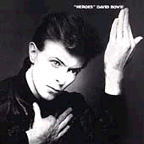
"Heroes"
David Bowie
RCA 2522
Released: October 1977
Chart Peak: #35
Weeks Charted: 19
 Heroes is the second album in what we can now hope will be a series of David Bowie-Brian Eno collaborations, because this album answers the question of whether Bowie can be a real collaborator. Like his work with Lou Reed, Mott the Hoople and Iggy Pop, Low, Bowie's first album with Eno, seemed to be just another auteurist exploitation, this time of the Eno-Kraftwerk avant-garde. Heroes, though, prompts a much more enthusiastic reading of the collaboration, which here takes the form of a union of Bowie's dramatic instincts and Eno's unshakable sonic serenity. Even more importantly, Bowie shows himself for the first time as a willing, even anxious, student rather than a simple cribber. As rock's Zen master, Eno is fully prepared to show him the way.
Like Low, Heroes is divided into a cyclic instrumental side and a song-set side. "V-2 Schneider" is an ingeniously robotic recasting of Booker T. and the M.G.'s -- at once typical of Bowie's obsession with pop dance music and a spectacular instance of an Eno R&B "study" (a going concern of Eno's own records). "Sense of Doubt" lines up an ominously deep piano figure with Eno synthesizer washes, blending them into "Moss Garden," an exquisitely static cut featuring Bowie on koto, a Japanese string instrument. Low had no such moments of easy exchange; Bowie either submitted his voice as another instrument for Eno to play the part of art-rock keyboard player.
 Click image for larger view. |
For the finale, Heroes explodes into a trilogy of dark prophecy: "Sons of the Silent Age," "Heroes" and "Black Out." It's a Diamond Dogs set that, this time, makes it into the back pages of Samuel Delaney's post-apocalypse fiction, pushed by a brilliant cerebral nova among the players. Bowie sings in a paradoxical (or is it schizo?) style at once unhinged and wholly self-controlled. With a chill, the listener can hear clearly through Bowie's compressed lyrics and the dense sound.
- Bart Testa, Rolling Stone, 1-12-78.
Bonus Reviews!
Bowie's new album is a more commercial extension of his previous effort with Brian Eno. Which means that if you can penetrate the Roxy Music-like atonal drones glopped onto every song, not to mention Robert Fripp's characteristically dense guitar work and Bowie's latest trick of filtering his vocals to sound as computerish as possible, you're going to hear what are basically well-constructed, attractive little pop tunes. Is it worth the effort? Probably. The title track, in fact, is undoubtedly the finest thing Bowie has ever done, a truly tender love song with a long melodic line, an arrangement that recalls Brian Wilson's most eloquent studio achievements, and a vocal from Darling Dave that is remarkably unaffected and believable. The rest of the stuff is nowhere near as good, but there is a strangely compelling beauty to the murkiness of it all. Definitely worth a listen.
- Steve Simels, Stereo Review, 3/78.
Bowie's newest is a musical excursion into a realm only Bowie himself can define. His songs are comprised of disparate images, haunting melodies and orchestrally chilling arrangements. Bowie's lyrics are filled with dark forebodings buried in synthesizer electronics, courtesy of Brian Eno. His vocals have taken on various intonations, sounding erratic yet controlled. Side one is more restrained, despite interludes of confusion, while side two is mostly an instrumental journey comprised of synthesizer, percussion, light sax and guitar orchestrations. This represents an extension of Bowie's cosmic rock vision and an extension of Low. Best cuts: "Heroes," "Joe The Lion," "Blackout."
- Billboard, 1977.
When I first heart the Enofied instrumental textures on side two, as background music, they struck me as more complex than their counterparts on Low, and they are. Low now seems quite pop, slick and to the point even when the point is background noise; in fact, after I completed my comparison, I began to play it a lot. But what was interesting background on "Heroes" proved merely noteworthy as foreground, admirably rather than attractively ragged. Maybe after the next album I'll get the drift of this one. B+
- Robert Christgau, Christgau's Record Guide, 1981.
Dating from Bowie's brief flirtation with life in the city of Berlin, Heroes was the culmination of Bowie's work with "inspirationalist" Brian Eno and guitarist Robert Fripp who both play and contribute. Bowie dares now to move away from an absolutely commercial sound and seems to feel free to experiment on the second side of the album with instrumental compositions, two of which are co-written with Eno.
Heroes was recorded at the evocatively named Hansa By The Wall studios in Berlin. The instrumental tracks certainly get the quality treatment and leave many of the shorter commercial rock singles sounding both confused and humdrum. "Sense of Doubt" has a demonic bass presence from the processed piano chords as is revealed in its subtle use of space and perspective by CD replay.
- David Prakel, Rock 'n' Roll on Compact Disc, 1987.
With echoes of Low's half-sung/half-instrumental approach, this one has longer songs (given a maniacal musical accompaniment by King Crimson's Robert Fripp) and chillingly desolate soundscapes. The brilliant title track features one of Bowie's most passionate performances. Those who like discordant rock should be in heaven with "Beauty and the Beast," "Joe the Lion," and "Blackout." * * * * *
- Rick Clark, The All-Music Guide to Rock, 1995.
"Heroes" is the highlight of the Bowie/Eno collaborations, incorporating some of Bowie's fines melodies into the atmospheric soundscapes. * * * *
- Aidin Vaziri, Musichound Rock: The Essential Album Guide, 1996.
Various groups had released albums similar in format to "Heroes" -- a side of songs with an avant garde flip of longer, more experimental tracks -- but Bowie's was a cut above. The former mod had been a folkie and a glam rock superstar in the preceding decade, and had become a kind of film star in The Man Who Fell To Earth but with divorce and punk rock breathing down his neck (and with Berlin's Hanse by the Wall studio as the Cold War location), the Thin White Duke produced something special. The softly pounding title track had stirringly defiant lyrics, brilliantly timed ad-libs and an oceanic wash of synths. Theatrical yelpings of "Joe The Lion" (dedicated to, and written about, a curious performance artist who liked to crucify himself on the roof of a Beetle each Easter), the unsettlingly strident nightmare of "Beauty And The Beast" and a flip side of magical near-instrumentals like the dramatic "Moss Gardens" and the breezy "V2 Schneider" only added to a rich mix. Punk rock continued to rage, the Berlin Wall was still standing and RCA executives were still demanding another Young Americans (Bowie's last million-seller, recorded in Philadelphia), but for possibly the last time, Bowie decided that he'd go his own way, and forget the sales figures.
- Collins Gem Classic Albums, 1999.
The best-known album of the Chameleon's Berlin trilogy, this sonically unique effort harnesses the creative talents of Brian Eno and guitarist Robert Fripp and almost sounds like a postwar German city: cold, angular, mechanical, yet with a delicious passion underneath. Side A offers magical songs wrapped in fantasy like the passionate title track, and side B contains moody instrumentals, the precursor to ambient music as art. * * * *
- Zagat Survey Music Guide - 1,000 Top Albums of All Time, 2003.
Riding the wave he had found with Low, "Heroes" -- the second part of the so-called "Berlin trilogy" -- saw David Bowie continue his gradual reintroduction to humanity. Fresh from a liberating stint as keyboard player on Iggy Pop's Idiot tour, Bowie was now living with Iggy in West Berlin. Relatively drug-free, the pair immersed themselves in seedy Berlin nightlife, miraculously avoiding falling back into old habits.
"Heroes" gives the trilogy its decadent splendor, its dramatic, performance art-influenced black-and-white cover photograph, and the darkly evocative song titles clearly inspired Bowie's new home. Where Low mapped the internal landscape of Bowie's fractured psyche, "Heroes," like Iggy's The Idiot (1977) is all about Berlin, from the denizens of its nightclubs in "Blackout" to the gloomy Turkish immigrant quarter in "Neuköln."
Featuring many of the musicians who had played on Low (producer Tony Visconti, collaborator Brian Eno, guitarist Carlos Alomar, and rhythm section George Davis and Dennis Davis) the album was recorded in the summer of 1977 at Hansa Studios, a former Gestapo ballroom near to the Berlin wall. Eno, Visconti, and Bowie distilled their location's powerful atmosphere in view of the Red Army guards at Checkpoint Charlie.
Like Low, "Heroes" mixed avant-garde pop songs with ambient instrumentals. Eno's influence is felt on the title track, a Velvets-like stomp taken somewhere different by Fripp's inspired, fluid guitar. Re-contextualized by its performance at 1985's Live Aid concert, the song's current existence as stadium fodder belies the emotional complexity of its parent album.
- Mark Bennett, 1001 Albums You Must Hear Before You Die, 2005.
The second chapter in the Berlin Trilogy sounds completely different, thanks mostly to guitar hero Robert Fripp. The title track became Bowie's most beloved standard, and "Blackout" is one of his great buried treasures -- a pileup of disco bass and guitar murk, as he shrieks, "Get me off the streets!" possibly in response to the notorious New York City blackout of 1977.
- Rob Sheffield, Rolling Stone, 8/25/16.
 Reader's Comments
No comments so far, be the first to comment.
 Buying Options





