
   |

Muscle of Love
Alice Cooper
Warner 2748
Released: December 1973
Chart Peak: #10
Weeks Charted: 21
Certified Gold: 12/7/73
 The Alice Cooper phenomenon, which began with the chart entry of "I'm Eighteen," rose to diabolical heights with Killer and School's Out and extravaganzed in the show surrounding Billion Dollar Babies, has now cooled itself down with Muscle of Love. While the album contains several highlights and wild-card experiments, its mood reveals that both the group and Alice are uncertain of what new directions they might turn to their own uses. This isn't necessarily bad; it was only a matter of time before they fully eroded the twin themes of horror-movie outrage and teenage rebellion/identification. But the evolutionary hit-or-miss which permeates Muscle of Love shows the Cooper machine has yet to come up with any replacements.
Part of the problem is conceptual. Muscle of Love is the first album since Alice's early efforts that doesn't center around a compleat stage routine or vaguely fleshed-out fantasy. The Cooper experience as a whole has seldom been song-oriented, rather relying on its strength as soundtrack and its cumulative image-impact. As a result, Muscle of Love, a collection of tracks, has a curiously hazy feel, in which various facets of the group's concerns are laid out and then left for the listener to sort into place.
 Click image for larger view. |
Carried over to the included songs, the same sort of sensibility can be seen at work. Simply sterling moments are paired against acceptable ones, embellishments to place between the dental nightmare and the guillotine.
Still, Alice is surely a long way from giving up the good ghost, and when Muscle of Love takes the time to settle squarely on a target, the switch of his blade is as sharp as ever. "Teenage Lament '74," helped out by an all-star cast, lights on a hometown world where gold lame pants and rooster haircuts are regarded as the norm rather than the aberration, coupled with an indelible chorus and a heated tinge of peer-group frustrado. In the same vein, the group's ongoing love affair with television theme music is given vent through "The Man With the Golden Gun," a bravura James Bond overkill in which Alice delivers his best Shirley Bassey impression.
"Crazy Little Child" is a Dixieland exercise based on a born-to-be-wild story line, "Working Up a Sweat" and the title tune are Muscle of Love's solid-state rockers, and "Woman Machine" closes out the session with some J. Airplane-ish guitars and a paean to encroaching technological advancement.
All things considered, it's not a bad collation, but the very safety that Muscle of Love implies makes me slightly apprehensive for the band's creative future. Has success spoiled Alice Cooper? Leave us all remember the fate of Charles Van Doren.
- Lenny Kaye, Rolling Stone, 1/17/74.
Bonus Reviews!
I have amended my opinion of Alice Cooper to the extent that I think they have improved as a band -- time does work wonders -- but, though their arrangements are getting more interesting and their performances are professional, Cooper's outfit is not markedly distinguishable from dozens of other bands playing a mixture of hard, jazz, and sneer rock. Cooper's is a show band; they play music as an excuse to appear on stage, which is where the real money is. The studied, choreographed outlandishness of the band, the dabblings with transvestism, evil, and violence, and the dubious historical achievement of opening the closet for other hard-core deviate groups all make for packed halls and very successful albums.
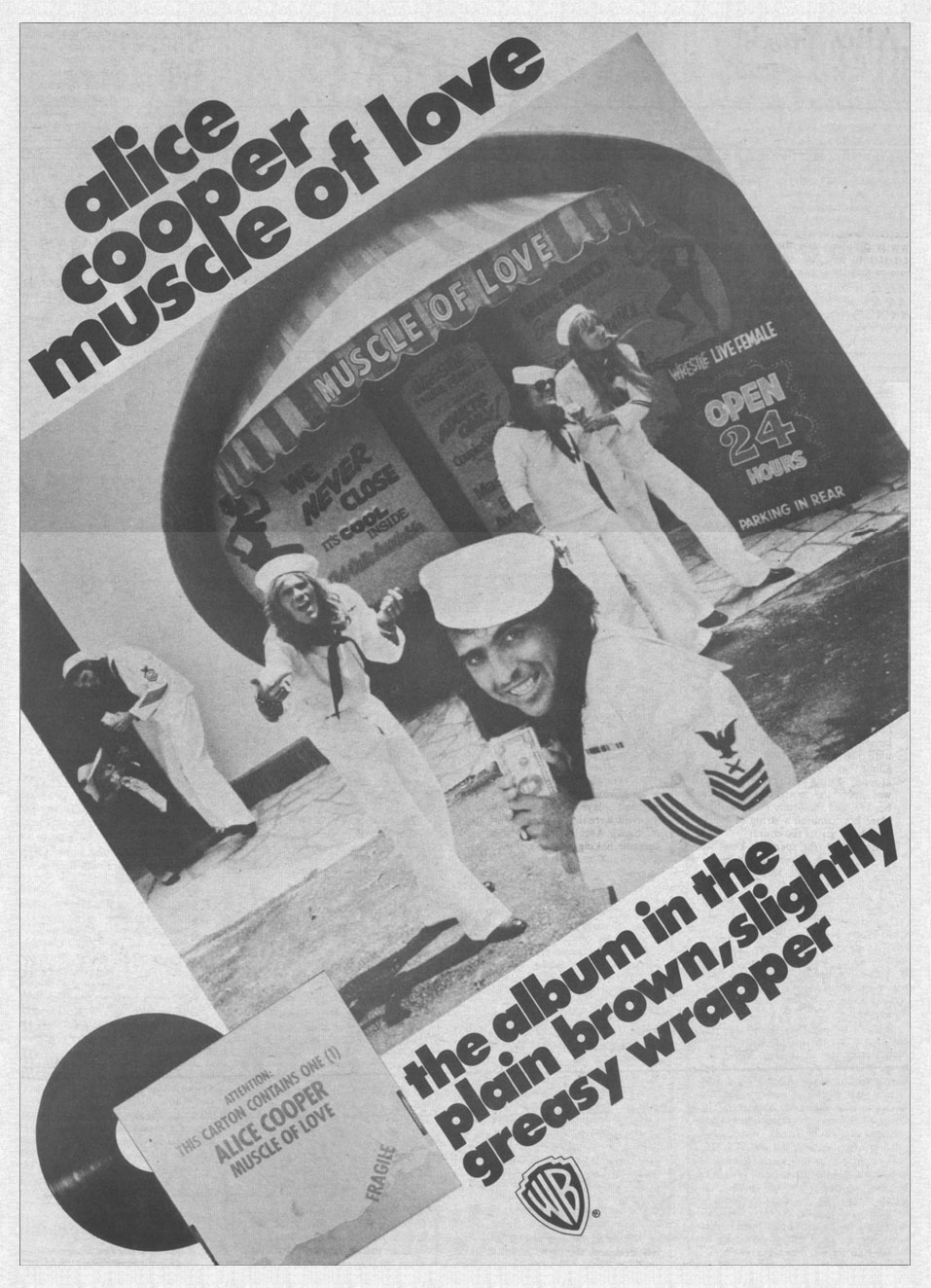
But there is very little muscle here. Cooper could (and does) record any ten songs, package them with a "suitable" album cover to fit the group's image, and lo! something to take to the market. The cover on this one shows the band dressed as sailors, hanging around one of those seamy San Francisco parlors where the local newts go to see naked ladies wrestle each other. There are all sorts of gamey little scenes to be portrayed, so Cooper will probably never run out of cover ideas. But I, for one, just hope Cooper's popularity, and that of all the other "glitter-rock" groups and performers, runs out before the cover ideas do.
- Joel Vance, Stereo Review, 6/74.
A more versatile mix than anything the band has done in the past, from the solid rock they are associated with like "Working Up A Sweat" and "Muscle Of Love" to the more ballad oriented, almost pretty, "Hard Hearted Alice." Still, there is enough variety here to satisfy all Alice's fans and a refreshing enough sound to win some new ones. Added bonus is Liza Minnelli, Pointer Sisters and Ronnie Spector on several backup vocals.
- Billboard, 1974.
At this point everything Alice Cooper puts out sound very similar. Muscle of Love sounds a great deal like Billion Dollar Babies which sounded a great deal like School's Out which sounded like the album before that, etc. This is to say, a great deal of time and effort goes into the production, the musicianship, the packaging and the concepts...but most of the melodies sound exactly like the last batch.
What makes Muscle of Love unique? Well, it comes in a plain brown corrugated carton (value for money?). Inside are strange, somewhat perverted photos of Alice and Co. in sailor suits, plus a highly confusing flyer which doesn't even get the order of the songs straight. And there, in between the rough and tough "Never Been Sold Before" and the honky tonk "Crazy Little Child" there's this ballad (of sorts). If you don't listen to the words it sounds very gentle and quiet and lilting. It's kind of like a Lou Reed ballad...only the unscratched surface is harmless. Inside are puss-filled ugly sores.
If you want to boogie, then flip the album over and get into "Working Up A Sweat." As enunciation is not one of Alice's specialties, it's a little hard to tell just what everybody is singing about, but it does sound rather mean.
This is the album that features all those famous and classy back-up singers. There's Liza Minelli on "Teenage Lament" and "Man With The Golden Gun" and The Pointer Sisters on "Teenage Lament" and "Working Up A Sweat." Other contributors to "Teenage Lament," the best song on the LP, include Ronnie Spector and La Belle. How's that for a chorus line-up?
"Muscle Of Love" really cooks. They say that the muscle of love is the heart, but that isn't the way our friend Alice would think, is it? "Man With The Golden Gun" is Alice Cooper's answer to "Goldfinger" and "Live And Let Die"...now, when he gets the film together he'll really be in business.
Muscle of Love is a magnificent effort from the only American act to be able to put theater back into rock and roll. It's always a good experience putting one of Alice Cooper's albums on.
- Janis Schacht, Circus Raves, 4/74.
Alice really gets his chance to flex here, and the result is pretty impressive. I could have done without some of the background vocals, but "Hard Hearted Alice" is definitely this group's best ballad yet. Not quite as heavy as Billion Dollar Babies, and not quite up to that record's solid overall excellence, but there ain't much slack here, baby. They're still one of America's finest rocking outfits, both live and on disc, and this record'll keep me satisfied for awhile. Go pull your Muscle of Love today.
- Jon Tiven, Circus Raves, 4/74.
They went out on the road long enough to pick up their share of chrome (well, this sure ain't platinum), but though it must pain them to realize it, they're not machines. Or maybe it just pains them to realize that machines break down. C
- Robert Christgau, Christgau's Record Guide, 1981.
 Reader's Comments
No comments so far, be the first to comment.
 Buying Options





