
   |

Let's Get It On
Marvin Gaye
Tamla T329V1
Released: September 1973
Chart Peak: #2
Weeks Charted: 61
 "Let's Get It On" is a classic Motown single, endlessly repeatable and always enjoyable. It begins with three great wah-wah notes that herald the arrival of a vintage Fifties melody. But while the song centers around classically simple chord changes, the arrangement centers around a slightly eccentric rhythm pattern that deepens the song's power while covering it with a contemporary veneer. Above all, it has Marvin Gaye's best singing at its center, fine background voices on the side, and a long, moody fade-out that challenges you not to play the cut again.
For the rest of the LP, Gaye uses his voice (in both lead and background) to create a dreamlike quality only slightly less surreal than he did on What's Going On, his very best record to date. But while on the earlier work he sang of the difference between his vision of God's will and man's life, he is currently preoccupied with matters purely secular -- love and sex.
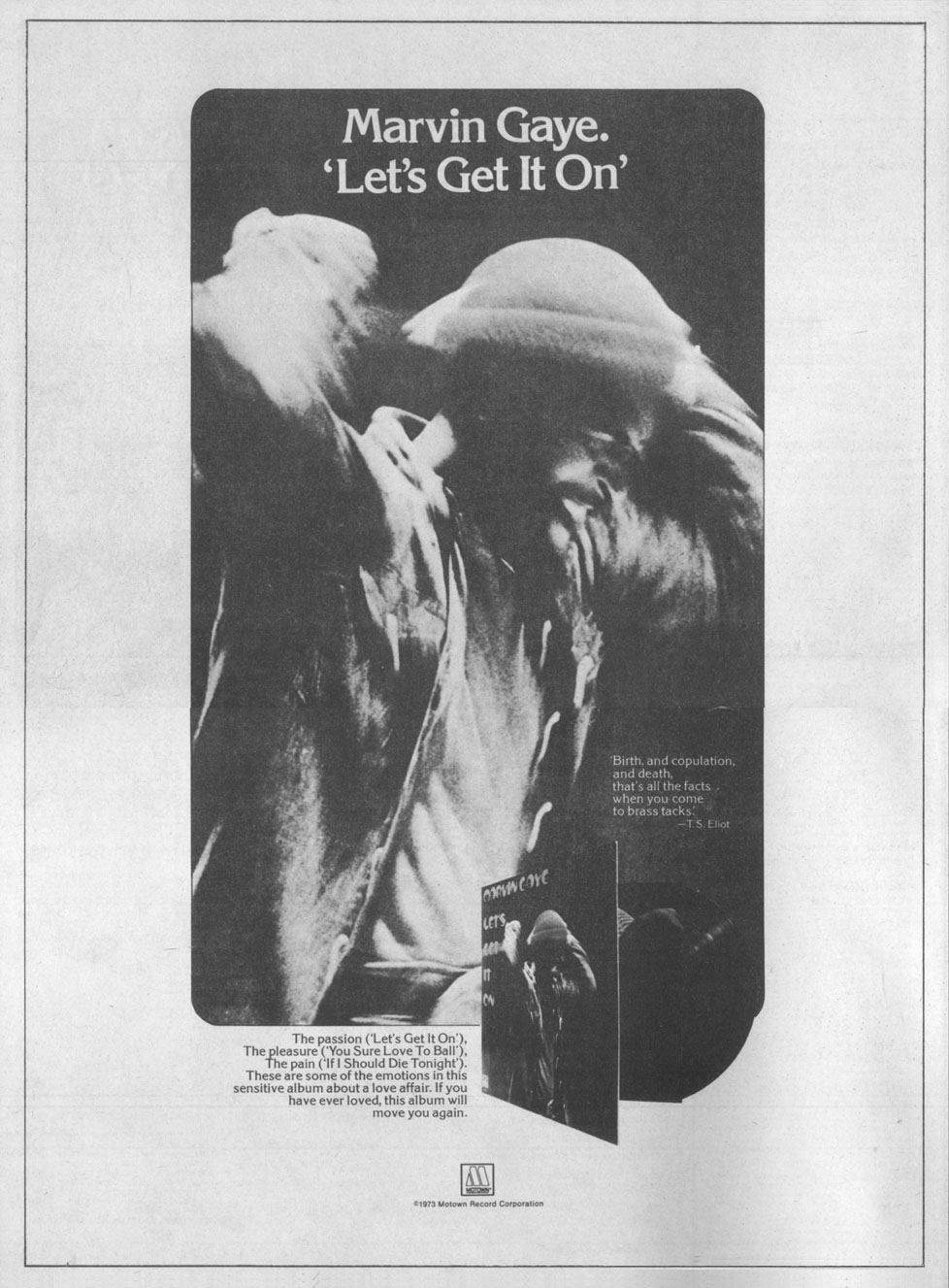 Click image for larger view. |
The first side was co-written and co-produced by veteran rock hand Ed Townshend, and it flows with ease, the melodies sometimes underdeveloped, but Gaye's voice, hovering around the falsetto, holding our attention and providing unique transitions in mood and style that happily bring us back to a reprise of the title cut, "Keep Gettin' It On."
Gaye produced the second side, and it is more daring and self-conscious. "You Sure Love to Ball" has the chant-like quality of most of the album but is overdone. What first induces a hypnotic response soon generates simple boredom, as his endless repetitions take on an unpleasantly obsessive quality. Conversely, the slow "Just to Keep You Satisfied" is too blatantly sincere. I prefer the loose sensuality of "Come Get to This," an upbeat song with a dazzling arrangement, devoid of the simplistic elements of some of the material.
Let's Get It On is as personal as What's Going On but lacks that album's series of highpoints. Instead, it ebbs and flows, occasionally threatening to spend itself on an insufficiency of ideas, but always retrieved, just in time, by Gaye's performance. From first note to last, he keeps pushing and shoving, and if he sometimes takes one step back for every two ahead, he gets there just the same -- and with style and spirit to spare.
- Jon Landau, Rolling Stone, 12/6/73.
Marvin Gaye was one of the original Motown stable of artists, like Stevie Wonder, he has declared his artistic independence, and his recordings avoid the shrewd, assembly-line "Motown SOund." Even while he was part of it, though, he cut some undoubtedly great singles: "Hitchhike," "I Heard It Through the Grapevine," and, with Tammi Terell, "That's All I Need to Get By." Gaye recorded several duets with Miss Terell, and her sudden death (she literally died in his arms on stage) affected him deeply; he retired for a while to develop a personal philosophy and make peace with himself. A few years ago he cut an album, What's Goin' On, which seemed to be entirely made up of one ethereal melody to which he set up different lyrics dealing with the conditions of life on the planet. Out of this album came "Inner City Blues," which said more in five minutes about the black experience than Curtis Mayfield has been able to say in three years.
Gaye has never been sanctimonious or preachy (though he can preach); his recent efforts have shown him to be a fellow of good will and common sense, as well as being a highly skilled entertainer. Here he turns to the joys of sex. Fifteen years ago this would have been called a "mood music" album, and that's what it really is. Gaye is honest without being blunt. None of the tunes are memorable , but the point of a mood music album is to create an effect no matter what the qualities of the material might be. And here the effect is right. The album is a happy development. Put it on and enjoy.
- Joel Vance, Stereo Review, 2/74.
Gaye's persuasive manner allows him to interpret songs that speak of the heart of the ghetto. This LP is standard Gaye fare -- fine in terms of vocal attack and material. It touches on the excellent in terms of instrumental support through the inclusion of several guest names from the pop and jazz fields. Their collective unionism provides a bright dash of spirit to Gaye's own pleadings. These Los Angeles musicians include Welton Felder (of the Crusaders), David T. Walker, Emil Richards, Marv Jenkins, Joe Sample (of the Crusaders) and Victor Feldman. Best cuts: "Let's Get It On," "Distant Lover."
- Billboard, 1973.
Post-Al Green What's Going On, which means it's about fucking rather than the human condition, thank the wholly holey. Gaye is still basically a singles artist, and the title track, as much a masterpiece as "Inner City Blues," dominates in a way "I'm Still in Love with You," say, doesn't. Then again, it's an even better song, and this album prolongs its seductive groove to an appropriate thirty minutes plus. A-
- Robert Christgau, Christgau's Record Guide, 1981.
On Let's Get It On, Marvin Gaye articulated love and lust in ways that presented sex as what it is for adults, a temporary escape from the world. Not until Prince's "1999" (the single, not the album) did someone articulate the dichotomy between social awareness and personal necesities more succinctly. Let's Get It On was a bit more conventional musically (soul crossing into mild funk) and much more focused lyrically than it's predecessor, What's Going On. The record is about loneliness, about ego, about all that goes into someone's mind when he or she is trying to make another person matter. Let's Get It On takes place in a bedroom, but it's about more than the act itself. As much as What's Going On, the album is about fitting into a perfect community. It's impossible to choose one album over the other.
- Jimmy Guterman, The Best Rock 'n' Roll Records of All Time, 1992.
Let's Get It On is one of the most erotic recordings known to mankind. Inspired by Gaye's obsession with a teenage girl, Janis Hunter, who would later become his second wife, Side one is a self-contained suite. Side two, including "You Sure Love to Ball," is nearly pornographic. Over time, five songs would chart from the album, including one of his concert standards, "Distant Lover." * * * * *
- Rob Bowman, The All-Music Guide to Rock, 1995.
Let's Get it On offers the visceral desire of a man in serious heat. * * * *
- Gary Graff, Musichound Rock: The Essential Album Guide, 1996.
"I mumble things into the microphone," Gaye said. "I don't even know what I'm saying, and I don't even try to figure it out. If I try, it doesn't work. If I relax, those mumbles will finally turn into words. It's a slow, evolving process, something like the way a flower grows." On this album, those words turn into meditations on the gap between sex and love and how to reconcile them -- an adult version of the Motown tunes Gaye had built his career on. Songs such as "Just to Keep You Satisfied" and "You Sure Love to Ball" are some of the most gorgeous music of Gaye's career, resplendent with sweet strings and his clear-throated, non-mumbled crooning.
Let's Get It On was chosen as the 165th greatest album of all time by the editors of Rolling Stone magazine in Dec. 2003.
- Rolling Stone, 12/11/03.
This is probably the only Motown album to feature a credit for the world-famous modernist poet T.S. Eliot. The author of The Wasteland, once said: "Birth and copulation and death, that's all the facts when you get to brass tacks"; a quote that adorns the gatefold sleeve to this seminal album.
And bizarrely, this sentiment fits the nature of this release beautifully. After the furrow-browed social commentary of What's Going On, Marv was telling his listeners to get back to the more basic business of, "sex between consenting anybodies." And what a torrid, engorged, breathlessly sweat-slicked beast (with two backs) the music is.
Despite being constantly overshadowed critically and commercially by its predecessor, Let's Get It On (a U.S. No. 2) is much more charming, convincing, and, dare it be said, soulful. It made perfect sense that Gaye, whose lyrics and entire live performance were covertly sexually charged earlier in his career, would eventually become entirely overt. The album's title track (which became a No. 1 smash) was a fairly obvious way of nailing his colors to the mast. The track, with its musical and lyrical climaxes, became the benchmark of bedroom music until, perhaps, Gaye himself released "Sexual Healing" in 1982. "You Sure Love To Ball," with its panting and barely concealed rutting noises was an erotic tour de force to some, and unbelievably beyond the pale to others. But, like good sex, the album was playful, inventive, sumptuous, and surprising; qualities that other albums have aped since, but not ever come close to surpassing.
- John Doran, 1001 Albums You Must Hear Before You Die, 2005.
"Have your sex," Marving Gaye writes in the liner notes of this landmark of bedroom soul. "It can be very exciting...if you're lucky." And if you're really lucky, that sex will feel a bit like this album sounds -- slippery and heated and all-consuming, governed equally by urgency and tenderness. An essay on carnal delight in eight parts, Let's Get It On is one for the ages not just because of its plush backgrounds (particularly the wah-wah guitar of Melvin Ragin, a key player on the L.A. Motown sides) or its melodies (largely improvised), but because of Gaye's needy-man delivery, the way he transforms "please baby" into a bouquet of beautifully arranged pleas. He's just a few years removed from What's Going On, his comment on society, but he's really worlds away. Sharing his formidable repertoire of bended-knee incantations, Gaye wants to stay in the bedroom as long as it takes to celebrate every last sacred ritual of love.
This album triggered an enormous outbreak of slightly salacious bedroom soul, much of it the equivalent of play-by-play coverage from ringside. Gaye's endeavor is different: Singing in that sly, delighted way, he brings listeners into his need, shares the pleasure and the torment, makes raw desire sound almost noble and immediate. When Gaye talks about getting it on, you are there.
- Tom Moon, 1,000 Recordings To Hear Before You Die, 2008.
Two years after What's Going On, Marvin Gaye delivered another album-length meditation, this one about the gap between sex and love and how to bridge it. "Just to Keep You Satisfied" and "You Sure Love to Ball" offer an adult version of the Motown tunes Gaye had built his career on.
What's Going On was chosen as the 422nd greatest album of all time in a Rolling Stone magazine poll of artists, producers, critics and music industry figures in Oct. 2020.
- Rolling Stone, 10/20.
 Reader's Comments
James Allard
Motown was pop. Motown was soul. Motown was jazz. Motown, and Motown only, was Motown. This shining piece of musical perfection was and remains stunning, richly and densely textured.
As a friend of mine has said (Scot Murphy), the best depiction of a performer at the top of his game caught on vinyl, possibly the best ever.
 Buying Options





