
   |

Selling England By The Pound
Genesis
Charisma FC 6060
Released: December 1973
Chart Peak: #70
Weeks Charted: 29


 "I know what I like, and I like what I know," Peter Gabriel sings on the second cut. This could be Genesis' problem. If American audiences are not willing to make the effort to decode the British English in which the lyrics are written, this album will not receive the attention it deserves.
Selling England merits some recognition because it contains a few good tracks which are pieces more than conventional songs. One number, "The Battle of Epping Forest," contains 13 stanzas, is constructed more artfully than a Top 40 tune, and uses military and sports terminology as metaphors for gang warfare. The opening selection, "Dancing With the Moonlit Knight," is an epic commentary on contemporary England that employs references to English staples like Wimpey hamburgers and Green Shield stamps.
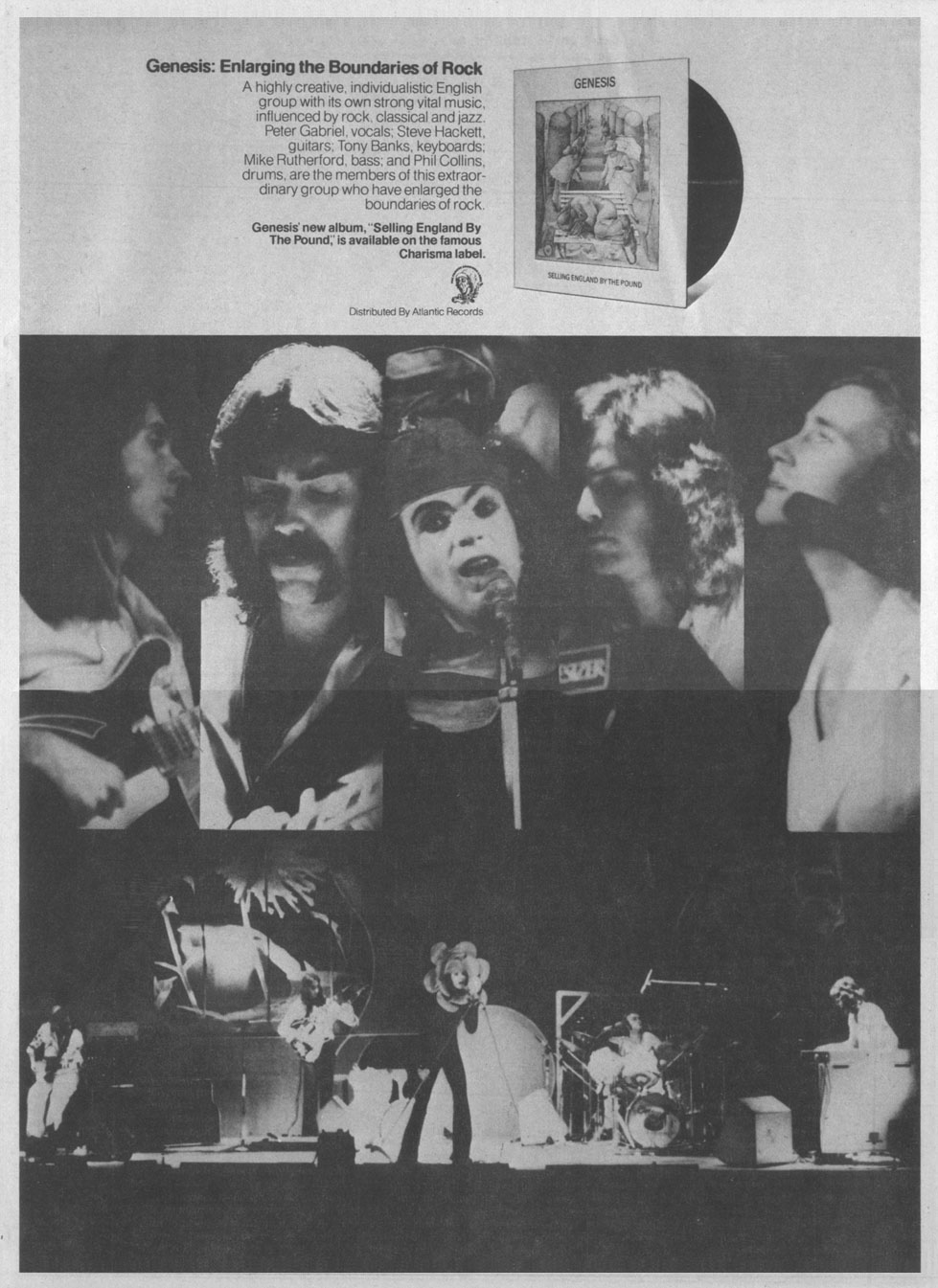 Click image for larger view. |
For all these faults the LP has its moments, and "Dancing With the Moonlit Knight" should be at least heard if not purchased. Genesis may well be the most wordy of today's pop groups, and their facility for the language is admirable. Musically their artiness is, in small doses, engaging. And a band that is trying to do something different is a stagnant pop scene deserves some encouragement.
- Paul Gambaccini, Rolling Stone, 3/14/74.
Bonus Reviews!
Guess I'm just going to have to get me 'ands (if 'ands is wot yer plays it wif) on one of those mellotrons and find out something for meself. Seems an increasing number of working-class British lads are coaxing not just music but character from the mellotron -- and think of that: character from an electronic gadget. Here Tony Banks does some of his best work yet for Genesis, providing for me the only excuse I can find to keep listening to the album. The thing soars, bends, slides, curls around every which way, and it isn't that Banks plays better than the other musicians -- they all play well, the problem being the songs they're playing -- but that he and his instrument do so much with a mediocre score.
Genesis' writing hasn't improved much, you see, and Peter Gabriel's strained, scratchy vocal are starting to get on my nerves. They still go in for pretentious gobbledegook in lyrics that aren't really about much of anything but whose awkward configurations pay havoc with melodic structure --they could write good melodies if they rearranged their priorities -- and the arrangement ideas still infringe too much on Yes and Jethro Tull and such folk. Occasionally, of course, some originality does squeeze through. "After the Ordeal" is beautifully done by everyone, especially -- hoo, boy -- that mellotron. I've called this a promising group before, and it seems I will again... and again... and again....

This popular English band's first for its new label showcases their pretty vocals and word pictures about life in England. Pretty piano playing, which leads into a crescendo on organ with rippling guitar runs, highlights the interesting instrumental "Firth Of Fifth."
- Billboard, 1974.
The best rock jolts folk-art virtues -- directness, utility, natural audience -- into the present with shots of modern technology and modernist dissociation; the typical "progressive" project attemts to raise the music to classical grandeur or avant-garde status. Since "raise" is usually code for "delegitimize," I'm impressed that on half of this Peter Gabriel makes the idea work: his mock-mythologized gangland epic and menacing ocean pastorale have a complexity that's pretty rare in any kind of art. Even more amazing, given past performances, organist Tony Banks defines music to match, schlocky and graceful and dignified all at once -- when he's got it going, which is nowhere near often enough. As for the rest, it sounds as snooty as usual. B
- Robert Christgau, Christgau's Record Guide, 1981.
The summit of Peter Gabriel's obscurantist and theatrical phase. Gabriel's Quixotic lyrics, jousting at somewhat stationary targets like supermarkets, full of puns, allusions and essentially English matters, read like Ray Davies on acid. Whatever Selling England... had, it had in plenty, pushing one of the few "progressive rock" singles, "I Know What I Like," up the UK charts. The album became prey for every DJ and pub philosopher to "explain" the lyrics.
At last the album can be heard right on Compact Disc though without spitching and distortion. Contemporary LP pressings were among the worst going. Fade ups and snatched edits have become audible however and there are patches of dullness in both sound and songs.
- David Prakel, Rock 'n' Roll on Compact Disc, 1987.
One of the best examples of '70s British art-rock, this album incorporates a variety of styles, showcasing the musical dexterity of the players as well as the lyrics to story-songs like "I Know What I Like (In Your Wardrobe)," the first Genesis British hit. * * * * *
- William Ruhlmann, The All-Music Guide to Rock, 1995.
The politically pointed Selling England by the Pound refines many of Foxtrot's virtues but without the same sense of drama. * * * *
- Gary Graff, Musichound Rock: The Essential Album Guide, 1996.
Their fifth studio album represented a quantum leap for Genesis in both creative and commercial terms. Many of their fans still consider it their finest achievement both with Peter Gabriel at the helm and beyond.
Although not a concept piece like the follow-up, The Lamb Lies Down On Broadway, its lyrics represented a scathing commentary on contemporary Britain, a country suffering industrial strife and economic uncertainty in stark contrast to the color and energy of the 1960s. The tone is set by opener "Dancing With The Moonlit Knight," wherein an unaccompanied Gabriel asks the question: "Can you tell me where my country lies?" From then on, Arthurian legend and medieval minstrelsy combine as the group set commercialism, Americanization, and the erosion of long-standing values firmly in their sights.
Paul Whitehead's surrealistic artwork had adorned studio predecessors Trespass, Nursery Cryme, and Foxtrot. This time the band chose a curious naive painting by Betty Swanwick, the inspiration for "I Know What I Like (In Your Wardrobe)" -- a surprise hit that undoubtedly helped Selling England By The Pound rise to No. 3 in the UK. "Firth Of Fifth," a masterpiece of prog rock, also deserves a mention. And with "The Battle Of Epping Forest" and "The Cinema Show," both 11-minute-plus epics, this is far from the bite-size Genesis of later years.
Having recently entered the Top Ten for the first time with a live album, Genesis would henceforth be a bankable commodity, even with the departure of figurehead Gabriel and the controversial elevation of Phil Collins from the drum stool.
- Michael Heatley, 1001 Albums You Must Hear Before You Die, 2005.
 Reader's Comments
No comments so far, be the first to comment.
 Buying Options





