
   |

Call Me
Al Green
Hi XSHL 32077
Released: May 1973
Chart Peak: #10
Weeks Charted: 41
Certified Gold: 7/12/73

 Willie Mitchell's production style continues to impress me with its consistency, restraint and understanding of Al Green's special needs. Because the singer disdains most forms of discipline, preferring to let his voice wander into every nook and cranny of the modest melodies he writes, turning phrases inside out, and wreaking havoc with vocal structure in general, he requires the leveling force of a steady band playing tight, clean arrangements. Mitchell and Co. provide the latter, unfraid of the criticism that he and Green are repeating themselves. If something is good they stay with it.
And if the lovely "You Ought to Be with Me" is another chapter in the "Let's Stay Together" book, it's a damn good chapter and I enjoy it all the more for the similarities it shares with the earlier song. In fact, I wouldn't mind hearing a 40-minute album made up of the basic Al Green riff, but that is, no doubt, a minority taste.
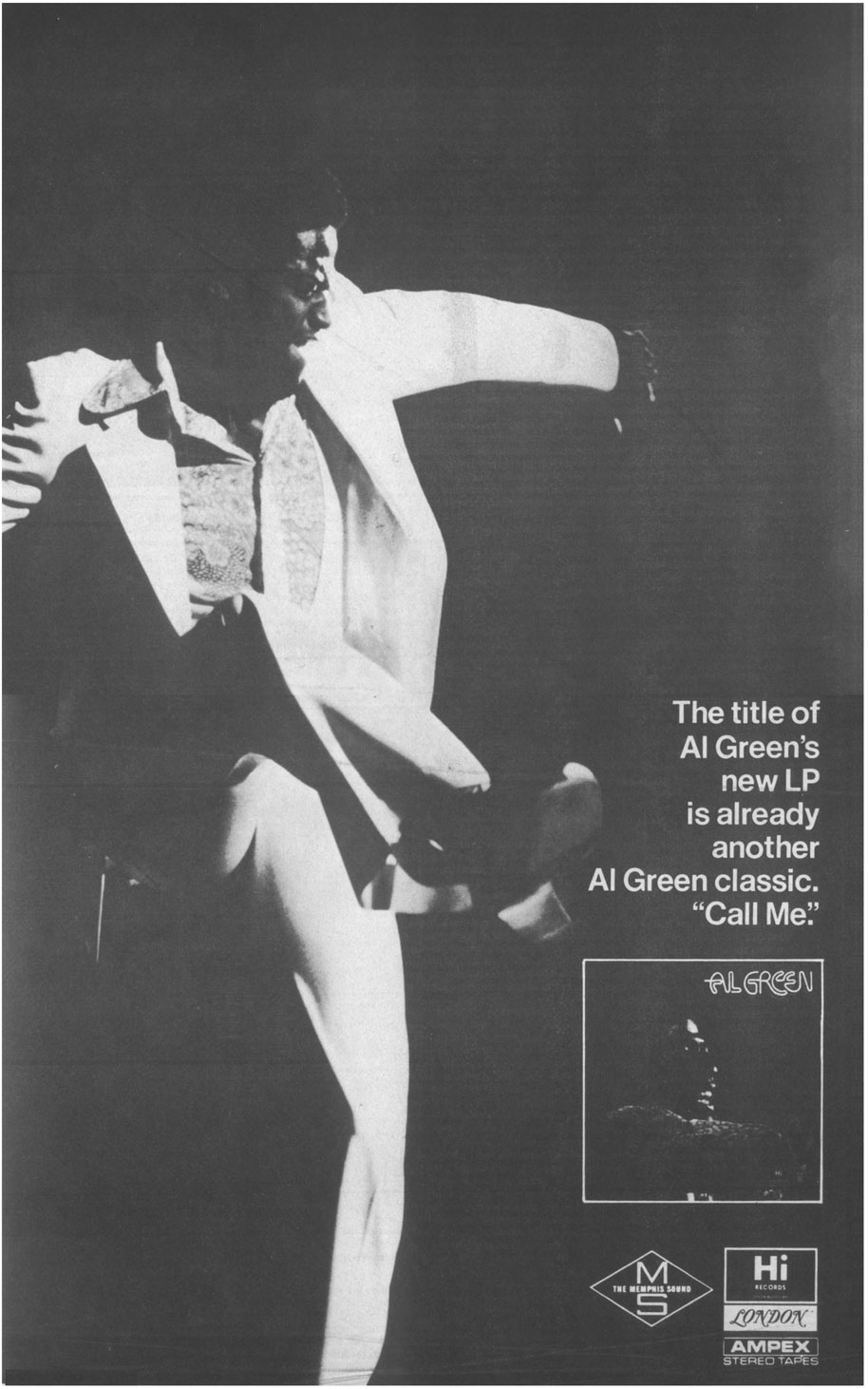 Click image for larger view. |
In that light the album's staples sound all the more refreshing. "Call Me" has lovely voices and a steady beat; "Stand Up" offers nice variations on the basic Green tempo' "Your Love Is Like the Morning Sun" is pleasantly relaxed' and "Here I Am" has an exceptional vocal, clever guitar dissonances and a tough-sounding veneer. The best of them, "You Ought to Be with Me," blends into the basic Al Green personal without making us think twice about it.
Regrettably, none of these measure up to the very top of Green's past form -- there is no masterpiece along the lines of "Love and Happiness." But then even the best artists can't hit a bull's-eye every time out. And if Green never hits the highest points of earlier albums he also misses the lowest ones, giving the album an endlessly playable quality sometimes missing in the past.
The accompanying musicians continue to improve and provide a substance of their own. It would be remiss to review another Al Green record without finally giving guitarist Tennie Hodges some special credit. Since his amazingly refreshing hit "Love And Happiness," his preeminence as an R&B instrumentalist ought to go unquestioned; his parts are so subtle that the listener frequently remains unaware of their effectiveness. This album's exception is on "Here I Am" where the glow of his playing is overshadowed only by Green's singing.
Green himself doesn't progress so much as fill out. He doesn't have one of the great R&B voices but he now sings with such authority that it doesn't make any difference. His lyrics are too casual but I don't suppose he will ever write narratives. His is on to something, keeps on pushing and takes the listener with him. Call Me is not an exceptional Al Green album, but it is as solid as a rock at its centerpiece. And that is what keeps me coming back for more.
- Jon Landau, Rolling Stone, 7/5/73.
There is a foot tapping quality to Green's music that ingratiates him to his audiences. In the main, he is a ladies' man, but he asserts himself so positively that his music rings true with the brothers on the street. These inbred ingredients are all powerfully on display in this LP, which retains the winning formula of Memphis-based production by Green and Willie Mitchell -- thumping bass, drum bottom, gentle strings and pungent horn bursts. Green's voice is sweet and clear and together with his lyrics. It all sounds so effortless, but that is the deceiving quality to his music. He's hard at work communicating. Best cuts: "Stand Up," "I'm So Lonely I Could Cry," "Here I Am (Come And Take Me)."
- Billboard, 1973.
I originally believed people would buy this only so they wouldn't have to get up and flip I'm Still in Love with You, and I was probably right. But no other album documents Green's genius for the daring nuance so thrillingly. "Stand Up" is the subtlest black identity song ever, "Jesus Is Waiting" a profession of faith you can believe in, and "Here I Am" an uptempo vehicle that sneaks up from in front of you. The interpretations of country weepers by Hank Williams and Willie Nelson are definitive. The vocals are tougher than on the two "classic" Green LPs that preceded it. And the rhythms are irresistible. Al Jackson's (and Henry Grimes's) thick third-beat 4/4 kicks in with all kinds of extra surprises, and as always it's only a frame for a music that moves as one sinuous body, with Green dodging and weaving at the head. A+
- Robert Christgau, Christgau's Record Guide, 1981.
Call Me is easily this fine artist's best release. From the original music written by Green's producer, Willie Mitchell, with words penned by Green and arrangements sparked by Al Jackson's tailored drumming, to covers of country classics (´ la Ray Charles), Green insinuates himself into a lyric like a serpent, with some truly breathtaking results. This is premier slick seventies soul with some overtly religious overtones that foreshadowed Green's 1977 change from secular to religious material, corresponding with his ordination as a minister. Whatever the guise, this man can sing. The sound is fine -- clear, defined, and subtly dynamic, all with an easy flowing naturalness that nicely compliments the material. There is some slight hiss, but it's negligible. A
- Bill Shapiro, Rock & Roll Review: A Guide to Good Rock on CD, 1991.
Soul music can mean anything you want it to, especially if you're Al Green. Before he gave up in 1980, the greatest soul singer of the seventies (not merely because there was no competion left) mixed all sorts of traditions -- blues, country, pop, the Beatles' "I Want To Hold Your Hand," rural gospel -- and came up with a unique gumbo that continued the tradition that began with Arthur Alexander and reached its apotheosis in the studios of Stax Records. Indeed, although Green was born in Arkansas, he recorded in Memphis, and he was the clear inheritor of the mantle Otis Redding wore at Stax, as well as someone who could add new accoutrements to that cape.
Green produced his records with Hi Records executive Willie Mitchell, and together they summoned up staccato horns, pumping strings, and a light-but-insistent rhythm section over which Green's transfiguring improvisations could dance. Virtually all of Green's albums before he turned to Jesus full-time are spectacular -- special note should be given to Let's Stay Together and The Belle Album, as well as many recent compilations -- but Call Me is unequivocally Green's most towering achievement, the album on which his eccentric voice and his eccentric tastes coalesced most spectacularly. Seven of its nine cuts are Green originals, among them his most explicit devotional song to that point and several cuts ("Call Me," "Here I Am," "You Ought to Be with Me") that remain among his most carnal. The other two are classic country songs, Hank Williams's "I'm So Lonesome I Could Cry" and Willie Nelson's "Funny How Time Slips Away," devastated country-soul fusions that are very much of a piece with the rest of the album. The beat unifies all, and not in typical disco lowest-common-denominator fashion; the steadiness lets the emotions soar free.
- Jimmy Guterman, The Best Rock 'n' Roll Records of All Time, 1992.
Three R&B Top Ten hits, the title song, "Here I Am (Come and Take Me)," and "You Ought to Be with Me," dominate what is probably his finest album. Once again he tackles some contry-soul, turning in moving versions of Hank Williams's "I'm So Lonesome I Could Cry" and Willie Nelson's "Funny How Times Slips Away." Green also returns to the gospel vein on "Jesus Is Waiting." * * * * *
- Rob Bowman, The All-Music Guide to Rock, 1995.
For a one-album slice of how wonderful Al Green can be, you can do no better than Call Me. In addition to the hits "You Ought to Be with Me," "Here I Am (Come and Take Me)" and the title song, this record explores Green's love for country in versions of Hank Williams' "I'm So Lonesome I Could Cry" and Willie Nelson's "Funny How Time Slips Away," which Green would re-record 20 years later with Lyle Lovett. There's also a powerful gospel workout, "Jesus is Waiting." * * * * *
- Roger Catlin, Musichound Rock: The Essential Album Guide, 1996.
It's amazing just how nourishing Al Green's music can be. Produced, brilliantly, by Willie Mitchell, and executed with telepathic exactitude by a band that included the Hodges Brothers -- Leroy, Charles and "Teenie" -- on bass, organ, and guitar, respectively, the music on Call Me is pillowy without any of the drippy, lubricious excess that mar even some of the finest records of Green's contemporaries: Marvin Gaye, Barry White, Isaac Hayes, etc. Backing vocals are spare; strings are occasional, pushed back in the mix. A churchy grit prevails, the better to let Al -- now the Right Reverend Green, thank you very much -- take center stage.
 Further reading on Super Seventies RockSite!: Album Review: Single Review: |
Call Me was voted the 70th greatest album of all time in a VH1 poll of over 700 musicians, songwriters, disc jockeys, radio programmers, and critics in 2003.
- Matthew Specktor, VH1's 100 Greatest Albums, 2003.
Al Green's Call Me contains a pair of familiar country songs, which were intended to bolster the soul singer's accessibility to white listeners: Hank Williams' "I'm So Lonesome I Could Cry" and Willie Nelson's "Funny How Time Slips Away," both reworked to blend seamlessly with Green's swaying Southern R&B.
Call Me was chosen as the 289th greatest album of all time by the editors of Rolling Stone magazine in Dec. 2003.
- Rolling Stone, 12/11/03.
Thanks to the enormous popularity of TV's American Idol, the ideal of singing in this great land has devolved into a kind of extreme sport -- empty athletic expressions, bombastic shows of brutal lung power. Al Green does not sing this way. He's gonna sneak in. He's gonna slide over until he's inches from your ear. He's hardly gonna open his mouth, just enough to give you one of those patented "Hmmm baby" lines that go right down to your knees. Have you been makin' out OK?
This works better.
This is singing of such subtlety and control it makes anything showy seem incredibly coarse by comparison. Starting with Gets Next To You (1971) and continuing through five releases over the next three years, Green, producer Willie Mitchell, and a crew of tuned-in Memphis musicians created not just a stack of hits, but a deeper shade of soul, in which nuance matters more than shouting. The "sound" that helped make Green one of the greats is minimal. Skeletal guitar, creeping organ, pattering drums set the table. Then Green slinks in and whips up a gourmet feast.
Though it wasn't the breakthrough (that would be Gets Next to You) and doesn't have the hugest hits (that would be Let's Stay Together), Call Me is Green's first totally cohesive statement. It's the moment when everything clicks, and the moment just before Green and Mitchell are aware of everything clicking: Later works have just a hint of self-consciousness.
Call Me also sports two of the most compelling covers in Green's songbook -- the Hank Williams chestnut "I'm So Lonesome I Could Cry" and Willie Nelson's "Funny How Time Slips Away." These are as significant as the loverman originals -- in part because they remind you of how the great voices of the South, white and black, moved their listeners beyond stereotypical notions about race.
With Green, all considerations of style and genre, the twang of Williams and all the rest, become insignificant next to the intense and perpetual seduction in progress. Green does his beautiful thing without clobbering anyone over the head. If everyone in America listened to him once a week, American Idol would quickly seem meaningless.
- Tom Moon, 1,000 Recordings To Hear Before You Die, 2008.
With his voice at the height of its biscuit-buttery power, Green effortlessly entwined the sensual and the sacred.
Call Me was chosen as the 19th greatest album of all time by the editors of Entertainment Weekly in July 2013.
- Entertainment Weekly, 7/5/13.
Al Green was on such a roll in the early Seventies that he could try anything -- country ballads, jazz, even gospel. When he reaches up for that falsetto growl at the end of "Your Love Is Like the Morning Sun," it's like he's bringing down the sugar walls of Jericho.
Call Me was chosen as the 427th greatest album of all time in a Rolling Stone magazine poll of artists, producers, critics and music industry figures in Oct. 2020.
- Rolling Stone, 10/20.
 Reader's Comments
No comments so far, be the first to comment.
 Buying Options





