
   |

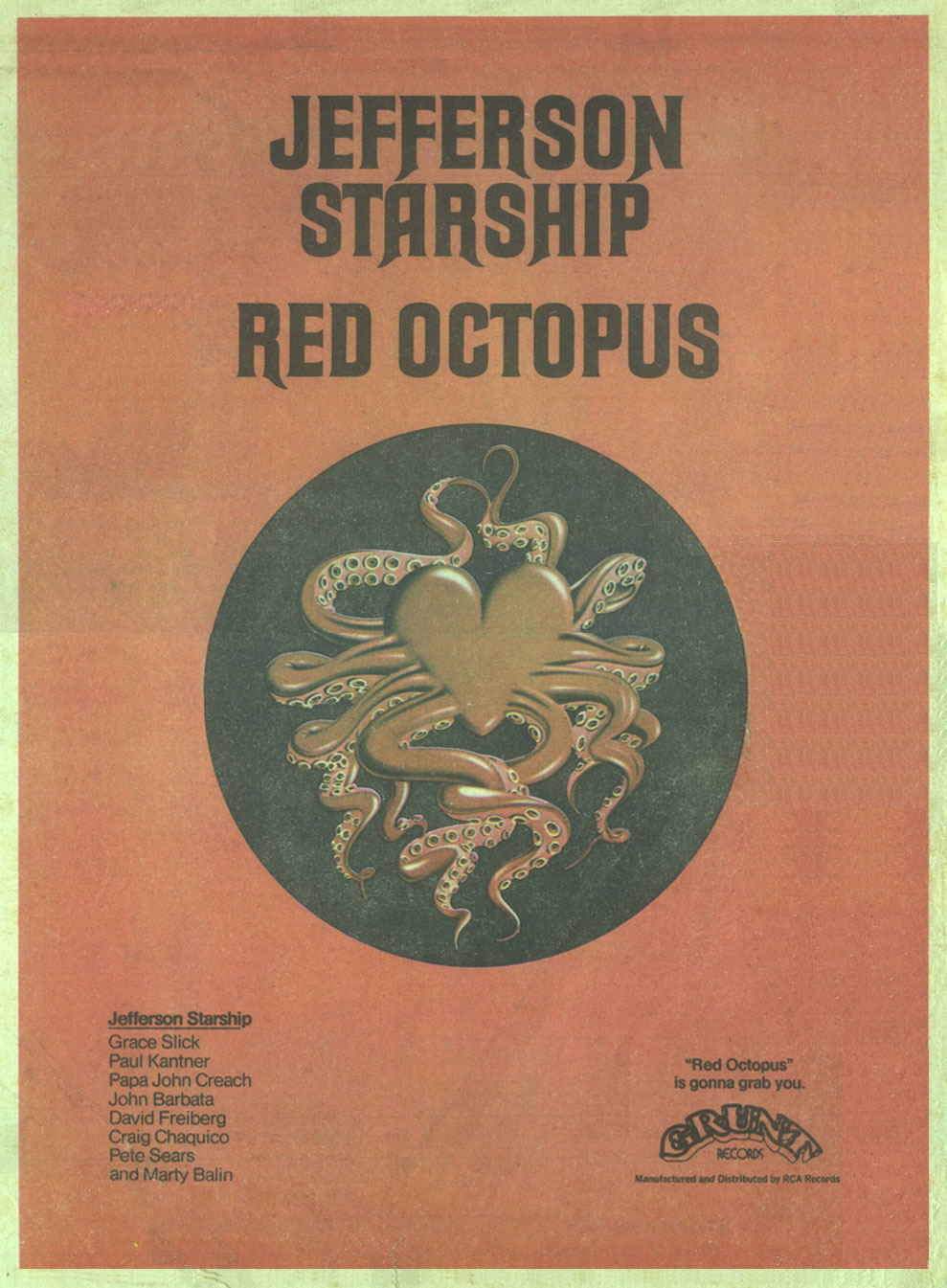
Red Octopus
Jefferson Starship
Grunt 0999
Released: July 1975
Chart Peak: #1
Weeks Charted: 87
Certified Gold: 8/22/75


 The big news, of course, is that Marty Balin is back. Balin never seemed to be able to get it together outside the Airplane/Starship, although he certainly did try. But nearly everything he started crumbled before it was finished. Bodacious D.F., his last band, showcased his vocals nicely, but somewhere between the decision to record a second album before going on tour and actually doing so, the band vanished. He joined the Starship for one song, "Caroline," on their last album, and from all the press and radio play it got, you'd have thought it was the only song on the album. Clearly, they needed him.
And good thing they got him, too. If it weren't for Balin, Red Octopus would be completely unlistenable. As it is, it sounds like a revue instead of a band, with Grace Slick getting her couple of songs, Papa John Creach getting his instrumental, Pete Sears getting his and so on. And with Grace's vocals now devoid of whatever subtlety they might have had, Marty's the only vocalist in the band.
 Click image for larger view. |
But the rest of the album is sadly undistinguished at best and embarrassing at worst (Kantner plumbs new lows with lyrics like "I want to see another world/ For me and my child/ My old lady too." Nice of you to remember the lady, Paul). Papa John is all but inaudible throughout (I never did figure out what he was doing in the Starship, but maybe that's my hangup), and Pete Sears's instrumental, "Sandalphon," is quintessential filler.
If only because it gives Marty Balin a place to write and sing, I wish the Starship well. Maybe in a couple of years there will be a Starship's Greatest Hits album, and I'll undoubtedly want that one -- it'll be Marty Balin's greatest hits, too.
- Ed Ward, Rolling Stone, 9/11/75.
 Further reading on Super Seventies RockSite!: |
It is difficult now to care who's the Best Rock Band in America, but you can sit back with the new Jefferson Starship album and temporarily forget how difficult it is. Although it is somewhat late for the Airplane regrouped as the Starship to be getting it together again (this is far and away the best album committed in the name of Starship, is among the the things I'm saying), I've been having a good time returning to those thrilling days of yesteryear, even if I can't stay in them. Grace Slick and Marty Balin are among the most gifted vocalists ever to mess with rock (strangely gifted, too), and their odd interweavings with an occasional burst of textural variety from Paul Kantner or one or two of the other fellows make it seem like the old heyday is still going on. The subject matter is, of course, updated (there's not a single threat here to get the rascals by first taking over outer space) and concentrates, as we do, on complex personal relationships. Still, the lyrics may be a little vague at times; Grace's "Fast Buck Freddie," for example, seems to hint at dabbling in the real politics of this time (simplified, as it must be if rock is ever to deal with it, it amounts tot he rich being much more blatant in how they exploit the poor), but it only hints and dabbles before turning refrain-happy. The material is pretty strong, though, by and large, and Slick's touchy throat is in great shape, and her strange vocal lines soar without the self-consciousness that harmed them in her solo album. Having Balin back in the group probably was catalytic; neither Slick nor Kantner plays off anyone else as well. Craig Chaquico seems to have found himself as a lead guitarist here, too, flashing the same kind of whacked-out feeling for harmony that Slick does vocally. The selections I particularly like include Slick's "Al Garimasu (There Is Love)," Balin's "Miracles" (which sounds like something from another planet, speaking of outer space), and the Kantner-dominated "There Will Be Love." Ah, if rock bands had written and played like this all along.... But later, of course, the Seventies do creep back in: I suppose much of the charm of this is anachronistic -- it doesn't answer the question of what it's doing here now.
- Noel Coppage, Stereo Review, 11/75.
The recharged Starship duplicates the power and energy of the early Airplane here while still bringing fresh elements to the music. Marty Balin returns as a full time member with this set, Grace Slick's vocals are stronger and she sounds more interested than she has in several years, and the harmonies worked through by Balin, Slick and Paul Kantner sound uncannily like the Airplane at times. The rest of the band (bassist/keyboardist David Freiberg, keyboardist Pete Sears, violinist Papa John Creach, drummer John Barbata, lead guitarist Craig Chaquico) sounds as if they have been together for years, with guitar and keyboard work particularly outstanding. Good balance between rockers and ballads, but up-tempo instrumentals with some excellent lyrics and vocal interchanges between Balin and Slick are high points. LP is a fine example of the ability to recapture some of the good music and feelings of the past without looking backwards. Best cuts: "Miracles," "Sweeter Than Honey," "Al Garimasu (There Is Love)," "Play On Love," "I Want To See The World," "There Will Be Love."
- Billboard, 1975.
This is indeed their most significant record of the decade, but what does it signify? It's their first number-one album, but it sells to an audience that refuses to distinguish between production values and musical ideas. While the returned Marty Balin is the most soulful folkie ever to set voice to plastic, he remains a mushbrain -- the paragon to whom he addresses "Miracles" is actually compared to both a river and a stringed instrument. And to call "I Want to See Another World" and "There Will Be Love" jive-ass would be to imply that standard-brand American bullshit has style. B-
- Robert Christgau, Christgau's Record Guide, 1981.
The masterpiece, and a massive seller, too. Grace Slick sings expressively, especially on "Fast Buck Freddie" and "Play on Love," but the real story is the integration of Marty Balin fully into the band, and again he brings a timeless ballad along in the hit "Miracles." * * * * *
- William Ruhlmann, The All-Music Guide to Rock, 1995.
 Reader's Comments
No comments so far, be the first to comment.
 Buying Options





