
   |
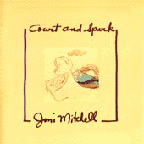
Court And Spark
Joni Mitchell
Asylum 5072
Released: January 1974
Chart Peak: #2
Weeks Charted: 64
Certified Gold: 2/27/74
 On first listening, Joni Mitchell's Court and Spark, the first truly great pop album of 1974, sounds surprisingly light; by the third or fourth listening, it reveals its underlying tensions. The lyrics lead us through concentric circles that define an almost Zen-like dilemma: The freer the writer becomes, the more unhappy she finds herself; the more she surrenders her freedom, the less willing she is to accept the resulting compromise. Joni Mitchell seems destined to remain in a state of permanent dissatisfaction -- always knowing what she would like to do, always more depressed when it's done.
Joni Mitchell has composed few songs of unambivalent feeling. Even her most minimal work suggests a need for chang and skepticism about its potential results. On Court And Spark she has elevated this tendency into a theme: No though or emotion is expressed without some equally forceful statement of its negation.
The actual opposites of Court And Spark -- the thrill of courtship modulated by the fear of emotional commitment -- suggest a series of choices that Mitchell touches on, passes through, and defines with astounding compression -- the alternatives of love and freedom, trust and paranoia, security and rootlessness, concern for herself and for others, compromise and pursuit of perfection, and even sanity and insanity.
Her boldest fears come out in her songs about madness, the last two on the album. Her own "Trouble Child" and Lambert-Hendricks-Ross' "Twisted" deal with it in strikingly different ways: The former is tragic, the latter is a piece of comedy with an hilarious punch line that plays on the very notion of schizophrenia. Together they flirt with insanity from a distance safe enough to show she can control even so threatening a concern.
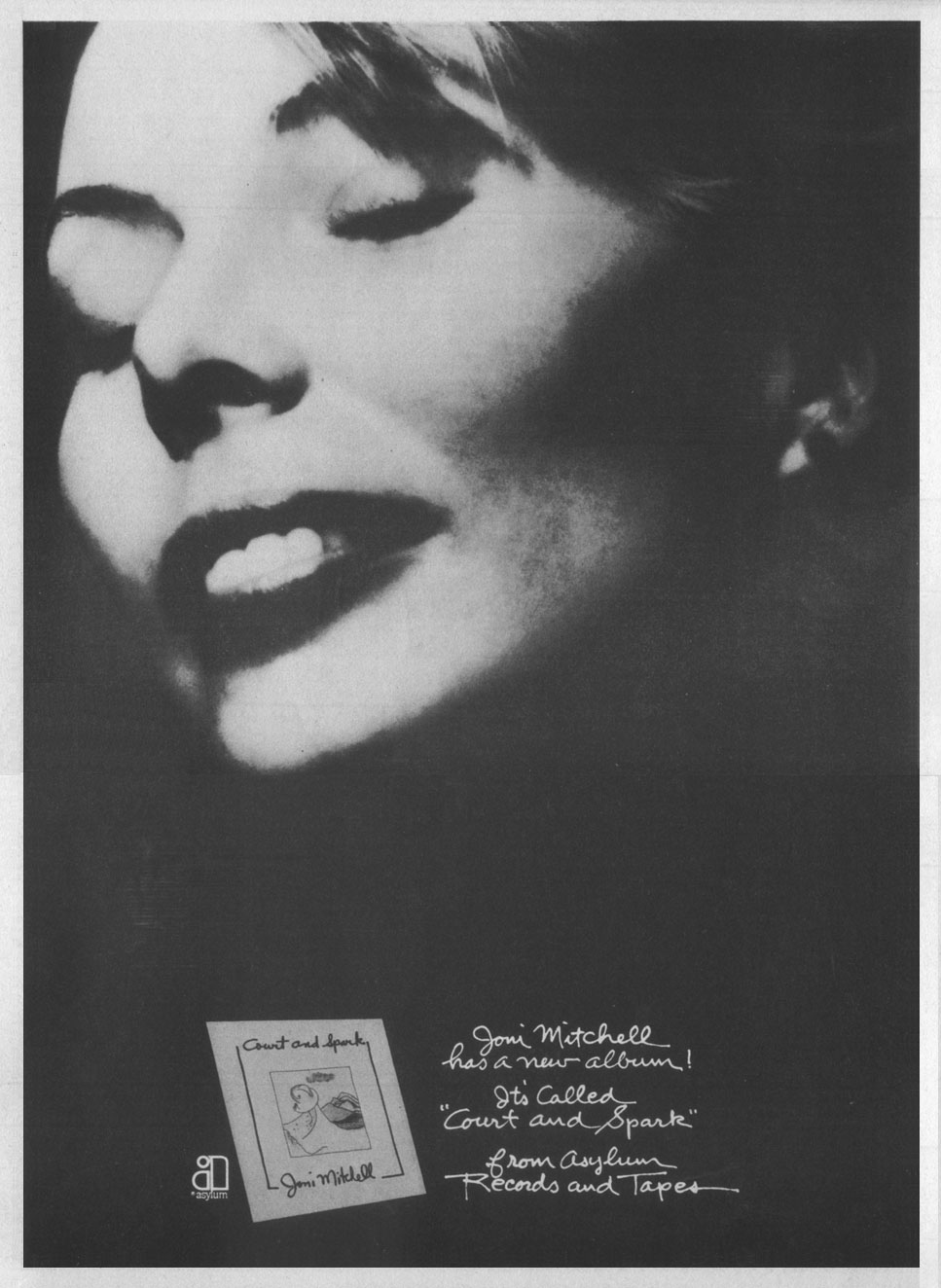 Click image for larger view. |
- Some are gonna knock you
- Some will try to clock you
- It's really hard to talk sense to you
- Trouble Child
- Breaking like the waves at Malibu.
- Some will try to clock you
It is a song of infinite compassion, but although she has externalized her feelings by writing about another person, the song is ultimately introspective. For that reason, the quick move into "Twisted" seems almost desperate. To me she says: Now that we've taken a look, let's get out of here -- there's nothing left to do but laugh.
But if Joni Mitchell is capable of subtly edging around the notion of breakdowns, she's unable to keep the same distance when singing about the men who dominate the album. She never seems to know where she wants to draw the line in love, or if a line exists at all. But it is precisely on the songs about love that the new lightness in her music makes so much sense.
The album achieves its ethereal and lyrical quality with even more instrumentation than any of her other recordings -- including horns, strings and a full rhythm section. Blue, her best album, defined a musical style of extraordinary subtlety in which the greatest emotional effects were conveyed through the smallest shifts in nuance. On Court And Spark the music is less a reinforcement of the Iyrics and more of a counterpoint to them. An album about an individual struggling with notions of freedom, it is itself freer, looser, more obvious, occasionally more raunchy, and not afraid to vary from past work. It is also sung with extraordinary beauty, from first note to last.
"Down To You" is every bit as intricate but works much better. It's the album's best love song -- sophisticated, subtle and complete in itself. As good as melody, vocal and arrangement are, the lyrics overshadow them, with intimations of the album's opposites: "Everything comes and goes... You're a kind person/ You're a cold person too..."
Simple songs like the title tune are almost as fulfilling. "Court and Spark" is about a drifter who suggests the possibility of her severing all inhibiting connections. She successfully (but depressingly) resists the temptation to make too much of a casual affair. But in the following song, "Help Me," she reverses herself -- the strength is gone and love becomes a threatening force that one copes with rather than surrenders to.
On "Free Man in Paris" and "People's Parties" she moves from love to her other favorite subject: fame and its demands. She sees it as a further complication in the process of sorting out values. "I'm just living on nerves and feelings..." she sings in "People's Parties." The song, musically related to the delightful "You Turn Me On (I'm a Radio)," is at once her least ambitious and most affecting work.
Some of Side Two is more playful and suggests a wish to gradually surrender everything to emotion. "Raised On Robbery" is pure release: She ducks every issue for an exhilarating fantasy imagery to define a relationship between freedom and time: "I used to count lovers like railway cars." Now she doesn't count anything and just lets things slide. Jealous loving makes her "crazy," and so she now equates goodness entirely with the heart: She can't find the one because she's lost the other. The album's most haunting song hangs on the deceptively simple line, "What are you gonna do about it/ You've got no one to give your live to."
On "People's Parties," Joni Mitchell sings, "Laughing and crying/ You know it's the same release." The special beauty of Court And Spark is that it forces us to do both, and that it does so with such infinite grace.
- Jon Landau, Rolling Stone, 2/28/74.
Bonus Reviews!
Court and Spark is the kind of experience a good Bergman film is. You want to turn it off but cannot, you hate it and love it at the same time, you feel you are in the hands of a brutal but trustworthy genius and are somehow being tested. It is, as popular cant would have it, heavy, and Joni's feminine viewpoint doesn't lighten it much. Neither does her use of humor, which gets undermined when it has the floor, as it does in "Raised on Robbery," the quotations of a pushy lady trying to pick up a gent who's more interested in the Toronto Maple Leafs game.
The title song ("courting" and "sparking" are dated terms used for a reason) is a charmer and only medium-heavy; "Free Man in Paris" is narrower in scope than all those boy-girl quandaries, but it is a brilliant song about fame-chasing, as ingratiating as it is well-built. "Car on a Hill" waits for the man to make the first move -- specifically an overdue move, it seems -- and reminds me of a story by Shirley Jackson. Only one song strikes me as weak -- "Help Me," which has no discernible melody. Joni's singing covers an even greater emotional range than it usually does, and the backing, while a bit too serene in places, is touched up with banks of harmonizing acoustic guitars, a stylized bouncy flow of piano and woodwinds, and other small delights.
- Noel Coppage, Stereo Review, 5/74.
No one expected this. Joni Mitchell's albums have sold well since Ladies of the Canyon, but Court and Spark is her first real giant and continues to grow without the benefit of a big single. Mitchell launched the album in the usual way -- a massive national tour -- but the record broke out before she had really begun. Apparently, Court and Spark satisfied the accumulated past interest in her and her special approach to women in love. Her most accessible work, its lyrics are crystal clear, even when dealing in ambiguities, and its music is lighter and broader (with the aid of a complete band) than in the past. Unlike some earlier albums, Court and Spark is more inspiring than depressing and larger numbers of people may therefore be open to it. But whatever the reasons, its presence proves that there is room for genius as well as mediocrity on the Billboard Top 20.
- Jon Landau, Rolling Stone, 6/6/74.
The first album she's ever made that doesn't sound like a musical departure -- it's almost standard rock. For the Roses gone mainstream. But the relative smoothness is a respite rather than a copout, the cover version of "Twisted" suggests a brave future, and she's the best singer-songwriter there is right now. Even the decrease in verbal daring -- the lyrics are quite personal and literal -- makes for a winning directness in songs like "Help Me" and "Raised on Robbery." Now all I want to know is whether "Free Man in Paris" is about David Geffen. A
- Robert Christgau, Christgau's Record Guide, 1981.
Joni Mitchell reached her peak of popularity in the United States with this major work. The songs on side one fit together thematically and musically like pieces in a jigsaw puzzle, presenting the picture of a woman wondering aloud and in print how to cope with the problems of being famous and female. "Help Me" became the singer-songwriter's sole US top ten single. "Free Man in Paris" entered music business language as an expression for escape from the pressures and responsibilities stemming from celebrity.
"Everything a record should be," exults Canadian disc jockey Geoff Edwards, "jazz, pop, and rock with sensitive and thought-provoking lyrics."
In 1987, Court and Spark was chosen by a panel of rock critics and music broadcasters as the #37 rock album of all time.
- Paul Gambaccini, The Top 100 Rock 'n' Roll Albums of All Time, Harmony Books, 1987.
Court and Spark is middle-period Mitchell -- no longer the simple folk singer and not yet the experimental jazz writer. Having a new found confidence in her lyrics and music, Mitchell has attracted some of the finest names to contribute to this album including Jose Feliciano, David Crosby and Graham Nash, Joe Sample and Larry Carlton -- even Cheech and Chong!
One of the first CDs available in the UK back at the launch of the medium, the Japanese pressed copies of Court and Spark were very hard on the ears. The present review sample, made in Germany by Polygram, is much improved with richer, fuller sound quality. There is a residual harshness in the treble, especially in heavily multi-tracked vocals, piano and acoustic guitar, though bass no longer blubbers and has a propulsive rhythm.
Joni Mitchell is currently poorly served on CD with Blue, The Hissing of Summer Lawns, the early jazz inspired Don Juan's Reckless Daughter and the live Shadows and Light double album still eagerly anticipated on CD in mid-1987.
- David Prakel, Rock 'n' Roll on Compact Disc, 1987.
Because of the more melodic nature of the material and its less intricate lyrical convolutions, this is the highlight of Joni's major musical career. It is also as fine an example of the singer/songwriter genre as you will ever hear. Fortunately, the sound of the CD is clean, clear, and warm; of the same consistent high level as the rest of the package, making this a must disc. A+
- Bill Shapiro, Rock & Roll Review: A Guide to Good Rock on CD, 1991.
Mitchell's commercial peak came with this polished collection, which features the backup of a clutch of jazz-oriented session aces. "Help Me" was a Top Ten hit, and "Free Man in Paris" reached #22. * * * * *
- William Ruhlmann, The All-Music Guide to Rock, 1995.
Court and Spark remains Mitchell's top achievement, a melding of pop and jazz stylings that netted multiple Grammy nominations and the hit singles "Help Me" and "Free Man in Paris." * * * * *
- Hilary Weber, Musichound Rock: The Essential Album Guide, 1996.
By 1973, Joni Mitchell was searching for a new sound. On albums like Clouds and Blue, she had accompanied herself on piano and acoustic guitar, and progressed from folkie waife to sophisticated chronicler of the gender wars. She needed musical arrangements that matched the complexity of her lyrics.
Tom Scott had played woodwinds on Mitchell's previous album, For the Roses (1972), and she decided to do some sessions with his jazz-rock band, the L.A. Express. The result is Court and Spark, an album that not only represents the culmination of Mitchell's folk-rock period but also signals the many musical experiments in her future.
Released at the end of 1973, "Raised on Robbery," the album's first single, caught all the humor and energy that had always been part of Mitchell's personality but that had barely found a place in her music. The second single, "Help Me," showed the flip side of Mitchell's sensibility -- the romatic dreamer, swept up in the currents of desire and uncertain about where they are carrying her or even where she wants to go. "We love our lovin'/But not like we love our freedom," she sings in lines that summararize the dueling impulses in so many of her songs.
Playing behind her, musicians like Scott, guitarist Larry Carlton, drummer John Guerin and trumpeter Chuck Findley add colors and depth to songs that stretch melodies and vocal lines in suprising directions. And as always with Mitchell, the lyrics penetrate deftly to the painful core of feeling beneath the requisitely cool coupling of the early Seventies. When she sings, in a kind of prayer, "Send me somebody/Who's strong and somewhat sincere," her reduced expectations (this was the age of less is more, remember) seem both poignant and desperate, Court and Spark was -- and still is -- Mitchell's most commercially successful album. In another sign of the times, she was defeated the following year in two major Grammy categories by Olivia Newton-John. That's why the criterion of "standing the test of time" was invented -- a standard that Court and Spark will always meet. * * * * *
- Anthony DeCurtis, Rolling Stone, 2001.
The starting point for your Joni infatuation is this very LA masterwork, a perfect blend of jazz and pop that's her most radio-friendly release, and one of the defining albums of the 1970s. All hail the high priestess: with accessible but stylistically challenging lyrics that demonstrate love found and lost, acerbic wit and remarkable insight into human nature, she takes you to a place of wonder. * * * * *
- Zagat Survey Music Guide - 1,000 Top Albums of All Time, 2003.
Mitchell followed up Blue with the underrated For the Roses, a set of harmonically and lyrically complex songs. Court and Spark is, in comparison, smoother and more straight-ahead; it became the biggest record of her career, hitting Number Two. Working with saxophonist Tom Scott's fusion group L.A. Express, Mitchell settles into a folk-pop-jazz groove that remains a landmark of breezy sophistication, particularly the Top Ten single "Help Me." Strange but true: A cover of "Twisted" by the scat-jazz vocal group Lambert, Hendricks and Ross closes the album -- with stoner comics Cheech and Chong singing backup.
Court and Spark was chosen as the 111th greatest album of all time by the editors of Rolling Stone magazine in Dec. 2003.
- Rolling Stone, 12/11/03.
 Further reading on Super Seventies RockSite!: Album Review: Book Review: Reckless Joni Mitchell: |
The singer/songwriter had enlisted musician Tom Scott to provide her with suitable woodwind backing on her previous album, For The Roses, and he brought his own LA Express ensemble to work on the sessions that would become Court And Spark, which when released, hit Number Two in the US and 14 in the UK.
As of 2004, Court And Spark was the #98 best-selling album of the 70s.
- Hamish Champ, The 100 Best-Selling Albums of the 70s, 2004.
Ladies Of The Canyon (1970) offered the right-on environmentalism of "Big Yellow Taxi" and "Woodstock," a much-covered paean to the festival (which she did not attend); the painstaking confessional of Blue followed. More so than David Crosby (whom she dated) and James Taylor (a guest on Blue), Canada-raised, California-based Joni Mitchell was the archetypal early Seventies singer-songwriter, a mascot for lost souls with acoustic guitars and broken hearts. Which made the early 1974 arrival of single "Raised On Robbery," a boogie helmed not by Mitchell's dulcimer but Robbie Robertson's heads-down electric guitar, so unlikely.
The rest of Court And Spark is not such a radical departure, but still, the main characteristic it shares with Ladies Of The Canyon is that both have Mitchell paintings on the cover. The songs are less intense than on Blue; "Free Man In Paris" is a sly tribute to label boss David Geffen, "stoking the starmaker machinery behind the popular song." But the loose, sun-soaked sound is the greatest surprise, from the starry-eyed lap-steel of the title song to the winking silliness -- and guest turn from, of all people, stoner comics Cheech and Chong -- on "Twisted." Like Steely Dan, whith whom the likes of "Car On A Hill" shares a jazzy radio-friendliness, Court And Spark could only have come from California.
Any commercial imperative went out of the window with 1975's The Hissing Of Summer Lawns, as Mitchell began a retreat into artfulness and, eventually, her acoustic roots. The atrocious Travelog (2002), a two-disc indulgence in which she reworked her catalogue with a glutinous orchestra, was a sad valediction.
- Will Fulford-Jones, 1001 Albums You Must Hear Before You Die, 2005.
Joni Mitchell's second album gave the world a little koan called "Both Sides Now," which became a huge hit for Judy Collins, Mitchell's third included "Woodstock," a skeptical travelogue that Crosby, Stills, Nash, and Young turned into a counterculture anthem. The album after that, Blue, is often referred to as a "pioneering classic of singer-songwriter music" for its painstaking accounts of romance's riptides.
Blue is plenty wrenching. It's also monochromatic. After it, the restless Canadian singer-songwriter and guitarist (she's also an accomplished painter) began expanding her notion of what a song might be. She hired a band (the ace studio musicians known as the L.A. Express), and sought both watercolor hues and bold splashes of instrumental color, setting her sharply observed lyrics against clarinets and icy muted trumpets and snarling treble-heavy electric guitars. This emphasis on texture coalesces on Mitchell's magnificent sixth album, Court and Spark -- a series of inward-looking confessional odes whisked along on the breezy, forever untroubled buoyance of California pop.
With a rhythm section on board, Mitchell is no longer tethered to the steady guitar strumming that defined previous works. There's a huge shift, and it loosens up everything else. Her tunes are dotted with abrupt pauses and shadowy interludes, and dramatic moments when the anchoring rhythm evaporates completely. Where she once sought to give blow-by-blow accounts of romantic messes, Mitchell here dashes off impressionistic sketches -- of music-biz types chasing "the star-maker machinery behind the popular song" ("Free Man in Paris") and disconsolate teens "breaking like the waves of Malibu" ("Trouble Child") and snooty types with "passport smiles" ("People's Parties"). The music's fast-changing nuances force Mitchell to become a more expansive vocalist -- she sings these little long-distance melodies with a wriggling freedom, swooping and lunging like a bird who's just escaped captivity and is discovering new ways to fly.
- Tom Moon, 1,000 Recordings To Hear Before You Die, 2008.
The platonic ideal of a particular 1970s L.A. sound: a garden of shiny, jazzy pop planted with strangely harmonized choral blooms. As a pop-song writer, Mitchell would never be more effective. Her bestselling record, it sold 2 million copies in a year. If the music is playful, even flashy, the lyrics are bone-deep; "Down to You" rivals her darkest moments. On "Twisted," in the voice of an adult remembering her three-year-old self, she affirms. "I knew I was a genius." If any doubts lingered, this LP buried them.
- Will Hermes, Rolling Stone, 5/19.
Smoothing out the raw intimacy of Blue and it's musically complex 1972 follow-up, For the Roses, Mitchell the most successful album of her career. Working with the fusion group L.A. Express, she settled into a folk-pop-jazz groove that remains a landmark of breezy sophistication, particularly on the Top 10 single "Help Me."
Court and Spark was chosen as the 110th greatest album of all time in a Rolling Stone magazine poll of artists, producers, critics and music industry figures in Oct. 2020.
- Rolling Stone, 10/20.
 Reader's Comments
NH Lineman
"Court And Spark" is #37 all-time, eh? Well, that's not too shabby; especially when one considers the thousands upon thousands of albums produced. But personally, I would rank it higher; much higher. If ever an artist gave us a single collection of quality crafted songs, this is it. For more than half a century, Joni Mitchell has remained unchallenged as Queen of Songwriter Hill. The only debate is about who ranks as #2? Now, that's what I call musical staying power. By any fair assessment, "Court And Spark" belongs in the Top Twenty albums of all-time. As for me, I'll keep it safely tucked inside of my Top Ten.
 Buying Options





