
   |

Ramones
Sire 7520
Released: May 1976
Chart Peak: #111
Weeks Charted: 18


 If today's Rolling Stone were the Cahiers du Cinema of the late Fifties, a band of outsiders as deliberately crude and basic as the Ramones would be granted instant auteur status as fast as one could say "Edgar G. Ulmer." Their musique maudite -- 14 rock & roll songs exploding like time bombs in the space of 29 breathless minutes and produced on a Republic-Monogram budget of $6400 -- would be compared with the mise en scene of, say, Robert Aldrich's Kiss Me Deadly or, better yet, Samuel Fuller's delirious Underworld U.S.A.
And such comparisons would not be specious. The next paragraph is almost literal transcription of something the American auteurist, Andrew Sarris, wrote about Fuller in The American Cinema: Directors and Directions 1929-1968. I've just changed the names and a few terms.
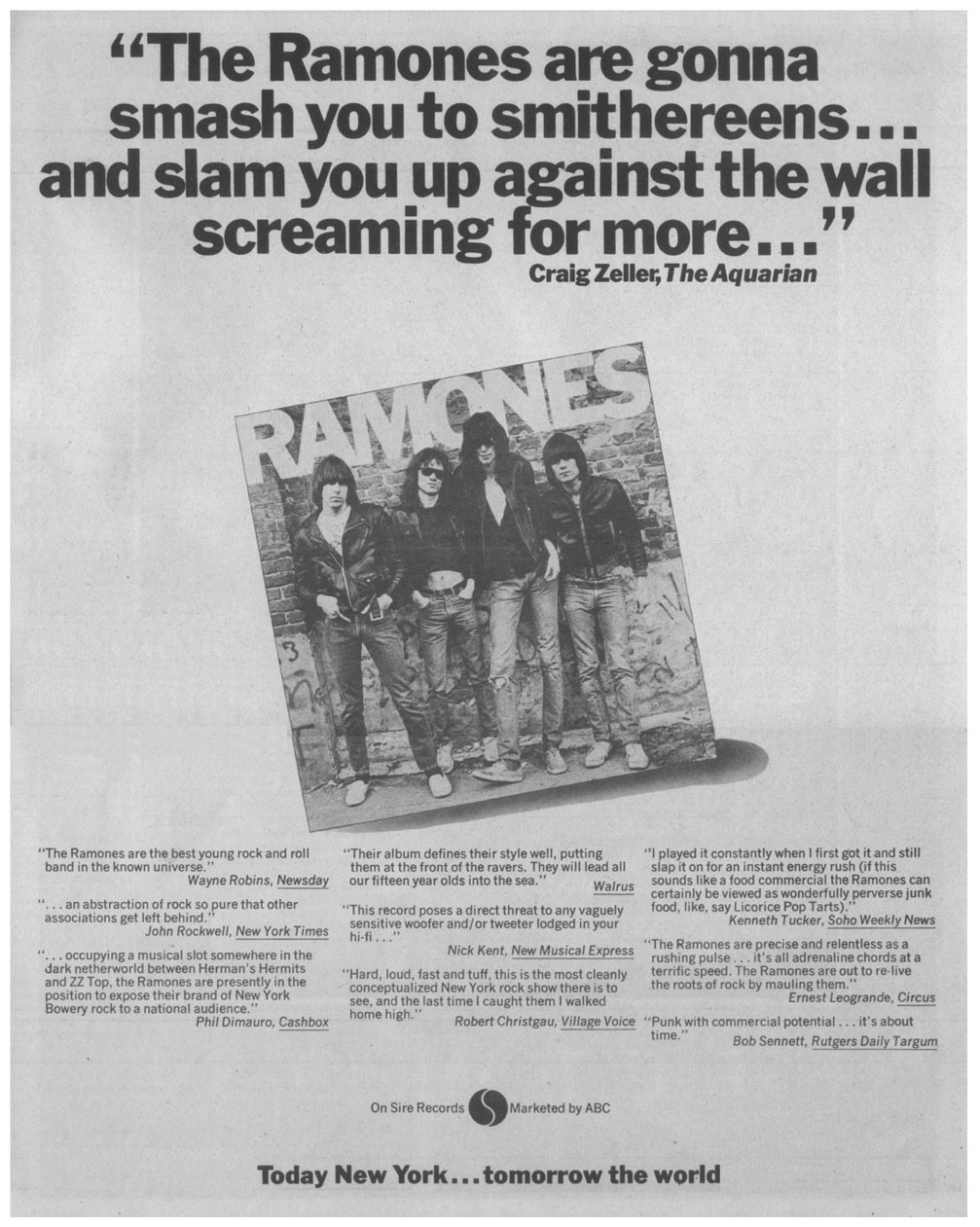 Click image for larger view. |
How the present will treat the Ramones, proponents of the same Manhattan musical minimalism as the New York Dolls who preceded them, remains to be seen. Thus far, punk rock's archetypal concept of an idealized Top 40 music -- the songs stripped down like old Fords, then souped up for speed -- has unintentionally provoked more primal anger from than precipitant access to the nation's teenagers, and the godheads of AM radio don't seem to be listening at all. Why? Do you have to be over 21 to like this stuff? Doesn't "Blitzkrieg Bop" or the absolutely wonderful "I Wanna Be Your Boyfriend" mean anything to anyone but an analytical intellectual? Until now, apparently not.
Where's your sense of humor and adventure, America? In rock & roll and matters of the heart, we should all hang on to a little amateurism. Let's hope these guys sell more records than Elton John has pennies. If not, shoot the piano player. And throw in Paul McCartney to boot.
- Paul Nelson, Rolling Stone, 7/29/76.
You couldn't make a recording this dumb by accident, not even in the new disco age -- someone is up to something here, but I can't figure out what. It could be a parody of punk-rock imaging, but it isn't funny or even marginally competent. The guitar, electric of course, seems to be turned all the way up and just plays chords, in a way that makes them sound like white noise. The "songs" mostly say things like "You're a loudmouth, baby... I'm gonna beat you up." Maybe it is meant straight. Who cares?
- Noel Coppage, Stereo Review, 10/76.
One of the funniest rock records ever made and, if punk continues to gain momentum, a historic turning point.
- Charles M. Young, Rolling Stone, 12/15/77.
I love this record -- love it -- even though I know these boys flirt with images of brutality (Nazi especially) in much the same way "Midnight Rambler" flirts with rape. You couldn't say they condone any nasties, natch -- they merely suggest that the power of their music has some fairly ominous sources and tap those sources even as they offer the suggestion. This makes me uneasy. But my theory has always been that good rock and roll should damn well make you uneasy, and the sheer pleasure of this stuff -- which of course elicits howls of pain from the good old rock and roll crowd -- is undeniable. For me, it blows everything else off the radio; it's clean the way the Dolls never were, and just plain listenable the way Black Sabbath never was. And I hear it cost $6400 to put on plastic. A
- Robert Christgau, Christgau's Record Guide, 1981.
Punk rock begins here. The cartoon kings of Queens at their most primitive and threatening. Rock's mainstream didn't know what hit it. * * * *
- Jeff Tamarkin, The All-Music Guide to Rock, 1995.
The mutation of glam into punk was instigated in the tiny, mid-70s' downbeat rock scene of New York. The New York Dolls, Wayne County, Patti Smith, Talking Heads and Television all started their bizarre careers in clubs like CBGBs down on The Bowery. The Ramones were the grubby oiks from the darkest corners of just such dark clubs. They stared from the cover of this magnificent debut album with dumb defiance written all over them. The songs within were a short, sharp exercise in vicious speed-thrash, driven by ferocious guitars and yet halting in an instant. It was the simple pop dream taken to its minimalist extreme. There just couldn't be anything faster or harder than this. The Ramones was the starting gun for English punk -- everyone learned to play listening to it. Discovering that album during the hot volatile summer of 1976 was like entering a new age. All your other albums seemed archaic.
- Collins Gem Classic Albums, 1999.
The standard-bearers for punk, the unassuming mop-haired guys from Forest Hills brought pop sensibilities to their hard-nosed street attitude and, with buzzsaw guitars, produced perfect three-chord, two-and-a-half minute blitzes that were stupid, simplistic and inspired. You can almost smell the Bowery as they whip through 30 minutes or so of unrelenting, humorous and catchy tunes about the Ice Capades, shock troopers, chainsaw massacres and more. * * * * *
- Zagat Survey Music Guide - 1,000 Top Albums of All Time, 2003.
Here it is -- the album that split the history of rock 'n' roll in half, New Testament, Old Testament. Those who heard -- I mean, really heard -- the fourteen bracing numbers that makeup Ramones upon its release in 1976 knew that rock would never be the same again. The sounds on the album all had their antecedents. The lunging chord structure and fuzzed-out attack of Johnny Ramone's guitar was clearly influenced by seventies heavy-metal bands like Black Sabbath, as well as proto-punk precursors like the Stooges. Meanwhile, the melodic simplicity of songs like "Blitzkrieg Bop" as well as the throbbing beat, came straight from late-sixties bubblegum, the Beach Boys, and other rock 'n' roll oldies. What the Ramones were doing was reestablishing the precedent of the original rock pioneers like Bo Diddley and Jimmy Reed, who utilized simplistic and sometimes repetitious formulas to create profound changes in the fabric of American music. In this sense, Ramones is one of the most groundbreaking albums of all time.
Ramones was voted the 54th greatest album of all time in a VH1 poll of over 700 musicians, songwriters, disc jockeys, radio programmers, and critics in 2003.
- Joe S. Harrington, VH1's 100 Greatest Albums, 2003.
"Our early songs came out of our real feelings of alienation, isolation, frustration -- the feelings everybody feels between seventeen and seventy-five," said singer Joey Ramone. Clocking in at just under twenty-nine minutes, Ramones is an intense blast of guitar power, rhythmic simplicity and ferocious brevity, a complete rejection of the spangled artifice and hollow, artsy pretensions of 1970s rock. The songs were fast and anti-social, just like the band: "Beat on the Brat," "Blitzkrieg Bop," "Now I Wanna Sniff Some Glue." Guitarist Johnny Ramone refused to play solos -- his jackhammer chords became the lingua franca of punk -- and the whole record cost just over $6000 to make. But Joey's leather-tender plea "I Wanna Be Your Boyfriend" showed that even punks need love.
Ramones was chosen as the 33rd greatest album of all time by the editors of Rolling Stone magazine in Dec. 2003.
- Rolling Stone, 12/11/03.
From its simple black-and-white cover photo to its quick-fire sonic assaults, the Ramones' debut album is the ultimate punk statement.
Recorded in two days for a meagre $6,000, Ramones stripped rock back to its basic elements. There are no guitar solos and no lengthy fantasy epics, in itself a revolutionary declaration in a time of Zeppelin-inspired hard-rock excess. Pushed along by Johnny Ramone's furious four-chord guitar and Tommy's thumping surf drums, all of the tracks clock in under three minutes. And while the songs are short and sharp, the group's love of 1950s drive-through rock and girl-group pop means they are also melodically sweet.
The album's lyrics are very simple, boiled-down declarations of teen lust and need. Joey Ramone yelps about what he wants ("I Wanna Be Your Boyfriend," "Now I Wanna Sniff Some Glue") and what he does not ("I Don't Wanna Walk Around With You'). Only "53rd And 3rd" -- a dark narrative based on Dee Dee's experiences as a rent boy -- hints at the expression of something more meaningful and deeply felt.
 Further reading on Super Seventies RockSite!: |
- Theunis Bates, 1001 Albums You Must Hear Before You Die, 2005.
Made for $6,000 by a group of misfit kids from Queens who could barely play their instruments, Ramones is the first, best, and most unlikely manifesto of punk rock. It's also a kind of antistandard, the record that decimates all the academic theorizing that gathered around punk as cultural watershed. Later punk became a "movement," a study in stance and calculation that could be endlessly reappropriated. But in 1976, when the four leather-jacket-wearing Romanes regularly terrorized New York's CBGBs with twenty-minute shows, punk was Joey Ramone (1951-2001) uttering the immortal words "Now I wanna sniff some glue" in a dire monotone.
Ramones is cheap thrills sped up to breakneck speed and played as though the four musicians (who, in a marketing ploy, each took the same last name Ramone even though they were not related) were racing to see who could finish first. Most of the songs depend on three chords, and last less than two minutes -- the basic Ramones strategy is run, gun, and done. In an interview in Please Kill Me, an oral history of punk, bassist Dee Dee Ramone (1952-2002) recalls that when the band began, the musicians "didn't know how or what to play. We'd try some Bay City Rollers and we absolutely couldn't do that. We didn't know how. So we just started writing our own stuff and put it together the best we could."
The songs the Ramones concocted for this album (and subsequent ones) work because they're so simple. Anyone could play them -- even though the Ramones had a relentless energy that was hard to duplicate. The Everyman quality proved critical to the spread of punk: Two of the significant U.K. punk bands, the Clash and the Damned, began performing within days after seeing the Ramones' London debut, which happened on July 4, 1976.
The Ramones' punk was a spastic lurch, a homemade contraption that seemed at any minute on the verge of spinning out of control. Yet unlike many who followed in their footsteps, the Ramones were inclined to embrace (and, in their own skronky way, celebrate) the joyous touchstones of early rock -- running through "I Wanna Be Your Boyfriend," "Judy Is a Punk," and (later) "Rockaway Beach" is an echo of the crazed-surfer-kid abandon of the 1950s. But it's just an echo: By the time the Ramones are finished, they've mangled the optimism of early rock into jaundiced, diffident, maniacal rallying cries of the disaffected that could only have risen from the post-Watergate 1970s.
- Tom Moon, 1,000 Recordings To Hear Before You Die, 2008.
Take teen angst and heartbreak, add glue sniffing, then repeat-repeat-repeat until the neighbors complain. Now, that's rock & roll!
Ramones was chosen as the 100th greatest album of all time by the editors of Entertainment Weekly in July 2013.
- Entertainment Weekly, 7/5/13.
Clocking in at just 29 minutes, Ramones is a complete rejection of the spangled artifice of Seventies rock. Songs like "Beat on the Brat" and "Now I Wanna Sniff Some Glue" were fast and anti-social, just like the band, driven by guitarist Johnny Ramone's buzz-saw chords. But Joey Ramone's leather-tender plea "I Wanna Be Your Boyfriend" showed that even punks need love.
Ramones was chosen as the 47th greatest album of all time in a Rolling Stone magazine poll of artists, producers, critics and music industry figures in Oct. 2020.
- Rolling Stone, 10/20.
 Reader's Comments
No comments so far, be the first to comment.
 Buying Options





