
   |

Bridge Over Troubled Water
Simon & Garfunkel
Columbia 9914
Released: January 1970
Chart Peak: #1
Weeks Charted: 85
Certified Gold: 2/27/70
 Simon and Garfunkel have apparently joined that select group of recording artists whose new records sell a million copies even before they leave the pressing plant. Bridge Over Troubled Water, their latest for Columbia, also won a gold record almost simultaneously with its release. It is nice to be able to say for once that such extraordinary success is deserved, that it is based on real worth. Everything in the new album has been accomplished superbly: the songs by Paul Simon, the performances by him and by Art Garfunkel, and the actual production of the recording.
The title song has already become something of a miniclassic, along the lines of the duo's earlier "Mrs. Robinson" and "Parsley, Sage, Rosemary, and Thyme," and it reflects beautifully the gentle essence of their art. The lyrics are moving without being maudlin, and the tune itself has a classic purity that makes it both memorable and distinctive. This track alone makes the album worth having, but it is not the only triumph. "Celia," "Bye Bye Love," and "Baby Driver" are all superior songs that stand on their own as really good material fautlessly performed. The subtlety of composition, mood, and delivery that Simon and Garfunkel can put into their work never ceases to astonish me, and neither does their ability to reveal what is at the core of so many of today's young people: that spirit of high romance that hasn't been in the mainstream of the arts since the nineteenth century. "Bridge Over Troubled Water" might seem on the surface to be only a benevolent promise along the lines of S & G's assurance to Mrs. Robinson that God loves her, but when probed a little deeper it reveals itself as an almost passionate declaration of fidelity.
If it is true that we are on the verge of another Romantic period in the arts, then I hope that it comes first from pop culture, where the vitality, concision, and directness are. Simon and Garfunkel seem to be heading in that direction, and though their style is inimitable, their influence is so vast that I look forward to a whole group of young writers, composers, and performers like that romping over the horizon. While I wait, I an listen to this lovely album again and again.
- Peter Reilly, Stereo Review, 7/70.
Bonus Reviews!
 Click image for larger view. |
- Paul Kresh, Stereo Review, 9/70.
- Billboard, 1970.
Britain's best-selling album of the seventies was led by its title track, one of the top cuts in the history of popular music. As Paul Simon related to Jon Landau in an outstanding Rolling Stone interview, Art Garfunkel did not want to sing lead vocal on it at first, feeling it was not right for him. On many occasions Simon wished he had sung it himself, particularly when he stood in the wings while Garfunkel got all the applause for it. "That's my song, man," Paul recalled thinking in bitter moments. "Thank you very much. I wrote that song."
It would not have been the epic it was had Garfunkel not suggested expanding it beyond two verses. Simon asked pianist Larry Knetchel to lengthen his piano track, then finally wrote a third verse. In retrospect he claimed the third sounded clearly different from the first two.
"The Boxer" had been an international top ten hit the previous year. "Cecilia," originally recorded in a living room on a Sony and then copied and extended in the studio, became a smash in America. "El Condor Pasa," performed on top of a Los Incas record (and properly acknowledged), became another US hit, Julie Felix enjoying a cover success in Britain.
Simon and Garfunkel both thought something like "Cecilia" would be the first single, but Columbia chief Clive Davis persuaded them to go with the title song. He felt that it had the potential to become a monster hit and a standard copyright despite its length and tempo. Events proved him right. Not only was it a number one single, it pushed the album past ten million in sales. In Britain Bridge spent forty-one weeks at number one, the highest figure of any pop or rock album.
"The Only Living Boy in New York" was Simon's personal favourite on this collection. "Bye Bye Love" was a live recording. The LP was originally intended to contain a dozen numbers, but Garfunkel did not wish to sing Simon's "Cuba Sí, Nixon No," which never appeared anywhere, and Paul did not fancy doing what he called Art's "Bach chorale thing."
In 1987, Bridge Over Troubled Water was chosen by a panel of rock critics and music broadcasters as the #42 rock album of all time.
- Paul Gambaccini, The Top 100 Rock 'n' Roll Albums of All Time, Harmony Books, 1987.
Bridge Over Troubled Water has always been bothersome. Vinyl copies of these tapes always seem to sound scratchy and distorted, particularly in the climax of the title track, with the audience in "Bye Bye Love," and any heavy brass scoring.
Compact Disc does a lot to overcome these problems but can do nothing for the tape hiss from the master tapes -- "The Boxer" and the intro to "Bridge" for instance are quite hissy. Nor can CD do anything to improve the wowy sound on the orchestral backing to the title track. But benefits there are to be had. Much improved low bass solidity now powers its way through tracks like "Cecilia," "The Boxer" and "Baby Driver." Multi-tracked vocals and echo no longer contribute to the very edgy quality which could make the LP disappointing hearing. The orchestral contributions still sound bright, the brass is rather fierce at times, but the gain in simple transparency will mark this CD out as a high priority purchase for many people.
- David Prakel, Rock 'n' Roll on Compact Disc, 1987.
Well-crafted as they are, the lyrics haven't worn all that well; perhaps because of overexposure due to the tremendous popularity the album initially enjoyed in 1970 and its continued playability. What endures are the lush melodies, superbly produced. Overall, the CD's sound revitalizes this old chestnut providing a precise, yet warm, dynamic rendering of the craftsmanship displayed by the duo and their wonderful producer/engineer, Roy Halee, in the recording studio. The sound is sadly afflicted with consistently audible hiss and some distortion and/or muddiness in its loudest passages. Yet, on balance, the digital conversion is a substantial improvement; in fact, it offers several truly stunning moments. B+
- Bill Shapiro, Rock & Roll Review: A Guide to Good Rock on CD, 1991.
The massive commercial success of Bridge Over Troubled Water -- it topped the charts for 10 weeks, won the Grammy Award for Album of the Year, included four hit singles, and has sold more than five million copies in the U.S. -- tends to exaggerate its significance in the Simon and Garfunkel catalog. Actually, it's a step down from the masterpiece of Bookends, containing some filler, such as the comic if slight "Baby Driver" and the pleasant if inessential live cover of the Everly Brothers' "Bye Bye Love"; it also lacks the previous album's musical and thematic unity. Still, one is admittedly splitting hairs when talking about an album that contains such classics as the title song and "The Boxer," as well as such notable tunes as "Cecilia," "El Condor Pasa," and "So Long, Frank Lloyd Wright." This is Simon and Garfunkel's most popular album because it legitimately spoke to its audience, and much of it continues to set standards in thoughtful pop music decades later. * * * * *
- William Ruhlmann, The All-Music Guide to Rock, 1995.
Bridge Over Troubled Water was Simon and Garfunkel's most successful album and, with the title track (their last No. 1) Garfunkel's best moment. The album is considered their masterpiece, though today it sounds overproduced. * * * * 1/2
- Leland Rucker, Musichound Rock: The Essential Album Guide, 1996.
It took an estimated 800 hours to complete, with Paul Simon patiently working around Art Garfunkel's lengthy periods on the set of Catch 22. So intense was the workload that the duo turned down the chance to perform at Woodstock. Bridge Over Troubled Water would see the duo moving away from their folksy Bohemian beginnings to become the first great artists of the new 70s mainstream. Although the album may sound relaxed, polished, effortless even, it was recorded, literally, all over the place. Even the first song in the can, "The Boxer," was started in Nashville, developed in New York and finished in L.A. "Cecilia" proved raucous and brash, with the duo at one point dropping fifteen drumsticks onto a parquet floor in an attempt to capture a "frantic" sound. In stark contrast, "The Only Living Boy In New York" was deeply reflective and melancholic. But the true glory belonged to the title track, which is huge in every way. Simon had heard the phrase, "I'll be your bridge over deep water..." in a version of "Oh Mary Don't You Weep For Me." He never forgot the phrase and wound it into this slowly building ballad. Much to Simon's astonishment Art Garfunkel didn't initially warm to the song, and only under duress agreed to supply the lead vocal.
- Collins Gem Classic Albums, 1999.
Their vocals a seamless blend, these talented, classy guys pulled together a final gift to mankind that spoke eloquently to their generation and is sure to thrill little girls and English teachers for the next 100 years. It may have turned out to be the swan song to a beautiful collaboration between Paul's intuitive, thoughtful lyrics and Art's awesome tenor, but at least they finished on top with armfuls of Grammys -- what a way to go out. * * * * *
- Zagat Survey Music Guide - 1,000 Top Albums of All Time, 2003.
Some albums are cries from the heart. Some albums are proud displays of technical muscle. And some albums are masterpieces of craft, carefully constructed to acheive maximum commercial appeal. Bridge Over Troubled Water belongs in this last category. Nearly every one of its eleven songs sounds like it was intended to be a hit single; from the high drama of "The Boxer" to the horn-stoked vibrancy of "Keep the Customer Satisfied," ear-catching hooks and unshakable melodies abound. And yet Bridge Over Troubled Water is more than just a collection of blockbusters. It's also the last full-length collaboration between Paul Simon and Art Garfunkel, a farewell to a long partnership and a foreshadowing of the solo work to come.
Bridge Over Troubled Water was voted the 33rd greatest album of all time in a VH1 poll of over 700 musicians, songwriters, disc jockeys, radio programmers, and critics in 2003.
- Mac Randall, VH1's 100 Greatest Albums, 2003.
On their fifth and final studio album, Paul Simon and Art Garfunkel were pulling away from each other: Simon assembled some of it while Garfunkel was in Mexico acting in the film Catch-22. Garfunkel vetoed Simon's song, "Cuba Sí, Nixon No," and Simon nixed Garfunkel's idea for a Bach chorale. What remains is the partnership at its best: wry, wounded songs such as "The Boxer" with healing harmonies, though the gorgeous title track was sung by Garfunkel alone, despite his resistance. "He felt I should have done it," Simon told Rolling Stone in 1972. "And many times I'm sorry I didn't do it."
Bridge Over Troubled Water was chosen as the 51st greatest album of all time by the editors of Rolling Stone magazine in Dec. 2003.
- Rolling Stone, 12/11/03.

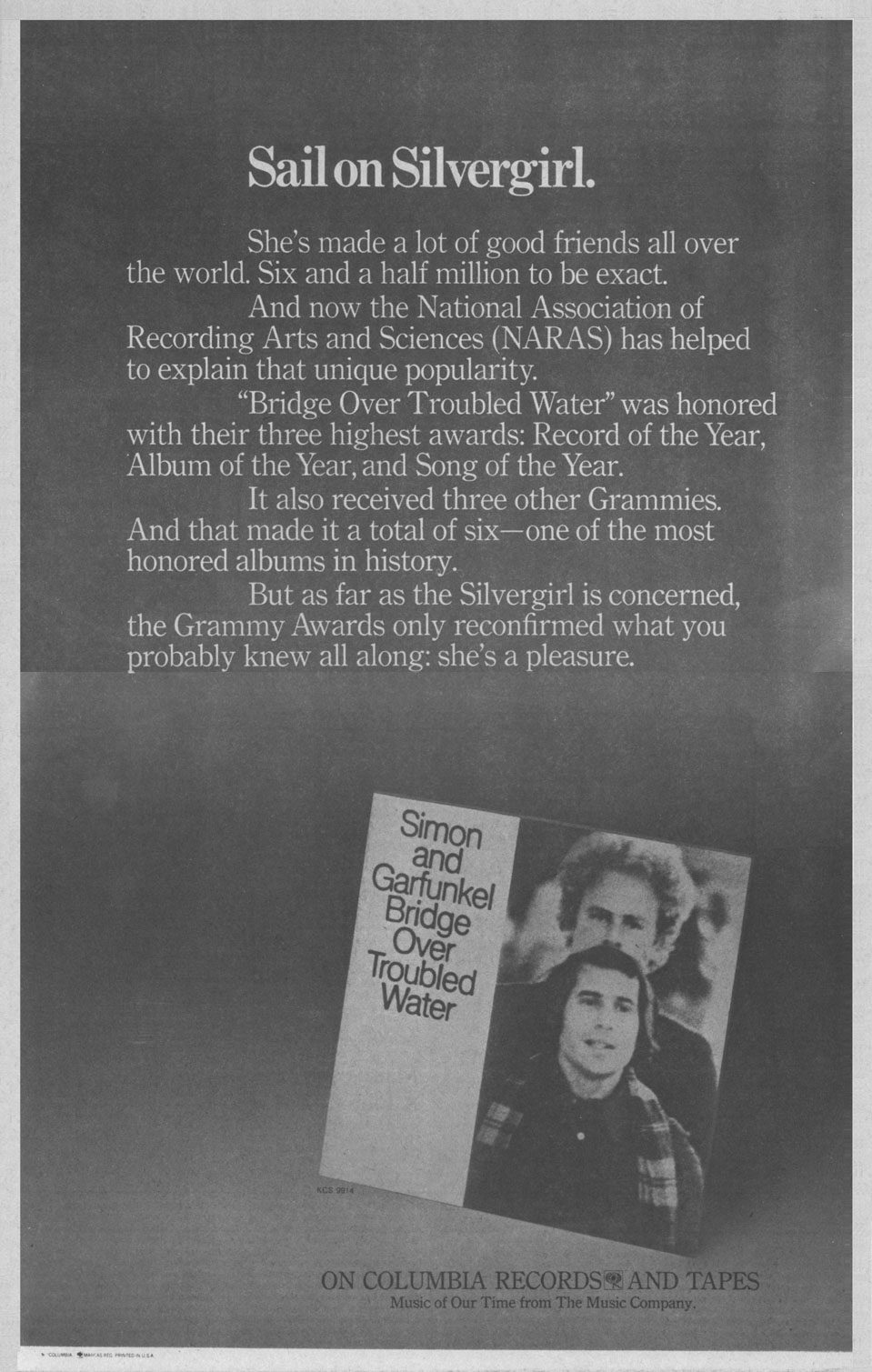
Bridge Over Troubled Water spent 10 weeks as the US Number One, while in the UK its 41-week chart-topping run remains the longest for a pop/rock release. Collectively, as an album and single Bridge Over Troubled Water won an unprecedented six Grammy Awards. By the end of 1970, Paul Simon had earned over $7 million from the tune.
As of 2004, Bridge Over Troubled Water was the #17 best-selling album of the 70s.
- Hamish Champ, The 100 Best-Selling Albums of the 70s, 2004.
Bowing out in 1970, The Beatles left Let It Be as a messy legacy. Fellow Sixties stalwarts Simon And Garfunkel exited with more grace and an album with a title track that coincidentally also became a hymnal standard.
Short on stature and style, the duo's greatness was nonetheless secure, thanks to astonishing classics from "The Sound Of Silence" in 1965 to "America" in 1968. A preview of Bridge... in 1969 -- the hit "The Boxer" -- confirmed once and for all that songwriter Paul Simon had emerged from the shadow of Bob Dylan.
Like Dylan, Simon wrote literate lyrics. But, like Smokey Robinson, he wrote literate lyrics and lovely songs that everyone from children to Aretha Franklin could sing. In a way, the epic title track does Bridge... an injustice, for it gives no hint of the chirpy likes of "Cecilia" and "El Condor Pasa (If I Could)."
There are delicacies too; deceptively so in the case of "The Only Living Boy In New York" and "So Long, Frank Lloyd Wright." Both were addressed to Simon's soon-to-be ex-partner Art Garfunkel, a former student of architecture (hence Frank Lloyd Wright) who skipped some recording sessions to act in Catch-22.
Bridge... is easy to adore even if you do not care about squabbling singers or folk music. Take a trip on ...Troubled Water and you will learn why so many get misty-eyed whenever the old sparring partners bury the hatchet long enough to sing together.
- Bruno MacDonald, 1001 Albums You Must Hear Before You Die, 2005.
This album, the last that Simon and Garfunkel recorded, serves as an effective counterbalance to the clichés that have grown up around American culture of the 1960s. The era is forever associated with a rampant flower-powered euphoria; Simon, the songwriter, specializes in pieces that sit idly and contemplate life in America from the window seat of a bus (or a subway bench, with a Peruvian folk band playing "El condor pasa" on the opposite platform).
The era is often portrayed as a time of unity, a moment of almost utopian togetherness, but Simon writes as an outsider, and some of his best songs take the perspective of an alienated, isolated young man. ("The Boxer" follows one such soul as he hustles in Manhattan.) The '60s stand for heedless free love; in Simon's songs, emotional entanglement brings heavy consequences and duties. The title song expresses devotion and empathy in terms more likely to resonate with an adult than some headstrong hippie: "When you're weary, feeling small," goes one verse, "I'll take your part." Simon is a deceptive lyricist -- he starts out describing the scenery, and pretty soon he's drawn listeners deep into the thoughts of his complicated, often conflicted characters. Every tune on Bridge conveys a slightly different perspective, and inhabits a different mood: There are moments of withering cynicism ("Keep the Customer Satisfied") and euphoric expressions of teenage romance ("Cecilia"), personal reflections ("The Only Living Boy in New York") and pieces that swell with the aspirations of millions ("The Boxer"). Each song is a marvel of introspection, and also concision -- Simon communicates deep tangles of emotion in coded bursts. And each provides listeners with something even more elusive -- a quiet respite from the exuberant noise of pop culture in the Age of Aquarius.
- Tom Moon, 1,000 Recordings To Hear Before You Die, 2008.
(2011 40th Anniversary Edition) The real news on this reissue of Paul Simon and Art Garfunkel's classic 1970 album is the accompanying DVD. It features Songs of America, a 1969 CBS special directed by Charles Grodin. Rejected by its initial sponsor, Bell Atlantic, the controversial 52-minute film juxtaposed the pair touring, performing, rehearsing and recording with a series of politically charged images -- including JFK, MLK, Cêsar Châvez and the Poor People's March on Washington. The DVD's other half, "The Harmony Game," examines Bridge's creation via contemporary interviews with Simon, Garfunkel and co-producer Roy Hallee. "They're just too simple," Simon says of the lyrics to "Bridge Over Troubled Water," "and of course that's what made it so universal." * * * * *
- Barry Walters, Rolling Stone, 3/31/11.
The duo's final studio album veered with meticulous poise from the title hymn -- an enduring monument to spirituality inclusive in healing and truly angelic singing -- to poignant anthropology ("El Condor Pasa"), crisp rockabilly ("Keep the Customer Satisfied") and baroque-folk majesty ("The Boxer"). But the friendship, never as strong as the vocal bond, was doomed. The pair split later that year.
- David Fricke, Rolling Stone, 12/1/16.
The hugely popular folk-pop duo were coming apart in 1970. What remains is the partnership at its best: wry, wounded songs with healing harmonies such as the title track, which was sung by Art Garfunkel alone, despite his resistance.
Bridge Over Troubled Water was chosen as the 172nd greatest album of all time in a Rolling Stone magazine poll of artists, producers, critics and music industry figures in Oct. 2020.
- Rolling Stone, 10/20.
 Reader's Comments
No comments so far, be the first to comment.
 Buying Options





