
   |

There's a Riot Goin' On
Sly & The Family Stone
Epic 30986
Released: November 1971
Chart Peak: #1
Weeks Charted: 31
Certified Gold: 11/8/71
 Maybe this is the new urban music. It's not about dancing to the music in the streets. It's about disintegration, getting fucked up, nodding, maybe dying. There are flashes of euphoria, ironic laughter, even some bright stretches but mostly it's just junkie death, oddly unoppressive and almost attractive in its effortlessness. Like going to sleep very slowly. The music has no peaks, no emphasis, little movement, it seems to fall away like a landslide in a dream (you falling slowly too, not panicking) or merely continue, drained of impetus, self-destructing. Smack rock.
It's Sly & the Family Stone's fifth album (not counting the Greatest Hits collection) and their first new LP since April 1969. Perversely titled -- There's a Riot Goin' On (Epic KE 30986) implies action -- irrelevantly packaged -- a wordless open-fold with a "flag" cover, the stars replaced by white sunbursts on black and a terrible junior high Polaroid collage of Family and friends on the back -- the album is a testament to two years of deterioration rather than two years of growth. One of the most influential innovators in recent years, Sly retains a certain inventiveness and a characteristically high-strung sound but he's left behind much more.
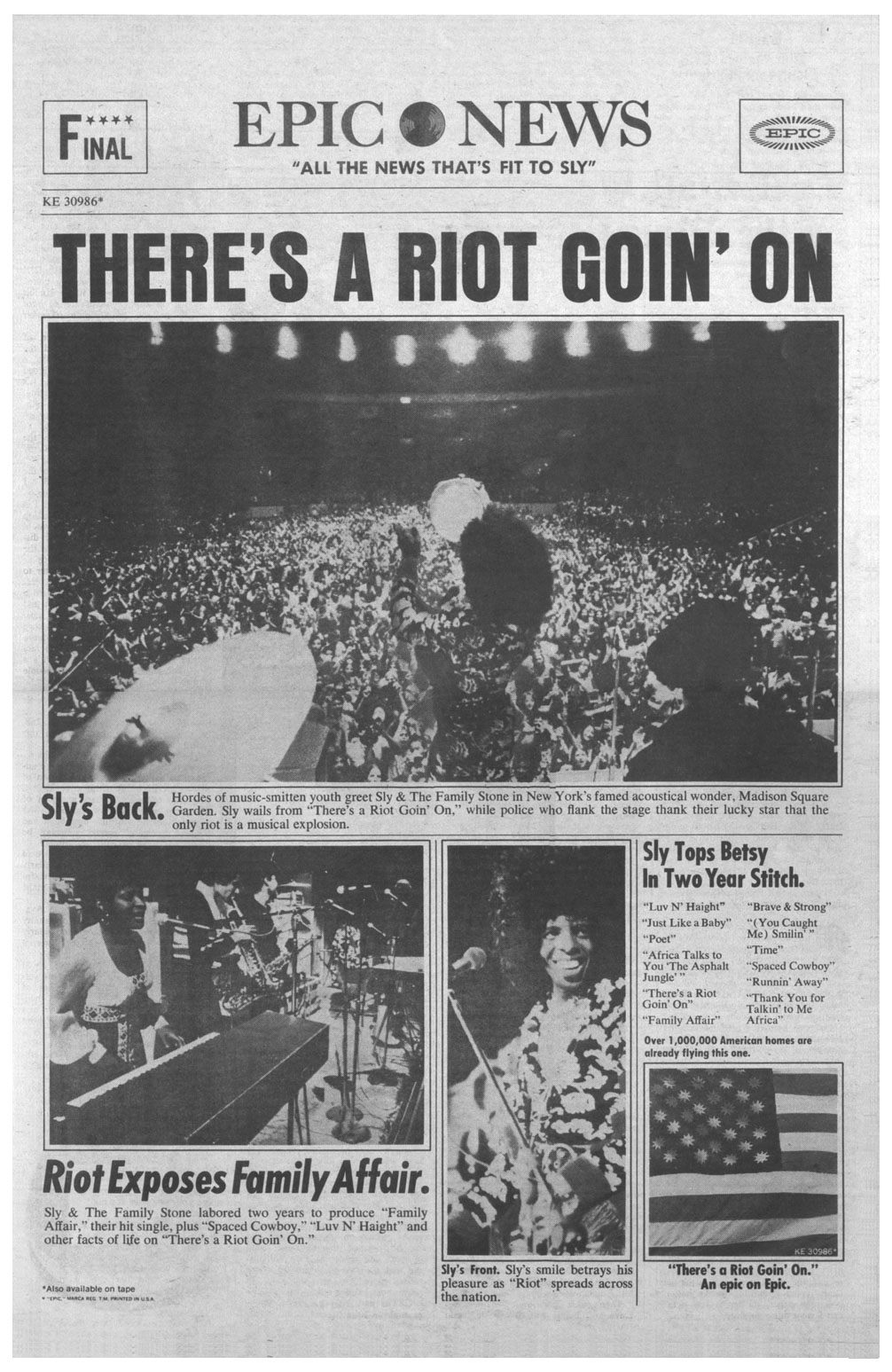 Click image for larger view. |
"Luv n' Haight" also contains these lines: "As I grow up,/I'm growing down./And when I'm lost/I know I will be found." As one of the many cryptic hints of Sly's condition spread through the album, this is a typical combination of hope and pain, two elements constantly at war here.
It's a very personal album and if there's a riot goin' on, its inside Sly Stone. David Kapralik, Sly's manager, has a line about the "riot" being in the environment, and timed at 0:00, is space for examination of the "riot" all around you, the interpretation is up to you. If Sly seems weaker lyrically than on his previous work, it can be laid in part to pure stoned self-indulgence and the kind of dumb incoherence he often displays on stage, but more importantly, it's the result of a very real personal struggle, with only tentative, vaguely grasped solutions. On "Africa Talks to You" he asks (himself), "When life means much to you,/Why live for dying?/If you are doing right,/Why are you crying?"
"Family Affair," its sound once mournful and playful, deals with these questions a little further down the line toward understanding them and their answers. The double meaning of the title -- a private matter, A Family (Stone) affair -- emphasizes its concerns are close to home. The singing is plain, gritty, stripped of any pretty vocal qualities, just Sly in the lead with Sister Rosie repeating almost plaintively, "It's a family affair." At the end, Sly states quite clearly the conflict at the center of the album: "You can't leave, 'cause your heart is there./But you can't stay, 'cause you been somewhere else!/You can't cry, 'cause you'll look broke down,/But you're cryin' anyway 'cause you're all broke down!"
"Africa Talks to You 'The Asphalt Jungle'" and "Brave & Strong" are both more complex, more irritating and less accessible. The lyrics are broken and puzzling, near-impenetrable in "Africa"; the sound, too, is fragmented, ominous, jittery, again, more so in "Africa" where the last half of the cut drifts off as if dazed, mixing with these ghostly voices warning "Timber!" Both songs seem to be warnings, personal, but directed outward to all of us more so than much of the other material here. In "Africa" the warning is "Watch out, 'cause the summer gets cold.../When today gets too old"; time is running out ("Timber...all fall down!") and ain't nobody gonna save you but yourself. "Brave & Strong" pushes the point -- "Survive!" -- more emphatically but less effectively -- a more muddled, less interesting song.
Much of the rest is just bad: pretentious ("Poet"), cut, dumb ("Spaced Cowboy"), inconsequential ("Time"). Kapralik, again, says that when any "great creator" has reached the top, "the only ting to do is step back and lay back." Is that what you call it? Feels more like being knocked back and struggling to recover. "Thank you for the party/I could never stay,/Many thangs [sic] is on my mind/Words in the way." Sly has cut to the minimum, reduced his music to bare structures, put aside the density and play of voices in the Family in favor of his anguished, unpolished lead and quiet choruses. Maybe he had little choice. You couldn't say Riot is a pulling through or an overcoming. It's a record of a condition, a fever chart.
As such, it doesn't invite an easy response. At first I hated it for its weakness and its lack of energy and I still dislike these qualities. But then I began to respect the album's honesty, cause in spite of the obvious deception of some cuts, Sly was laying himself out in all his fuck-ups. And at the same time holding a mirror up to all of us. No more pretense, no more high-energy. You're dying, we're all dying. It's hard to take, but There's a Riot Goin' On is one of the most important fucking albums of this year.
- Vince Aletti, Rolling Stone, 12/23/71.
Bonus Reviews!
A long time in the making, with all the attendant stories about Sly's non-appearances, being fined for not producing, accusations and denials...but it's here and it's Sly as before creating a lot of almost physical excitement. Listen to "Thank You For Talkin' To Me Africa" and that will take you higher in your seat. Good times are to be had listening to the fun "(You Caught Me) Smilin'." There's some put-on here but also a lot that makes Sly the in-person rave that he is.
- Hit Parader, 4/72.
Despairing, courageous, and very hard to take, this is one of those rare albums whose whole actually does exceed the sum of its parts. Bleak yet sentient songs of experience like "Runnin' Away" and "Family Affair" lend emotional and aesthetic life to the music's dead spaces; bracing alterations of vocal register, garish stereo separations, growls and shrieks and murmurs, all the stuff that made Sly's greatest hits the toughest commercial experiments in rock and roll history, are dragged over nerve-wracking rhythms of enormous musical energy. The inspiration may be Sly's discovery that the pot of gold at the end of the rainbow doesn't mean shit, but what's expressed is the bitterest ghetto pessimism. Inspirational Verse: "TIME they say is/The answer/But I don't believe it." Original title: Africa Talks to You. Length of title track: 0:00. A+
- Robert Christgau, Christgau's Record Guide, 1981.
Nihilistic and nasty, this tough, abrasive slice of community hopes and shattered dreams remains one of the most disturbing recordings ever released by a commercially successful pop band. A couple of the songs charted: "Family Affair" got some airplay, but you ain't gonna dance to this music for long -- not if the messages are coming through the lyrics. This is Sly's last great album statement -- its rhythms are extraordinary, its message brutally honest. There's a Riot Goin' On and Greatest Hits are the two ends of the spectrum of one of the least-appreciated, most influential musicians of the soul/rock era, and both recordings are genuine classics. The CD's excellent sonics are hard, bright, and completely appropriate. A+
- Bill Shapiro, Rock & Roll Review: A Guide to Good Rock on CD, 1991.
The party always ends, the drugs take their toll, and things fall apart. In the late sixties, thanks to their spirited records and their filmed performance at Woodstock, Sylvester Stewart and his San Francisco band the Family Stone epitomized optimistic egalitarianism. Their greatest hits -- "Dance to the Music," "Everyday People," "Stand!," and "Thank You (Falettinme Be Mice Elf Agin)" -- were as celebratory and openhearted as any in pop music. These were songs about unlimited possibility for oneself and tolerance for others; these were love songs in dozens of ways.
Sly's drug problems were transforming him into something of an unsure show on the arena scene (among major performers, only George "No-Show" Jones earned a worse reputation), and the physical and spiritual dissatisfaction such habits represented were a major part of his 1971 album There's a Riot Goin' On. Sly was far from the end of his rope -- subsequent records suggest that he could find nooses in all corners -- but it was clear that Sly's intention was to make a record that was nothing so much unexpected as off-putting. Yet he accomplished both. Desolation and anger, sadnesses triumphed over in his earlier albums, were at the core of There's a Riot Goin' On, and coming from someone known for his ability to dance over all sorrows, the record shook many listeners awake. And although the LP peaked at Number One, it also scared many away.
The deliberate beats underline the sense of violation of There's a Riot Goin' On: Basses burp at odd intervals, drums stumble and stutter, and rhythm guitars sometimes drop out of the mix completely. The big hit from the record, "Family Affair," at least partly a play on the name of the band, provided a perfect extended metaphor for the sorrow and ravages that Sly suddenly recognized around him. His shouts before the fade, a brief arousal from his sad stupor, sound like the cries Al Green was perfecting a continent away, but this was the dark side of Green's romantic longing. There was nothing warm about the performance: "Nobody wants to be left out" was its key slurred line. Even more muddy, moving and ominous was "Thank You for Talkin' to Me Africa," a downer remake of "Thank You (Falettinme Be Mice Elf Agin)" that remains incredibly influential to this day in its call to address untouched issues in unexpected ways, no matter the costs (it cost Sly his career). Bands like Public Enemy and N.W.A. are this scary only in their dreams.
- Jimmy Guterman, The Best Rock 'n' Roll Records of All Time, 1992.
Sly gets darker and funkier. By Riot, Sly was a bona fide superstar. His personal behavior became more erratic, and his songwriting became more eclectic and adventurous. There is no precedent for such a record; songs were conceived from the rhythm up, and often left in sparse, naked, seemingly semi-finished form. Sly's earlier hit,"Thank You (Falettinme Be Mice Elf Agin)" is slowed down, turned inside out, and retitled "Thank You for Talkin' to Me Africa." The result is an extremely personal stab at exorcism that takes the listener through the new reality of Black and White America in the early '70s. Mesmerizing. The album's most accessible songs, "Family Affair" and "Runnin' Away," were R&B and pop hit singles, the former reaching the #1 spot on both charts. * * * * *
- Rob Bowman, The All-Music Guide to Rock, 1995.
Sly's epic, angry and sarcastic masterpiece, There's a Riot Goin' On, is a bitter, snarling diatribe that presaged his downfall. * * * *
- Joel Selvin, Musichound Rock: The Essential Album Guide, 1996.
 Further reading on Super Seventies RockSite!: Album Reviews: |
- Collins Gem Classic Albums, 1999.
This highly anticipated studio follow-up to Sly and the Family Stone's 1969 blast of hope, Stand!, was the grim, exact opposite: implosive, numbing, darkly self-referential. Sly Stone's voice is an exhausted grumble; the funk of "Family Affair," "Runnin' Away" and especially the closing downward spiral, "Thank You for Talkin' to Me Africa," is spare and bleak, fiercely compelling in its anguish over the unfulfilled promises of civil rights and hippie counterculture. "It is Muzak with its finger on the trigger," wrote critic Greil Marcus in Mystery Train. Take that as a recommendation.
There's a Riot Goin' On was chosen as the 99th greatest album of all time by the editors of Rolling Stone magazine in Dec. 2003.
- Rolling Stone, 12/11/03.
Sly And The Family Stone's upbeat multiracial rock 'n' soul reflected the optimism of the Civil Rights movement through the 1960s; but as that optimism withered away into bitter radicalism, so Stone underwent a similarly painful spiritual journey. Darkness was no stranger to Sly's Day-Glo fusion-pop; "Hot Fun In The Summertime" slyly sang of the Watts riots. But worsening civil unrest and the carnage of Vietnam, combined with his fragile emotional state and a mess of drugs, prompted him to deliver this haunted State of the Nation address.
This album was the product of endless sessions and overdubs, a coke-wired Stone wearing out the tapes. Rumor has it Miles Davis contributed some trumpet to the album, and live drums struggle for space with primitive drum machines; bass squelches freely about, loose and predatory; wah-wah guitars slash.
The heavyweight funk that dominates the album -- hazy, spooked, stoned -- lends an extra poignancy to the album's wistful slivers of pop, "Runnin' Away" and "You Caught Me Smilin'" -- moments of tenderness, relief from the defeated, angry funk. Previous Sly hits are referenced, pointedly the "'Everyday People' looking forward to a simple beating" on "Time," or a death-rattle crawl through previous hit "Thank You" was a closer.
A painfully accurate diagnosis of America's malaise and Sly's own spiritual disintegration, it alienated much of the fanbase, and signaled Sly's subsequent drug-fueled descent. It remains, however, a starkly brilliant album, a bruised, funky howl of soul under pressure.
- Stevie Chick, 1001 Albums You Must Hear Before You Die, 2005.
This zonked-out funk bummer is full of bad vibes and molasses tempos -- the sound of a tattered genius trying hard to keep it together.
There's a Riot Goin' On was chosen as the 91st greatest album of all time by the editors of Entertainment Weekly in July 2013.
- Entertainment Weekly, 7/5/13.
(2013 Deluxe Edition) Not even a 24K-gold disc -- the centerpiece of this new deluxe edition of Sly and the Family Stone's 1971 touchstone, along with a stitched flower-flag cover -- can fully brighten this Rosetta stone of dark funk and proto-hip-hop blues. Recorded largely in a Los Angeles home studio over two years, Riot's tapes were overdubbed so much they lost any aural luster. But the tracks' hissy tonality merely enhances the verité feel of the most transfixing music Sly Stone ever wrote -- and his most hard-nosed lyrics, depicting, as A. Scott Galloway puts it in the booklet, "a man in a tug of war with who he has become vs. who he has always strived to be." It's as lowdown as music gets -- and as great.
- Michaelangelo Mantos, Rolling Stone, 8/1/13.
Sly Stone's 1969 LP, Stand!, was full of hope. Its follow-up was the opposite. His voice is an exhausted grumble; the funk in "Family Affair," "Runnin' Away," and especially the closing downward spiral, "Thank You for Talkin' Me Africa," is spare and bleak, fiercely compelling in its anguish over the unfulfilled promises of the Sixties counterculture.
There's a Riot Goin' On was chosen as the 82nd greatest album of all time in a Rolling Stone magazine poll of artists, producers, critics and music industry figures in Oct. 2020.
- Rolling Stone, 10/20.
 Reader's Comments
No comments so far, be the first to comment.
 Buying Options





