
   |

The Six Wives of Henry VIII
Rick Wakeman
A&M SP-4361
Released: February 1973
Chart Peak: #30
Weeks Charted: 45
Certified Gold: 10/20/75
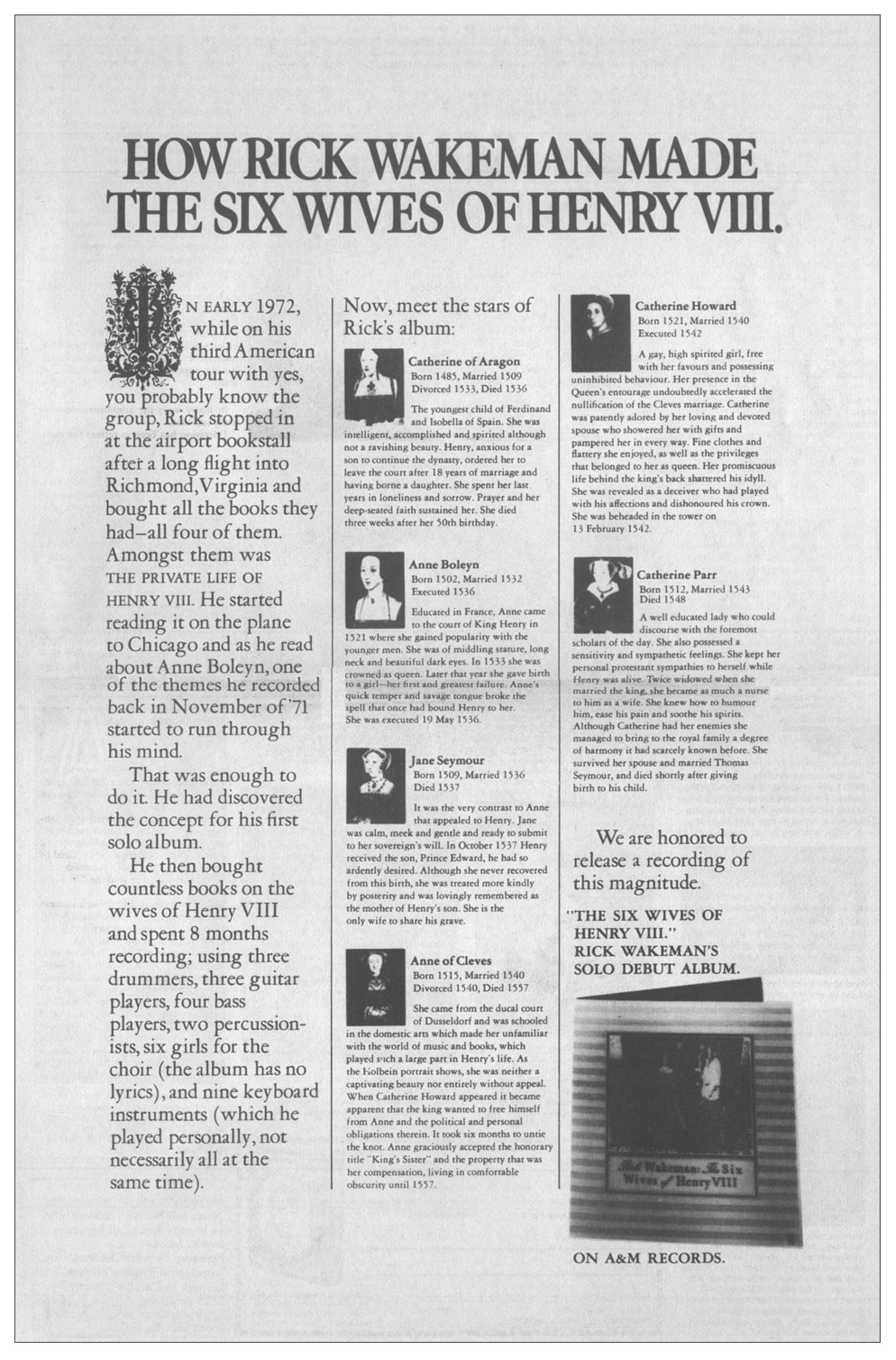
 It says in the fine print of Rick Wakeman's first solo album that the music is "based around [my] interpretations of the musical characteristics of the wives of Henry VIII." The idea for the album came from the book of the same name, which Yes' Wakeman purchased at a London airport. He writes that the music for each of Henry's wives came flowing inside his head as he read about them. A bit apocryphal perhaps, but apparently Wakeman found what he was looking for -- a theme through which he could expose his keyboard virtuosity. He overdubbed eight of them: Mini-Moog synthesizer, mellotron with brass and string effects, a Steinway Grand piano, another mellotron with voice effects, C-3 Hammond organ, RMI electric piano, Arp synthesizer and a Thomas Goff harpsichord.
 Click image for larger view. |
With this album, Wakeman has made his bid for Keith Emerson's place as the master of keyboard electronics. Though falling a little short in technique, he has a brilliant feel for tasteful impressionistic composition. For example, "Catherine Of Aragon," at first sounds like ELP's "Tarkus," but evolves into a more melodic cut featuring some human choral work by Liza Strike, Barry St. John and Judy Powell.
 Further reading on Super Seventies RockSite!: Album Review: |
Henry VIII is an exceptionally interesting instrumental album. The production is superb, the mixing tasteful with hardly an uncomfortable studio effect. In fact, most of what we would normally think of as effects are the product of Wakeman's own playing which is just fine.
- Steve Apple, Rolling Stone, 6/21/73.
Bonus Reviews!
This is, well, program music, the secret plot behind which may have been to teach Emerson, Lake and Palmer a thing or two about stealing from the classics and how to fence the goods once pinched. Yes-member Rick Wakeman has composed six not-so-easy pieces for his multiple keyboards (electric piano, two mini-Moog synthesizers, Arp synthesizer, electric organ, two mellotrons, Steinway grand) and other rock instruments. Each piece is a musical portrait of one of the wives of Henry VIII, although the wives don't turn up in the album in the order that they happened to Henry. Wakeman has taken the poor man's direct approach -- that is, it's easy to deduce, just from listening, that Catherine Howard was the youngest, least inhibited, most fickle of Henry's wives, but beyond that the music grows ambiguous and I cannot tell for sure, simply by listening, whether Jane Seymour picked her feet or not. Ms. Howard's piece turns on a lovely, sprightly melody that eggs some fine mellotron work out of Wakeman. Sounds as if she was his favorite, which is only fair, since the writers of all those incredibly dull plays on this subject have seemed intent on making a pet of Anne Boleyn -- or at least that was always my impression before I either walked out, turned off the television, stopped reading, or fell asleep. Maybe... maybe RIck has a thing for Cathy Howard... ummm? Well, that, too, has possibilities. How about a concept album on the vicissitudes of being in love with a girl who lost her head -- in the Tower of London?
They're right. They're absolutely right. There'll always be an England.
- Noel Coppage, Stereo Review, 9/73.
Wakeman's first solo album is also his least pretentious work and, in many respects, his most effective. Essentially a selection of six electronic tone paintings done on a multitude of synthesizers, Mellotrons, and other keyboard instruments, all of the material here is beautifully melodic and excitingly played and arranged, based on the lives and perceived personalities of Henry VII's six spouses. Some of the music comes off as trite 19th-century Romantic meanderings, but the running times are held in check, and besides, that seems to be exactly what Wakeman was aiming for. * * * *
- Bruce Eder, The All-Music Guide to Rock, 1995.
 Reader's Comments
No comments so far, be the first to comment.
 Buying Options





