
   |
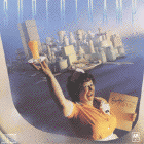
Breakfast In America
Supertramp
A&M 3708
Released: March 1979
Chart Peak: #1
Weeks Charted: 88
Certified 4x Platinum: 11/14/84


 Breakfast In America is a textbook-perfect album of post-Beatles, keyboard-centered English art rock that strikes the shrewdest possible balance between quasi-symphonic classicism and rock & roll. Whereas Supertramp's earlier LPs were bogged down by swatches of meandering, Genesis-like esoterica, the songs here are extraordinarily melodic and concisely structured, reflecting these musicians' saturation in American pop since their move to Los Angeles in 1977.
Supertramp's major problem is an increasing dichotomy between their rhapsodic aural style and a glib, end-of-the-empire pessimism. The music in "Gone Hollywood" is so suffused with romantic excitment that it's difficult to believe the ennui the lyrics claim: "So many creeps in Hollywood/...Ain't nothin' new in my life today." Though laced with nice, Beach Boys-style falsettos, "Goodbye Stranger," an uncharacteristically happy fantasy about endless one-night stands, seems far more honest.
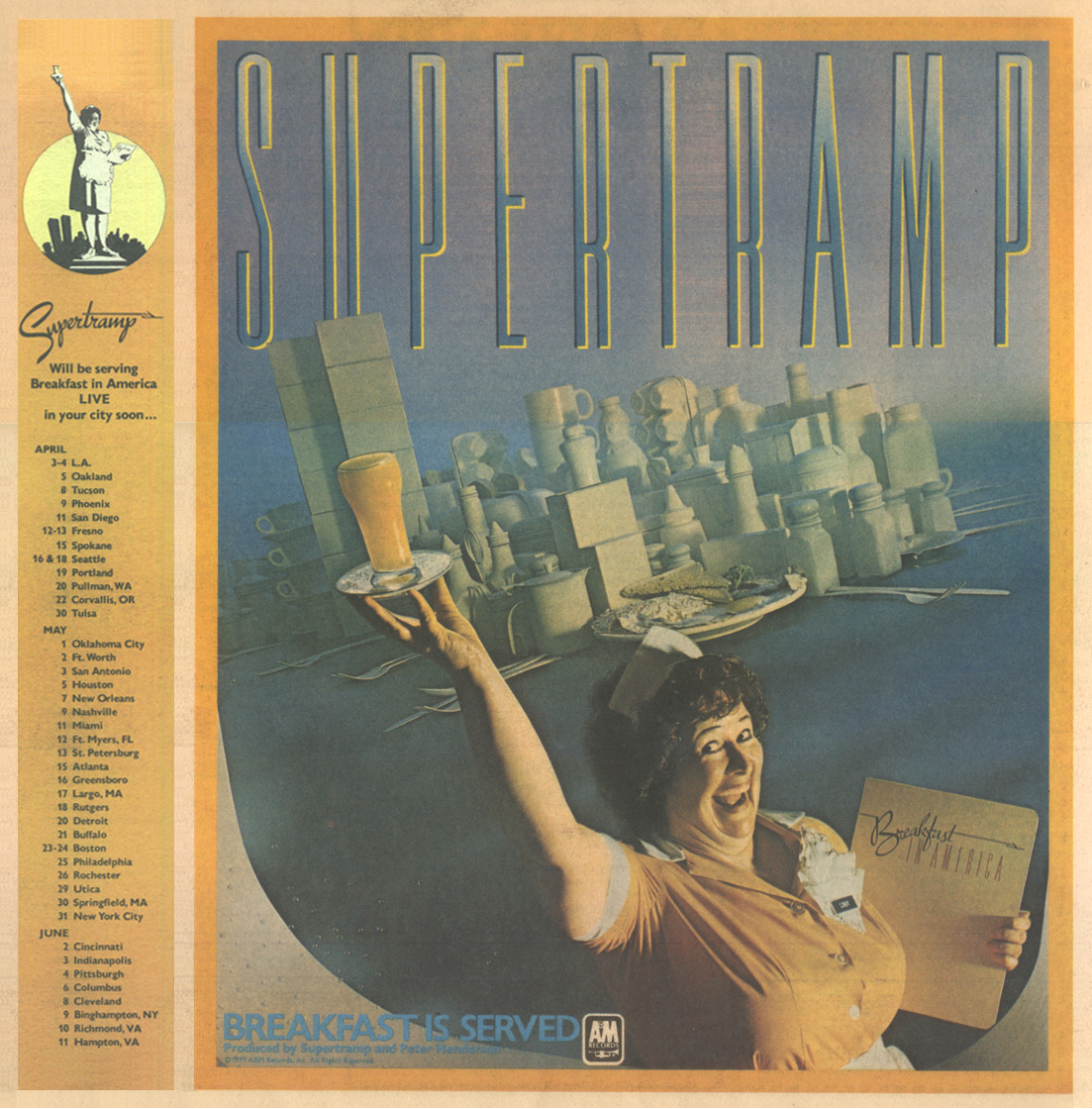 Click image for larger view. |
- Stephen Holden, Rolling Stone, 6-14-79.
Bonus Reviews!
This sophisticated English quintet graduated from a cult to a mass group with its last album, Even In The Quietest Moments, nearly two years ago. Its newest work again is centered around the layered keyboard wizardry of writers Rick Davies and Roger Hodgson and the woodwinds of John A. Helliwell. While the group rocks out, it is best on its introspective ballads and midtempo fare with poetic lyrics and lushly arranged orchestrations. The album's catchiest and most incisive track is "The Logical Song" that is ably augmented by other songs that dig deep into the human situation. Amazingly, the group produces a full sound without a lead guitarist. Bassist Dougie Thompson and drummer Bob Benberg round out the group. Best cuts: "The Logical Song," "Gone Hollywood," "Breakfast In America," "Child Of Vision."
- Billboard, 1979.
Somewhat histrionic, late-Seventies British pop that just about makes up in sonic exuberance what it lacks in musical/lyrical substance. Age hasn't been kind to even its most popular cuts, "The Logical Song," "Goodbye Stranger," and "Take the Long Way Home," but if you want to impress your friends and neighbors with the wonders of your CD stereo rig, the pure sound quality of this release is up to the task. The CD release, like the LP before it, sounds pretty damn good. B-
- Bill Shapiro, Rock & Roll Review: A Guide to Good Rock on CD, 1991.
With Breakfast in America, Supertramp had a genuine blockbuster hit, topping the charts for four weeks in the U.S. and selling millions of copies worldwide; by the 1990s the album had sold over 18 million units across the world. Although their previous records had some popular success, they never even hinted at the massive sales of Breakfast in America. Then again, Supertramp's earlier records weren't as pop-oriented as Breakfast. The majority of the album consisted of tightly-written, catchy, well-constructed pop songs, like the hits "The Logical Song," "Take the Long Way Home," and "Goodbye Stranger." Supertramp still had a tendency to indulge themselves occasionally, but Breakfast in America had very few weak moments. It was clearly their high-water mark. * * * *
- Stephen Thomas Erlewine, The All-Music Guide to Rock, 1995.
 Further reading on Super Seventies RockSite!: Album Review: |
- Gary Plochinski, Musichound Rock: The Essential Album Guide, 1996.
A multiplatinum, Grammy-winning guilty pleasure, this great sing-along album was chock-full of witty, charming urbane hits, like "Take the Long Way Home," "The Logical Song" and the title track, that propelled this super fun act to superstar status. But a vocal minority tramples on the Tramps, attesting that while it was staggeringly popular, fluffy writing with little or no meaning sounds pretty tired by now. * * * *
- Zagat Survey Music Guide - 1,000 Top Albums of All Time, 2003.
Supertramp's fourth album, Breakfast In America, did what earlier efforts had singularly -- or even collectively -- failed to do; it broke the band in the United States. Breakfast In America proved to be a huge hit both in the US and the UK; a Number One album on the US Hot 100 and a Number Three position in the UK. The album spawned four hit singles, ensuring that for a few months Supertramp were one of the most played acts on radio in both the US and the UK.
At a time when punk rock had already evolved into "new wave" pretty much on both sides of the Atlantic, Supertramp were to be found ploughing the same creative furrow they had been doing since their formation, namely produce rather overblown songs whose catchiness belied their musical complexity. Infectious, melodic pop songs such as "The Logical Song," "Goodbye Stranger" and "Take The Long Way Home" had mass appeal, something the band had been unable to capture with its earlier works, and all three singles made it into the US Top Twenty. "The Logical Song" reached Number Six.
The appropriately named album, which was recorded in Los Angeles' Village Recorder studio, also prompted the band to relocate to California.
As of 2004, Breakfast In America was the #50 best-selling album of the 70s.
- Hamish Champ, The 100 Best-Selling Albums of the 70s, 2004.
 Reader's Comments
No comments so far, be the first to comment.
 Buying Options





