|
Earth, Wind & Fire Columbia 10172 Jul. 1975 Billboard: #12  
Technical proficiency and a mastery of various styles may be impressive, but perfection tends to have its price. Sometimes virtuosity thrives at the expense of feel. E.W.F. scrubbed all the grit out of their brand of funk, making it unrecognizably clean to traditional fans of the genre. To paraphrase Ray Charles, real funky R&B is a matter of dirtying up a song with your own particular brand of stink. E.W.F. played an antiseptic type of funk that helped them bridge racial barriers more effectively than most others, while their avoidance of disco's most offensive trappings helped keep them in good graces with a widely diversified audience. E.W.F. fans ran the gamut from middle-aged, African-American housewives to seventeen-year-old, white metal-heads.
Earth, Wind & Fire was the extended vision of White, a percussionist and vocalist whose Memphis roots were definitely of this Earth. He attended high school with such future luminaries of the Memphis music scene as Booker T. Jones, David Porter, and Isaac Hayes. When his family moved to Chicago, it could have crushed his musical ambitions, but he adapted quickly and landed the enviable job of session drummer for Chess Records. While there, he obtained a musical education that all the money in the world could never have bought. Howlin' Wolf, Muddy Waters, Buddy Guy, Ramsey Lewis, and practically anyone else who passed through Chess's doors counted on White's impressive ability with drums. His reputation also led to session work at Motown (that's White playing drums on ("Heat Wave"). A stint as one-third of the Ramsey Lewis Trio led White to form his own group, albeit with significantly more members. Warner Brothers took an immediate interest, but after two albums was unable to capitalize on Earth, Wind & Fire's strange brew of funk for the Aquarian Age. Warner Brothers' loss was Columbia's gain when the band went on to become the first black group in the history of Columbia Records to reach #1 on the pop charts. "That's the Way of the World" was excerpted from a movie of the same name starring Harvey Keitel and featuring the band as a struggling version of themselves. The song caught Earth, Wind & Fire in a mellower mood than usual but contained all of the other essential ingredients that made up a typical E.W.F. single. With its gorgeous horn lines and well-sung melody, it further broadened the group's appeal and should have boosted the film's marketability. Intended to be an expose of the seedy practices employed by most record labels, the movie instead remained a first-class secret. Although most film critics recognized it, everybody else ignored it, and it disappeared rather quickly. To avoid any problems that might have arisen from their affiliation with a box-office disaster, White decided to name the group's upcoming album Shining Star. Postscript from the "Yer damned if you do, yer damned if you don't" department: when "Shining Star" became a #1 hit, the movie's producers had a revelation and rereleased the film, this time under the alternate title of Shining Star. Earth, Wind & Fire reversed the process with their next single, "That's the Way of the World," but it proved to be only partially as successful as its predecessor when it stalled at #12. - Thomas Ryan, American Hit Radio, Prima Entertainment, 1996.
No comments so far, be the first to comment.  |


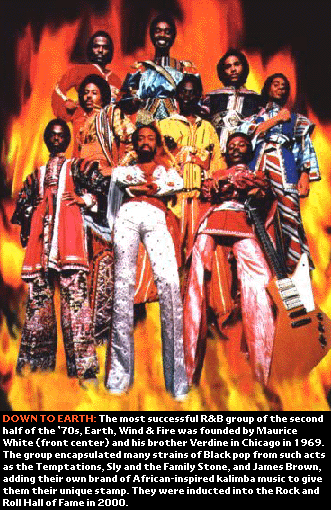
 o band was more representative of the ultraslick sheen that enveloped late '70s pop music than Earth, Wind & Fire. Perfectly synchronized horn charts layered with acute perfection over a brilliantly executed rhythm track was ordinary stuff for these guys. With Philip Bailey's keen falsetto drifting all around the disciplined arrangement, they were the sharpest outfit going. Most R&B from the mid-to-late '70s was heading straight for the disco dance floor, but Earth, Wind & Fire kept their options open by trying to appeal to everybody. Their incorporation of both jazz and rock-inflected rhythms broadened their appeal considerably beyond the traditional R&B market, though it was at the risk of alienating what they originally perceived to be their core audience.


 Reader's Comments

