
   |

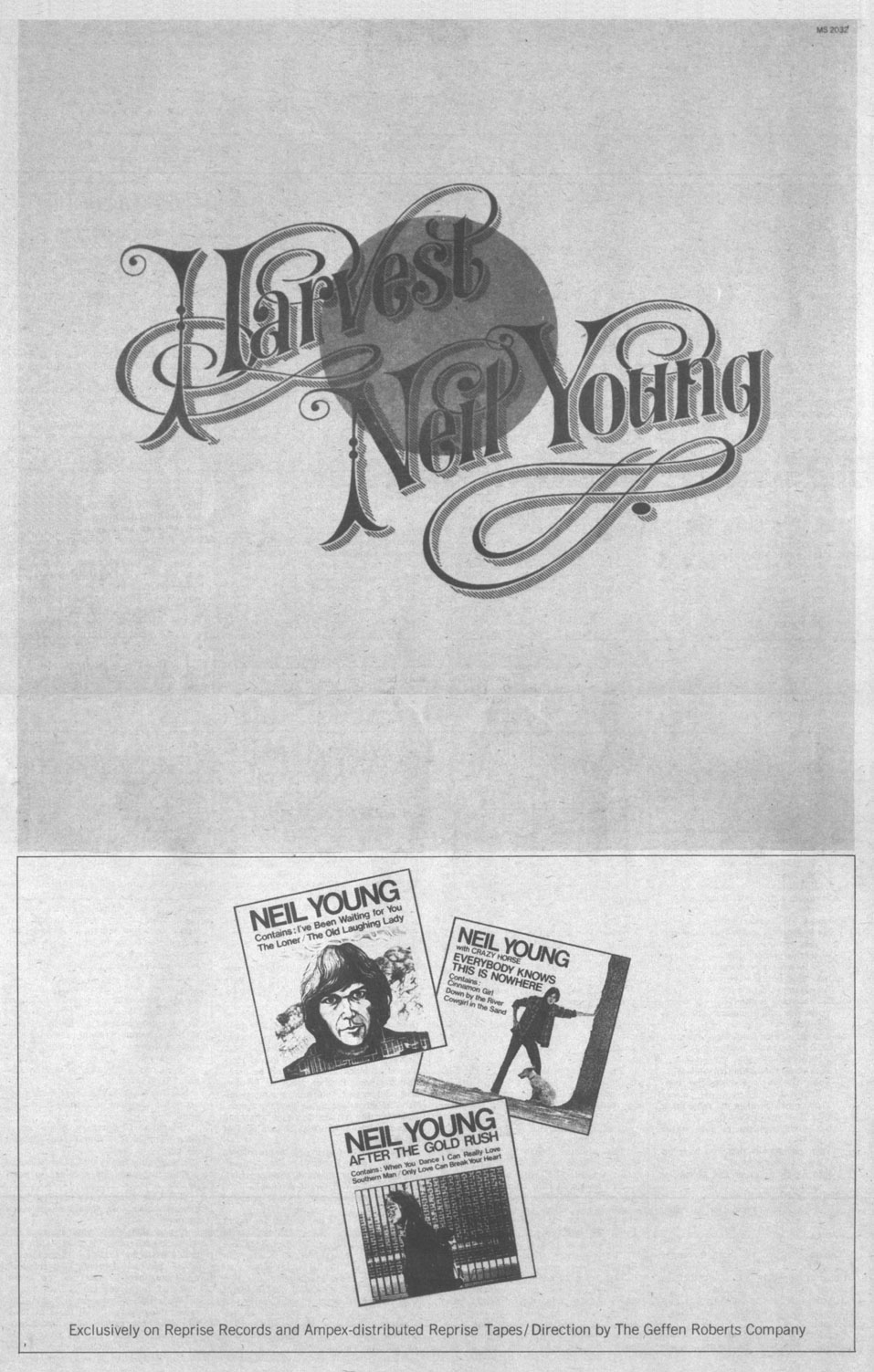
Harvest
Neil Young
Reprise 2032
Released: February 1972
Chart Peak: #1
Weeks Charted: 41
Certified Triple Platinum: 10/13/86
 Harvest, a painfully long year-plus in the making (or, seemingly more aptly, assembling), finds Neil Young invoking most of the L.A. variety of superstardom's weariest cliches in an attempt to obscure his inability to do a good imitation of his earlier self.
Witness, for example, the discomfortingly unmistakable resemblance of nearly every song on this album to an earlier Young composition -- it's as if he just added a steel guitar and new words to After the Gold Rush. Witness his use of said steel guitar to create a Western ambience worlds less distinctive than that conjured in earlier days by his own vibrato-drenched lead guitar.
Witness, in fact, that he's all but abdicated his position as an authorative rock-and-roller for the stereotypical laid-back country-comforted troubadour role, seldom playing electric guitar at all any more, and then with none of the spellbinding economy and spine-tingling emotiveness that characterized his playing with Crazy Horse. Indeed, his only extended solo on the album, in "Words," is fumbling and clumsy, even embarrassing.
Neil's Nashville backing band, the Stray Gators, pale miserably in comparison to the memory of Crazy Horse, of whose style they do a flaccid imitation on such tracks as "Out On The Weekend," "Harvest," and "Heart of Gold." Where the Crazies kept their accompaniment hypnotically simple with a specific effect in mind (to render most dramatic rhythmic accents during choruses and instrumental breaks), the Gators come across as only timid, restrained for restraint's sake, and ultimately monotonous.
 Click image for larger view. |
Here, with the music making little impression, the words stand or fall on their own, ultimately falling as a result of their extremely low incidence of inspiration and high incidence of rhyme-scheme-forced silliness. A couple are even slightly offensive -- "The Need And The Damage Done" is glib, even cute, and displays little real commitment to its subject, while "There's A World" is simply flatulent and portentous nonsense. Only "A Man Needs A Maid," in which Neil treats his favorite theme -- his inability to find and keep a lover -- in a novel and arrestingly brazen (in terms of our society's accelerating consciousness of women's rights) manner, is particularly interesting -- nearly everything else being limitlessly ponderable, but in a scant, oblique way that offers few rewards to the ponderer.
It might be noted (with remorse) that neither of the symphony-orchestrated tunes of Harvest even approaches "Expecting To Fly," from 1967, in terms of production or over-all emotional power. Would that the two unreleased movements of that earlier masterpiece, originally conceived as a trilogy, being given the grooves used for "Maid" and "There's A World." (Apologies if "The Emperor of Wyoming" or "String Quartet From Whiskey Boot Hill," from Neil Young, or "Broken Arrow" are in fact the missing two-thirds.
"Alabama" aspires to the identical effect of "Southern Man" but contains nothing nearly so powerful as that Gold Rush song's "I heard screamin' and bullwhips crackin'," followed by a vicious slash of Danny Whitten's rhythm guitar and a stinging lead line from Neil. "Old Man"'s first line promises a lot more than the song ever delivers in terms of compassionate perception. "Heart of Gold"'s basic conceit would be laughed off the airwaves coming from another solo troubadour. "Are You Ready For The Country," like "Cripple Creek Ferry," seems an in-joke throwaway intended for the amusement of certain of Neil's superstar pals. The title tune is lyrically cluttered and oblique, and "Out on the Weekend" is puerile, precious, and self-indulgent, not to mention musically insipid.
Which can't help but bring me down.
- John Mendelshon, Rolling Stone, 3-30-72.
Bonus Reviews!
In the late Sixties Neil Young took up the musical tools Tim Hardin had been using sporadically and finished creating the prototype of the latest -- and still current -- model of the folk-rock troubadour. If it appeared for a while there that others, notably James Taylor, might surpass Young with is own patent, it now turns out that such appearances were without foundation, being based merely on the noise made by a very young, very fickle audience. Neil's new solo album for Reprise clearly establishes who is king of the genre: Harvest is his best album since the first (simply Neil Young), and probably his best ever.
Style is almost Young's personal, unique possession. He simply has more of it than anyone else doing his particular kind of thing -- so much so that asking "Does he sing well?" is an irrelevant question. Does Picasso paint well? The songs of Harvest complement Young's style better than those on previous albums. Gone are the ultra-high-note excesses of After the Gold Rush; these new songs cover the upper middle range that his voice handles best. Melodically, as usual, he makes a definite promise to the listener in the first four bars (except for "Are You Ready for the Country," which borrows an old blues melody), and he keeps his promises -- such a relief after all those graduates of the fishing-expedition school of melody who whave plagued us so lately.
"A Man Needs a Maid" (backed by the London Symphony Orchestra, no less!), is probably the most subtly involved melody Young has written, and one of the best. Jack Nitzsche's sweeping voluptuous arrangement makes excellent use of the LSO in "Maid," but the organization sounds a bit stilted in its other appearance, in "There's a World." The songs "Heart of Gold," "Old Man," and "Harvest" are as good as some kid will soon be trying to tell you they are. But "Out on the Weekend" has the kind of lyric Young does best: pessimism, fractured images, and implications of things unsaid strewn everywhere. "Words"' words are a bit surreal, but Young's good at that too.
The backup band, an all-star studio assortment called the Stray Gators, attains a spacious country-rock sound that the next troubadour's backup band will copy, but isn't likely to beate. Ken Buttrey's crips drumming and Ben Keith's timely steel guitar have a lot to do with it, and so does the fine strumming of electric and acoustic guitars by Neil Young. If you think all these elements add up to one of the best albums of the year, you're probably right.
- Noel Coppage, Stereo Review, 6/72.
Well, Neil Young has finally graced us with a new album and, as was expected, it's a gem. It's been a year and a half since After The Gold Rush, and while Neil's compatriots, CS&N, have been turning out their own solo ventures, Neil Young, again, firmly established his unique musical genius. His haunting tenor, vividly coherent lyrics, seemingly simple music and superb instrumental and vocal support coalesce into a flowing pastiche of musical brilliance.
Young continues to write original and memorable tunes, many of which have an air of familiarity to them; that's due to his atypical distinctive style. As seen on "The Needle And The Damage Done," Young's lyrics are terse and full of lucid observations. The latter song is a strong anti-hard drug message, wrapped up in a lilting, melodic musical package. The production work, shared by Neil Young, Elliot Mazer, Jack Nitzsche and Henry Lewy, is impeccable. Some of the recording was done in Nashville, with backing provided by the Stray Gators (and top Nashville session men Ben Keith, Kenny Buttrey and Tim Drummond along with Mr. Nitzsche). Two of the tunes, "A Man Needs A Maid" and "There's A World," were recorded with the London Symphony Orchestra, and to the credit of Nitzsche, the orchestra is tastefully employed. As an added bonus, there is background and vocal harmonies from James Taylor, Linda Ronstadt, Stephen Stills, Graham Nash and David Crosby.
- Buffalo Evans, Words & Music, 6/72.
Harvest has been the most anxiously awaited album of the year and it is indeed an admirable showcase for the genius of Mr. Neil Young. His melodies are hypnotically insistent, framed in lyrics that have a strange drifting quality. He is joined by CS&N, James Taylor, Linda Ronstadt and backed by the Stray Gators. "Old Man," "Alabama," and "Out on the Weekend" seem instant successes. "Heart of Gold" is, of course, included.
- Billboard, 1972.
Like all his albums, Neil Young's Harvest is beautiful and difficult. Difficult because, while Neil's mournful songs are for the most part simple and affecting, they are often rich in poetic suggestion and melodic charm. This disc is more polished than After the Gold Rush, but it may not have quite the impact: Except for a few tunes, such as "Heart of Gold," the title song and "Old Man," there's a bit too much stress on gimmickry (two unfortunate cuts with the London Symphony Orchestra) and significance ("Words"). Crosby, Stills and Nash appear from time to time, as do James Taylor and Linda Ronstadt, so it's an all-star cast, including Young's fine band. Neil's artless minor-key musings have lost none of their quirky power.
- Playboy, 7/72.
For those who haven't gotten into Neil Young yet, this album will help you on your way. You've all heard "Heart of Gold," the single from Harvest, so you know how good it is but the album as whole is much better.
Neil has given us this album with a little help from his friends. Linda Ronstadt and James Taylor for example provide great backing vocals on "Heart of Gold." And for all of us who like the idea of having the next best thing to a CSN&Y album, Stills, Nash and Crosby are also on hand, not to mention the London Philharmonic for two superb tracks -- "A Man Needs A Maid" and "There's A World."
In my opinion the best songs on the album are the above mentioned, "Harvest," "Old Man," "Alabama," and "Words." Oh I forgot "Are You Ready" and "The Needle."
Is that the entire album? Coincidence? Not with Neil Young, it isn't. It's a habit.
- Tommy Nichols, Hit Parader, 9/72.
Anticipation and mindless instant acceptance made for critical overreaction when this came out, but it stands as proof that the genteel Young has his charms, just like the sloppy one. Rhythmically it's a little wooden, and Young is guilty of self-imitation on "Alabama" and pomposity on the unbearable London Symphony Orchestra opus "There's a World." But those two excepted, even the slightest songs here are gratifying musically, and two of them are major indeed -- "The Needle and the Damage Done" and the much-maligned (by feminists as well as those critics of the London Symphony Orchestra) "A Man Needs a Maid." B+
- Robert Christgau, Christgau's Record Guide, 1981.
Young's most popular and musically successful album after After the Goldrush turns up in fine form and is a significant sonic improvement over the LP.
In addition to the studio tracks, recorded with notables like James Taylor, Linda Ronstadt and members of the CSN&Y crew, there is a live track, "The Needle and the Damage Done," and two heavyweight orchestrated tracks recorded in London. The live recording, just Young and acoustic guitar, is superbly clean, though the applause cuts quickly and disturbingly into the next track.
Jack Nitzche's productions on the tracks recorded with the London Symphony Orchestra are powerfully conveyed with added weight and impact. Surprisingly, it is the studio tracks that sound a little dated, with a fatter, slower bass and a somewhat muffled and boxy quality.
- David Prakel, Rock 'n' Roll on Compact Disc, 1987.

- William Ruhlmann, The All-Music Guide to Rock, 1995.
Harvest is Neil Young's most popular album for good reason, though it's docked one star for the presence of two horribly overwrought orchestral numbers. The rest is pure gold. * * * *
- Alan Paul, Musichound Rock: The Essential Album Guide, 1996.
The solitary troubadour is at his most elegiac on his only No. 1 album, and it includes his only No. 1 hit, "Heart of Gold," as well as "The Needle and the Damage Done," one of the most poignant songs about drug addiction ever recorded. Along with David Crosby, Linda Ronstadt, Stephen Stills, James Taylor and the London Symphony Orchestra, Neil's haunting voice rocks this sublime collection of country-tinged rock that feels like a visit from an old friend every time you put it on. * * * * *
- Zagat Survey Music Guide - 1,000 Top Albums of All Time, 2003.
Harvest yielded Young's only Number One hit, "Heart of Gold," and helped set the stage for the Seventies soft-rock explosion -- both James Taylor and Linda Ronstadt sing on the album. Along with Young, they were in Nashville to appear on Johnny Cash's variety show the week that Harvest was cut with an odd group of accomplished session players that included bassist Tim Drummond, who had played with James Brown. The sound was Americana -- steel guitar, slide guitar, banjo -- stripped down and rebuilt with every jagged edge exposed. The standout tracks include "Old Man" and "The Needle and the Damage Done."
Harvest was chosen as the 78th greatest album of all time by the editors of Rolling Stone magazine in Dec. 2003.
- Rolling Stone, 12/11/03.
Coming two years after the demise of Crosby, Stills, Nash & Young, Harvest is possibly the guitarist's most popular solo work. Recorded, among other locations, at the Quadrafonic Sound Studio, Tennessee, the album topped both the US and UK charts on its release. Described as a melancholic work, Harvest's songs are riven with sadness and an air of uncertainty, whether they cover the quest for love and a relationship, as in "A Man Needs A Maid," or witnessing the death of so many friends in "Needle And The Damage Done." There is also something almost obscenely simple about the title track, with its tale of unrequited -- and unwanted -- love set against a lilting, see-sawing country rhythm and plaintive steel pedal guitar.
Two songs, "A Man Needs A Maid" and "There's A World," were recorded with the London Symphony Orchestra in the rather modest surroundings of Barking Town Hall, in London's East End. Young apparently recorded the album in a full-length back brace, and said of the album's prominent track, "Heart Of Gold" (which features James Taylor and Linda Ronstadt on backing vocals) that travelling that road "became a bore" and sent him heading "for the ditch."
Harvest was chose as the 78th greatest album of all time by the editors of Rolling Stone magazine in 2003.
As of 2004, Harvest was the #60 best-selling album of the 70s.
- Hamish Champ, The 100 Best-Selling Albums of the 70s, 2004.
An album that perfectly evoked both the dying optimism of San Francisco's counterculture movement and the burgeoning cynicism of the Watergate generation, Harvest stands as a commercial pinnacle of the West Coast country-rock scene, a U.S. and UK No. 1. Yet its relevance was almost pre-empted by both The Byrds and The Buffalo Springfield.
Harvest, though, undoubtedly augured Young's 1970s creative peak, utilising harmonies by Linda Ronstadt and James Taylor to strike commercial paydirt on the hit single "Heart Of Gold." The song's success would daunt Young for the next three decades, and he has purposely omitted it from live sets since. "This song put me in the middle of the road," he wrote. "Traveling there soon became a bore and I headed for the ditch."
That song aside, Harvest contains some of the most arresting imagery of Young's career to date, from the slow-burning scorn of "Alabama," an acerbic denunciation of corruption in America's Southern beltway, to the haunting and personal "The Needle And The Damage Done," and the touching if sentimental "Old Man," written as a homage to the caretaker of Young's ranch. Harvest often threatens to descend into country mawkishness, but ultimately shines with its creator's songwriting strengths.
Unsurprisingly, Young would soon retreat from the runaway success of this album. And the majority of his Seventies work would veer toward a more insidious realization of America via explorations in the realm of punk and the blues. Harvest, though, stands as the coming-of-age of the Baby Boomer generation.
- Burhan Wazir, 1001 Albums You Must Hear Before You Die, 2005.
High off the success of CSNY and After the Gold Rush, Young headed to Nashville, where he hunkered down with a collection of session musicians, including pedal steel player Ben Keith, he dubbed the Stray Gators to create a country-rock sound that would loom large over the soft-rock Seventies. The track list almost reads like a greatest-hits album, including his lone Number One single, "Heart of Gold"; the wistful title track; and beloved tunes like "Old Man" and "Out on the Weekend."
- Angie Martoccio, Rolling Stone, 1/20.
Harvest yielded Neil Young's only Number One hit, "Heart of Gold," and helped set the stage for the Seventies soft-rock explosion -- both James Taylor and Linda Ronstadt sing on the album. The sound is Americana -- steel guitar, slide guitar, banjo -- stripped down and rebuilt with every jagged edge exposed. The standout tracks include "Old Man" and "The Needle and the Damage Done."
Harvest was chosen as the 72nd greatest album of all time in a Rolling Stone magazine poll of artists, producers, critics and music industry figures in Oct. 2020.
- Rolling Stone, 10/20.
 Reader's Comments
No comments so far, be the first to comment.
 Buying Options





