|
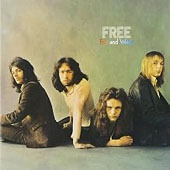
Free A&M 1206 October 1970 Billboard: #4    
The British blues institution Alexis Korner gave the guys the name "Free" and walked them into Island Records and a contract. The band's first two LP's -- Tons of Sobs (1968) and Free (1969) -- passed by both U.K. and U.S. audiences without much notice. Album three, Fire and Water (1970), contained something just too fine to be ignored by anyone, even by those who only listened to Top 40 radio. "All Right Now" had a pulsating, electric sound, packed with blues power and rock excitement. Rodgers was gritty, the riff was contagious, and Kossoff's guitar was hot. "There was a purity to what we were doing that was very special," Kirke explained. "We weren't that concerned with making hit records, and we weren't jaded by the industry -- we just wanted to keep everything as simple as possible." Highway (1971), their next LP, offered "Stealer" (#52, 1971) as a single. The boys would never make the stateside pop/rock 45 listings again, though British fans would later rechart the group name with takes on "My Brother Jake," "Little Bit of Love," and "Wishing Well." Free ran its course. Their label packaged a live set (Free Live, 1971). Rodgers went off and formed Peace; Kossoff formed Toby. Both efforts were short-lived. Kossoff then rejoined Kirke to record an instrumental LP with Tetsu Yamauchi and John "Rabbit" Bundrick called Kossoff Kirke Tetsu and Rabbit (1971). The original band members reunited for one explosive occasion and resulting album, Free at Last (1972). Fraser departed, then Rodgers dropped out. Rabbit and Tetsu functioned as replacements for the band's last effort, Heartbreaker (1973). Rodgers and Kirke formed Bad Company and carried on for another decade or more. Fraser joined the Sharks and later fronted his own Andy Fraser Group; Rabbit recorded with Pete Townsend and toured with the Who; Tetsu joined Rod Stewart's Faces. Paul Kossoff, possible the group's most talented individual and certainly one of rock's most distinctive guitarists, formed Back Street Crawler (later billed Crawler), but died on March 19, 1976, of a drug-induced heart attack on an airplane en route to New York City. In 1984, Rodgers with ex-Yardbird/Led Zeppelin guitar extraordinaire Jimmy Page and ex-Uriah Heep drummer Chris Slade formed The Firm, for two LPs. Then Rodgers and ex-Face/Who drummer Kenny Jones fored The Law. - Wayne Jancik, The Billboard Book of One-Hit Wonders, Billboard, 1998.  |


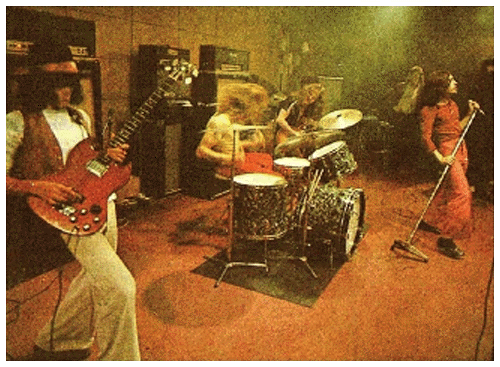
 uitarist Paul "Koss" Kossoff (b. Sept. 14, 1950, London) and drummer Simon Kirke (b. July 28, 1948, Shropshire, England) were unhappy playing in a band called Black Cat Bones. When they happened to catch a glimpse of lead singer Paul Rodgers (b. Dec. 14, 1949, Middlesborough, England) fronting Brown Sugar, they knew he would fit into a new band they were hoping to create. A mutual friend introduced the three to 15-year-old Andy Fraser (b. Aug. 7, 1952, London), then playing bass in John Mayall's Bluesbreakers. Andy was not keen on the jazzy direction that Mayall was moving toward, and agreed to drop by and jam with the other three.