
   |

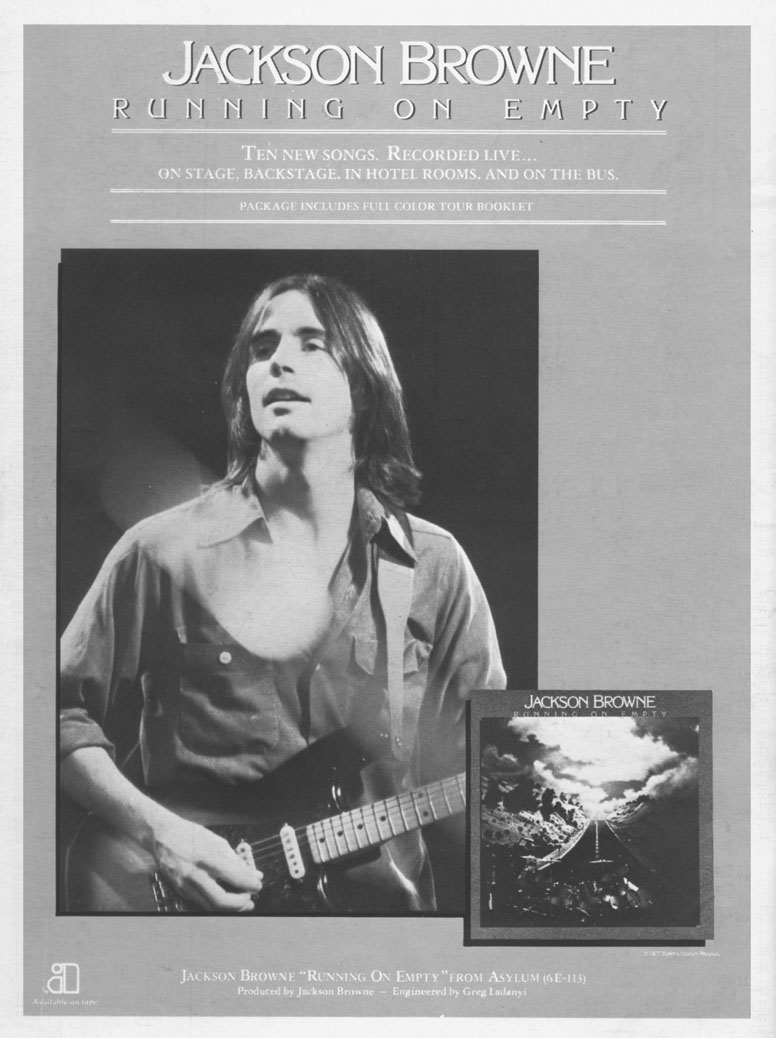
Running On Empty
Jackson Browne
Asylum 113
Released: December 1977
Chart Peak: #3
Weeks Charted: 65
Certified Platinum: 8/25/78
 As our finest practicing romantic, Jackson Browne has been stuck inside of Mobile with the Memphis blues again for so long that the road probably looks like a realistic way of life to him. Whether or not he knows it, he's been writing about highways and their alternate routes since his beginnings, so the subject matter of Running on Empty aren't all that different from those of his first four LPs. But the approach is. This time, Browne has consciously created a documentary, as brightly prosaic as it is darkly poetic, with a keen eye for the mundane as well as the magical. Running on Empty is a live album of new material about life on the road as conceived and recorded by a band of touring musicians in the places they spend most of their time (onstage, backstage, in hotel rooms, even on the bus). Since there are two separate concepts here, the audience gets an unprecedented double feature: ten songs they've never heard Browne sing, and a behind-the-scenes look at the "the show they didn't see." Ostensibly, the Gawain of rock & roll has scaled down his heroic obsessions, re-covered the Round Table with Formica and invited us in for a cup of truck-stop coffee, thus proving a point we knew all along: that small gestures can be just as meaningful and revealing as large ones.
Ironically, when Browne tries for specifics, he achieves both facts and universals. But his inclination to ease up makes sense here because he's really running two different, very dangerous races: one positively mythopoetic (the Road and its metaphorical implications), the other presumably maudlin (musicians on the road). The first can barley be done justice to within the confines of a pop record, while the second has rarely risen above its inherent cliches.
 Click image for larger view. |
- Sixty-nine I was twenty-one and I called the road my own
- I don't even know when that road turned onto the road I'm on....
- You know I don't even know what I'm hoping to find
- Running into the sun but I'm running behind.
- I don't even know when that road turned onto the road I'm on....
Best of all, there's a finale. "The Load-Out" is Jackson Browne's tribute to and summation of every aspect of live performance: the cheering audience out front, the band playing hard-nosed rock & roll, the backstage crew loading up the trucks -- and, always, the road to the next town. Packed to capacity with the data of first-rate reporting and with music so warm and soaring it belies the album's title, this song flows triumphantly into Maurice Williams and the Zodiacs' "Stay," where Browne tells us he doesn't ever want it to end.
What I really like about Running on Empty probably has little to do with the generosity or genius of its dual concepts, with the songwriter's craftmanship skill, with how much I admire the music of David Lindley and the Section, but rather with Jackson Browne himself. In other words, as impressed as I am with Jackson Browne's art, I'm even more impressed with the humanity that shines through it. Maybe they're inseparable, but I doubt it.
- Paul Nelson, Rolling Stone, 3-9-78.
Bonus Reviews!
On the face of it, nothing would seem less likely right now than a gritty, unsentimental, insightful revitalization of one of rock's most played-out themes -- the psychic travails of Life on the Road -- by a singer/songwriter whose previous recorded Laments have verged perilously (to echo "Doonesbury" creator Garry Trudeau) on mere Whines. But clearly Jackson Browne, heretofore recognized as the Mellow Sound's Premier Metaphysical Pretty Face, is toughening up his act, and Running on Empty, his latest album for Asylum, has both the real rocker's raw-edged sensibility and a film maker's unflinching reportorial eye.
The film reference is not gratuitous. "It's a rock-and-roll band or a movie, you can take your pick," Jackson sings toward the end of the album, and in fact the whole structure of the thing recalls cinema verité documentaries à la the Maysles Brothers. It was recorded live in a variety of settings, both in and out of concert halls, the apparent idea being to convey some sense of how a touring musician lives and how this life reflects upon the way he plays, to portray the alternately numbing ("Cocaine," complete with somewhat updated lyrics) and inspiring ("The Load-Out") effects of musical communication as a vocation. It's a concept fraught with the perils of mawkishness and self-pity, but it is brought off sensationally, even the potentially hokey stuff, as when an acoustic hotel-room version of Danny O'Keefe's "The Road" suddenly segues in mid-song into an on-stage, full-band electric performance, or when a long and lovely tribute to Jackson's audience metamorphoses into that most sublime of early r-&-b chestnuts, Maurice Williams' "Stay." Jackson's music has never been so startling; for the first time, there's real rock-and-roll bit to his performances. Truth to tell, his records have always had a superficial patina of "prettiness" that undercut what he seemed to want to get across. Here, however, his regular recording band works out with a vengeance, and the raw clutter adds a weight and an authority to his lyrics that the relative perfection of the sounds on his studio efforts never could.
In short, Running on Empty represents the work of an artist newly matured and unafraid to take risks, a breakthrough comparable to Neil Young's post-Harvest realization that the wonders of studio technology do not necessarily provide a path to Total Enlightenment. And, finally, it gives the most resonant and interesting answers to all the questions implicit in the Byrd's oversimplified "So You Wanna Be a Rock-and-Roll Star?" It's a marvelous, compelling piece of work that has converted this rather halfhearted admirer into a total, unabashed partisan. Phonorealism has never before sounded this good.
- Steve Simels, Stereo Review, 4/78.
Presented here are 10 new selections from this gifted singer/songwriter, all recorded live onstage, as well as in hotel rooms, from a recent cross-country tour. The material deals mainly with experiences of the brief road encounters, loneliness and roadies -- all done with Browne's evocative, haunting and penetrating insight. Music is a mix of soft rock ballads and pounding, uptempo tunes with the Section (Craig Doerge on keyboards, Danny Kortchmer on guitars, Russ Kunkel on drums, Leland Sklar on bass, as well as David Lindley on electric fiddle and lap steel) supporting Browne's piano. Best cuts: "Running On Empty," "The Road," "You Love The Thunder," "Love Needs A Heart," "The Load Out."
- Billboard, 1978.
Out of the studio -- this was recorded on tour -- Jackson sounds relaxed verbally, vocally, even instrumentally. He cuts his own meager melodies with nice ones by Danny O'Keefe and Danny Kortchmar. He does a funny and far from uncritical version of "Cocaine" and a loving and far from unfunny version of "Stay." I consider this his most attractive album. But his devotees may consider the self-effacement a deprivation. B+
 Further reading on Super Seventies RockSite!: Album Review: Album Review: Album Review: Jackson Browne: |
Audio verité -- one of the most conceptually fascinating recordings in the history of rock & roll. With Running On Empty, Browne attempted to capture the experience of a rock & roller's life on the road. To achieve the desired result, the selections (most of which were not written by Browne) were recorded both on and behind the stage, on the tour bus, and in motel rooms: the milieu of the rock tour. As must be expected with an undertaking of this type, there is variation in the quality of the recordings, but not as extreme as one might expect. The CD sound is full and open, consistent with the entire enterprise, even to the extent of providing background details inaudible in prior releases. A
- Bill Shapiro, Rock & Roll Review: A Guide to Good Rock on CD, 1991.
Having acknowledged a certain creative desperation on The Pretender, Jackson Browne lowered his sights (and raised his commercial appeal) considerably on Running On Empty, which was more a concept album about the road than an actual live album, even though its songs were sometimes recorded on stage (and sometimes on the bus or in the hotel). Although unlike most live albums, it consisted of previously unrecorded songs, Browne had less creative participation on this album than on any he ever made, solely composing only two songs, co-writing four others, and covering another four. And he had less to say -- the title song and leadoff track neatly cojoined his artistic and escapist themes. Figuratively and creatively, he was out of gas, but like "the pretender," still had to make a living. The songs covered all aspects of touring, from Danny O'Keefe's "The Road," which detailed romantic encounters, and "Rosie" (co-written by Browne and his manager Donald Miller), in which a soundman pays tribute to autoeroticism, to, well, "Cocaine," to the travails of being a roadie ("The Load-Out"). Audience noises, humorous asides, loose playing -- they were all part of a rough-around-the-edges musical evocation of the rock 'n' roll touring life. It was not what fans had come to expect from Browne, of course, but the disaffected were more than outnumbered by the newly converted. (It didn't hurt that "Running On Empty" and "The Load-Out"/"Stay" both became Top 40 hits.) As a result, Jackson Browne's least ambitious, but perhaps most accessible, album ironically became his biggest seller. But it is not characteristic of his other work: for many, it will be the only Browne album they will want to own, just as others will always regard it disdainfully as Jackson Browne Lite. * * *
- William Ruhlmann, The All-Music Guide to Rock, 1995.
An awesome on-the-road diary, this sensitive singer-songwriter's eclectic mix of quasi-live original tracks compiled in hotel rooms, on tour buses and onstage was a risky undertaking worth taking -- years later, classic '70s anthems like "The Load Out" and the title track assure you'll never run out of listening fuel. A terrific adventure, it captured the performer's life so well that it made a lasting contribution to the musical landscape. * * * *
- Zagat Survey Music Guide - 1,000 Top Albums of All Time, 2003.
Entering somewhat of a creative lull following some sterling albums -- his eponymous debut; For Everyman; Late For The Sky and The Pretender -- Running On Empty was regarded by many as lacking ambition but was nevertheless Browne's most commercially successful of his career to date, peaking at Number Three in the US and reaching Number 28 in the UK.
Browne had exhausted himself emotionally on previous records, laying his soul bare, and the album's title suggests he was indeed close to the edge, or perhaps even the end. Although many of the songs are recorded onstage or in hotel rooms while on the road, it is an album about being on the road, rather than a genuinely "live" performance album, with songs such as "The Road," "Cocaine" and "The Load Out/Stay" -- an homage to his road crew -- leaving relatively little to the imagination. Still, with two hits in the US in "The Load Out/Stay" and the title track it served him well. His heartfelt introspection is called upon on "Love Needs A Heart," an accessible lilting ballad very much in the Browne mould, while one of the album's highlights is the Daniel Kortchmar-penned "Shaky Town."
As of 2004, Running On Empty was the #23 best-selling album of the 70s.
- Hamish Champ, The 100 Best-Selling Albums of the 70s, 2004.
(2005 Deluxe Reissue) First Disc: The 1977 landmark -- recorded on the road, often in hotel rooms or on the bus -- that marked Browne's artistic peak and actually made you want to hear songs about rock stars' lives on tour. Bonus Disc: Worth owning if you want to click through over 200 photos taken during those shows (a backstage buffet! roadies skateboarding!) or crave a 5.1 DVD Audio remix. But useless if you're looking for extra songs. Only two have been dredged up (the redundant, mumble-mouthed "Cocaine Again" and the tumbleweeds instrumental "Edwardsville Room 124"), and neither is what you'd call high octane. Overall grade: C
- David Browne, Entertainment Weekly, 11/18/05.
 Reader's Comments
No comments so far, be the first to comment.
 Buying Options





