
   |

Tusk
Fleetwood Mac
Warner 3350
Released: October 1979
Chart Peak: #4
Weeks Charted: 37
Certified Double Platinum: 10/22/84


 At a cost of two years and well over a million dollars, Fleetwood Mac's Tusk represents both the last word in lavish California studio pop and a brave but tentative lurch forward by the one Seventies group that can claim a musical chemistry as mysteriously right -- though not as potent -- as the Beatles'. In its fits and starts and restless changes of pace, Tusk inevitably recalls the Beatles' "White Album" (1968), the quirky rock jigsaw puzzle that showed the Fab Four at their artiest and most indecisive.
Like "The White Album," Tusk is less a collection of finished songs than a mosaic of pop-rock fragments by individual performers. Tusk's twenty tunes -- nine by Lindsey Buckingham, six by Christine McVie, five by Stevie Nicks -- constitute a two-record "trip" that covers a lot of ground, from rock & roll basics to a shivery psychedelia reminiscent of the band's earlier Bare Trees and Future Games to the opulent extremes of folk-rock arcana given the full Hollywood treatment. "The White Album" was also a trip, but one that reflected the furious social banging around at the end of the Sixties. Tusk is much vaguer. Semiprogrammatic and nonliterary, it ushers out the Seventies with a long, melancholy high.
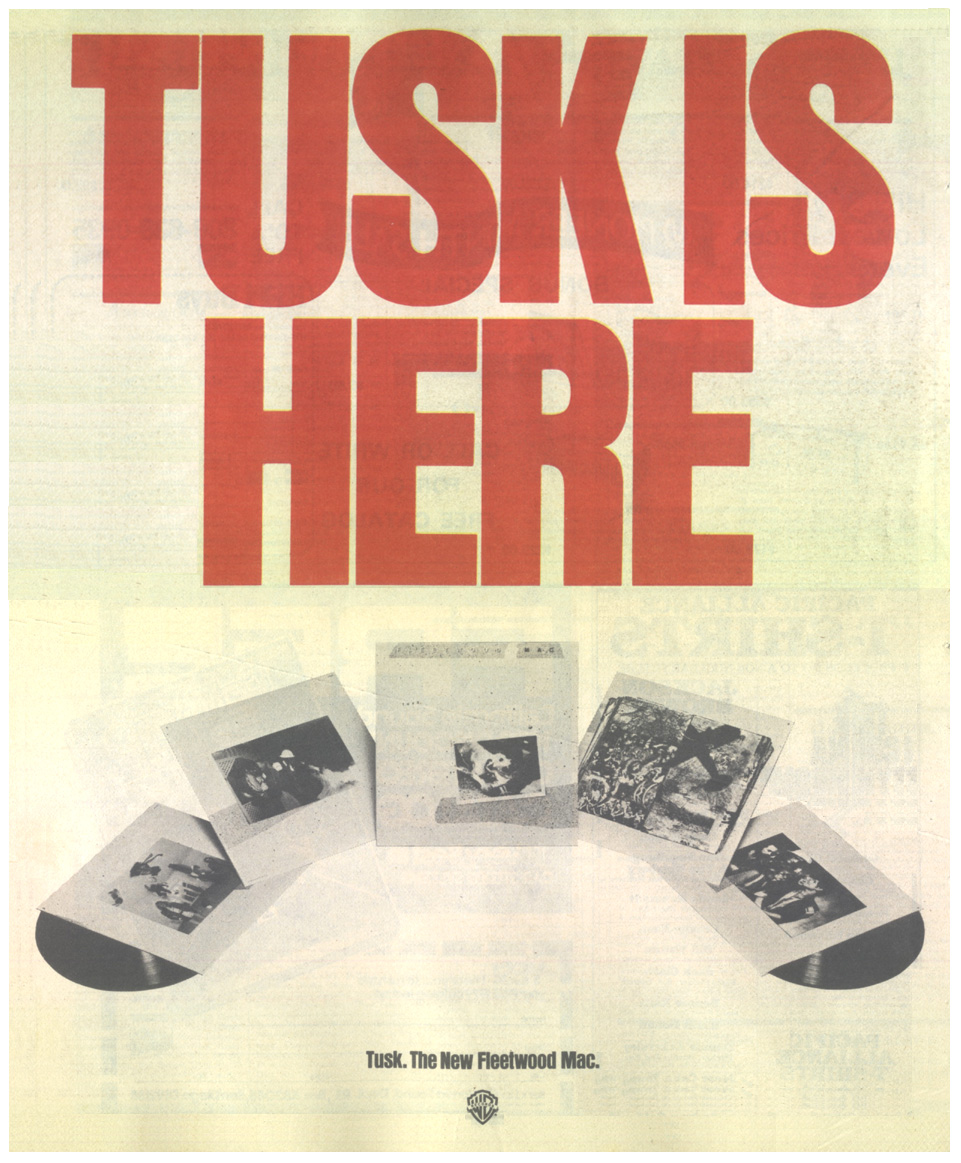 Click image for larger view. |
If Christine McVie and Stevie Nicks were the most memorable voices on Fleetwood Mac and Rumours, Lindsey Buckingham is Tusk's artistic linchpin. The special thanks to him on the back of the LP indicates that he was more involved with Tusk's production than any other group member. Buckingham's audacious addition of a gleeful and allusive slapstick rock & roll style -- practically the antithesis of Fleetwood Mac's Top Forty image -- holds this mosaic together, because it provides the crucial changes of pace without which Tusk would sound bland.
The basic style of Tusk's "produced" cuts is a luxuriant choral folk-rock -- as spacious as it is subtle -- whose misty swirls are organized around incredibly precise yet delicate rhythm tracks. Instead of using the standard pop embellishments (strings, synthesizers, horns, etc.), the bulk of the sweetening consists of hovering instrumentation and background vocals massively layered to approximate strings. This gorgeous, hushed, ethereal sound was introduced to pop with 10cc's "I'm Not in Love," and Fleetwood Mac first used in Rumours' "You Make Loving Fun." On Tusk, it's the band's signature. Buckingham's most commercial efforts -- the chiming folk ballads, "That's All for Everyone" and "Walk a Thine Line" -- deploy a choir in great dreamy waves. In McVie's "Brown Eyes," the blending of voices, guitars and keyboards into a plaintive "sha-la-la" bridge builds a mere scrap of a song into a magnificent castle in the air. "Brown Eyes" sounds as if it were invented for the production, rather than vice versa.
McVie is as dour and terse as Nicks is excitable and verbose. Her two best songs -- "Never Forget," a folk-style march, and "Never Make Me Cry," a mournful lullaby -- are lovely little gems of pure romantic ambiance. With a pure, dusky alto that's reminiscent of Sandy Denny, this woeful woman-child who's in perpetual pursuit of "daddy" evokes a timeless sadness.
Tusk finds Fleetwood Mac slightly tipsy from jet lag and fine wine, teetering about in the late-afternoon sun and making exquisite small talk. Surely, they must all be aware of the evanescence of the golden moment that this album has captured so majestically.
- Stephen Holden, Rolling Stone, 12-13-79.
Bonus Reviews!
The thesis that style is content (the medium is the message?) has shuttled between the front and back burners of our minds throughout the Seventies. Now here's the new Fleetwood Mac album, among other things (including, I notice, the way Francis Ford Coppola says he regards his Apocalypse Now), bringing it back to the front and turning up the head. Well, there are worse ways to start the Eighties.
Called Tusk and consisting of twenty new songs on two discs, this album is, first of all, an Event -- and we need no reminding by now, I hope, that style is everything to an Event. As this is written, a movie about the making of the album is being offered around to the television networks, and Warner Brothers is gearing up to spend perhaps more promotion money on this package than it has spent on any previous album. Which is to say that the style of this Event may be opulence, even overkill.
So Tusk couldn't possibly be a loser in the marketplace. Fleetwood Mac is one of the few bands still liked and respected by the Golden Age baby-boom audience; it is also going down great with these new, buttoned-down conservative alcohol guzzlers who have the nerve to call themselves kids nowadays; and, more important, it has a growing casual audience made up of people who have intelligence and taste, know what's going on, and like music but are not obsessive about it. And neither could Tusk be a loser critically. True, it couldn't be the kind of culmination Rumours was -- on the Treadmill of Life, there's only one place where you really reach your stride -- but there was no reason to believe that this band wasn't still near the height of its powers. Tusk suggests it is, not by doing very much that's new or innovative, or even making any further (further than Rumours, that is) definitive statement, but by presenting itself as a Fleetwood Mac Experience. Style -- their way of doing things -- is what's on parade here.
The experience starts with the packaging, an elaborate complex of sleeves and envelopes decorated with out-of-focus color and montages of black-and-white snapshots that, of course, show several tusks, on and off elephants. It doesn't remind you of pop art, exactly, but it does seem vaguely dated. It also complements the found-art quality of Lindsey Buckingham's songs inside. One of the main things gong on in the album turns out to be the way Buckingham puts a little harder edge on the band's overall sound with strange, cryptic snatches of songs he seemingly found lying around in the yard -- plus the drums, which Mick Fleetwood gets to band a lot louder when it's a Buckingham song.
Other parts of Tusk are more predictable. Christine McVie again discourses (mainly on the joys of sex) in that stately way of hers, and Steve Nicks, the other writer and singer, continues to practice her own more complex but instantly recognizable style behind the sultry nasality of her vocals. Each of the Fleetwood women writes a stylized song. One Stevie Nicks song (even "Storms," one of the simplest and nicest songs in Tusk) will inevitable remind you of one or two other Stevie Nicks songs in the way it rounds off phrases or segues into the bridge or does something. Christine's all seem to float some distance away and slightly above us. Christine never seems to be down here amongst us sweating masses the way Stevie is. That contrast, of course, is part of what makes Fleetwood Mac Fleetwood Mac.
Buckingham's songs (he wrote nine, McVie six, and Nicks five) are all cryptic, pursuing just a snatch of an idea both lyrically and musically. They're not about much of anything, beyond setting a mood; what they do is pick up the tempo, change the pace, liven things up. They're all interesting as little outbursts of sound or as contributors to a style. "Walk a Thin Line," the most melodic one, is faintly reminiscent of the Bee Gees and has a touch of grandiose Angst. Its sketchy lyric is about failing (for reasons unexplained) to get a little help -- or even response -- from one's friends. "Tusk" has the U.S.C. Trojans marching band in the background (they sound a good deal more sophisticated than the college bands I hear at halftime), African drums in Ping-pong stereo in the foreground, and voices singing cryptic lyrics in the middle. The refrain, "Don't blame me," crops up in two of Buckingham's songs. But that's content, and, as I was saying, content is not the thing.
The Fleetwood Mac Experience offered up in Tusk is not only comprehensive in showing off the band's style, but is what you might call expansive about it. Instrumentally, the group had already had a sound that was difficult to describe but easy to recognize. Here's that refined in the straight-ahead McVie song and the more earthy Nicks song (the instrumental subtlety and savvy reminded me more than once of Steelye Span), and it's stretched and distorted (though still recognizable) in Buckingham's little mood benders. In strictly "objective" (that is, comparative) critical terms, Tusk is not a great album -- it does not deal clearly with a sufficient number of ideas or feelings -- but it is a fascinating parade of sounds.
- Noel Coppage, Stereo Review, 1/80.
Fleetwood Mac's hotly anticipated followup to Rumours continues in the band's tradition of making precision soft rock music with an accent on beautiful melodies, fluid harmonies and superb vocal work. Given that this is a two-record set, the band injects a few tracks that deviate from the traditional Fleetwood sound such as in "Tusk," the album's initial single. Yet the majority of tracks boast the group's svelte, gently rocking sound that won't disappoint. In fact, there are a number of tunes that sound as if they were culled right off the Rumours LP. The band has always been a stickler for quality and the playing of Mick Fleetwood, drums; Lindsey Buckingham, guitar; John McVie, bass; Christine McVie, keyboards; and Stevie Nicks is first-rate all the way. Nicks, Buckingham and Christine McVie penned all 20 songs which cover a broad base of styles. Best cuts: "Storms," "The Ledge," "Brown Eyes," "Never Make Me Cry," "Walk A Thin Line," "That's All For Everyone," "Sisters Of The Moon," "Tusk," "Over & Over."
- Billboard, 1979.
A million bucks is what I call obsessive production, but for once it means something. This is like reggae, or Eno -- not only don't Lindsey Buckingham's swelling edges and dynamic separations get in the way of the music, they're inextricable from the music, or maybe they are the music. The passionate dissociation of the mix is entirely appropriate to an ensemble in which the three principals have all but disappeared (vocally) from each other's work. But only Buckingham is attuned enough to get exciting music out of a sound so spare and subtle it reveals the limits of Christine McVie's simplicity and shows Stevie Nicks up for the mooncalf she's always been. Also, it doesn't make for very good background noise. B+
- Robert Christgau, Christgau's Record Guide, 1981.
In some ways more impressive than Rumours, this two-record set (compressed onto one CD by editing "Sara," one of its hits!) is an ambitious effort full of unusual arrangements and striking instrumental passages, plus a wealth of topflight songwriting. * * * *
- William Ruhlmann, The All-Music Guide to Rock, 1995.
Tusk is more an eccentric masterpiece than a pop masterpiece, with Lindsey Buckingham running wild and reinventing lo-fi on his pieces while Stevie Nicks ("Sara") and Christine McVie ("Think About Me") keep the group in the mainstream. * * * *
- Steve Holtje, Musichound Rock: The Essential Album Guide, 1996.
Fleetwood Mac were bound to fall from the heights reached on 1977's Rumours, which spent a staggering 31 weeks on the top of the charts. But few have "fallen" in such an epic fashion as the Mac did with Tusk.
Recorded over a ten-month period, the sprawling two-disc set reached new heights of studio excess and ran up a then-unprecedented one-million-dollar tab. However, the money seems well spent -- including whatever it cost to rent out Dodger Stadium and hire the USC marching band to record the title track.
Borrowing equally from both Brians (Eno and Wilson), the album is a dreamy collage that utilizes every bell and whistle then known to man. Lindsey Buckingham, who assumed control of the band with Rumours, stays at the forefront here and creates his own sparkling version of Pet Sounds.
Rumours boils with tension, stemming mainly from Buckingham's failed relationship with Stevie Nicks, but level-headed professionalism reigns on Tusk. It is an older, wiser band that brings a sense of steely detachment, and even acceptance, to poignant tracks like "Angel" and "Save Me A Place." Nicks' breathy alto has never sounded better than on "Sara" and Christine McVie is absolutely haunting on the country-tinged folk rock of "Over & Over."
Tusk could not match Rumours in sales, but it did go platinum four months after its release. It was not the expected follow-up, but what else would you expect from the band that told us to "Go Your Own Way"?
- Jim Harrington, 1001 Albums You Must Hear Before You Die, 2005.
 Reader's Comments
No comments so far, be the first to comment.
 Buying Options





