
   |

Goodbye Yellow Brick Road
Elton John
MCA 10003
Released: October 1973
Chart Peak: #1
Weeks Charted: 91
Certified Gold: 10/12/73
 These boys -- singer/piano player Elton John, librettist Bernie Taupin and producer Gus Dudgeon -- sure do relish their fantasy. One evening last summer I found myself in a screening room in Los Angeles with all of the above, plus the guitarist, the bass player and the rest of the white-suited English retinue that follows Elton around. The occasion was a command performance of American Graffiti, George Lucas' dream-sequence film of a night of teenage life in a California town in 1962. From the first scene on, watching the film was almost as much fun as the film itself; their jaws collectively dropped in astonishment, as if they were invited guests to a surprise glimpse of their own mythology. The Americans were hushed and hissed down as they commented on the action. These boys didn't want to miss a line. In a way it was touching.
Goodbye Yellow Brick Road is a massive double-record exposition of unabashed fantasy, myth, wet dreams and cornball acts, an overproduced array of musical portraits of hard rock & roll that always threatens to founder, too fat to float, artistically doomed by pretension but redeemed commercially by the presence of a couple of brilliant tracks out of a possible 18.
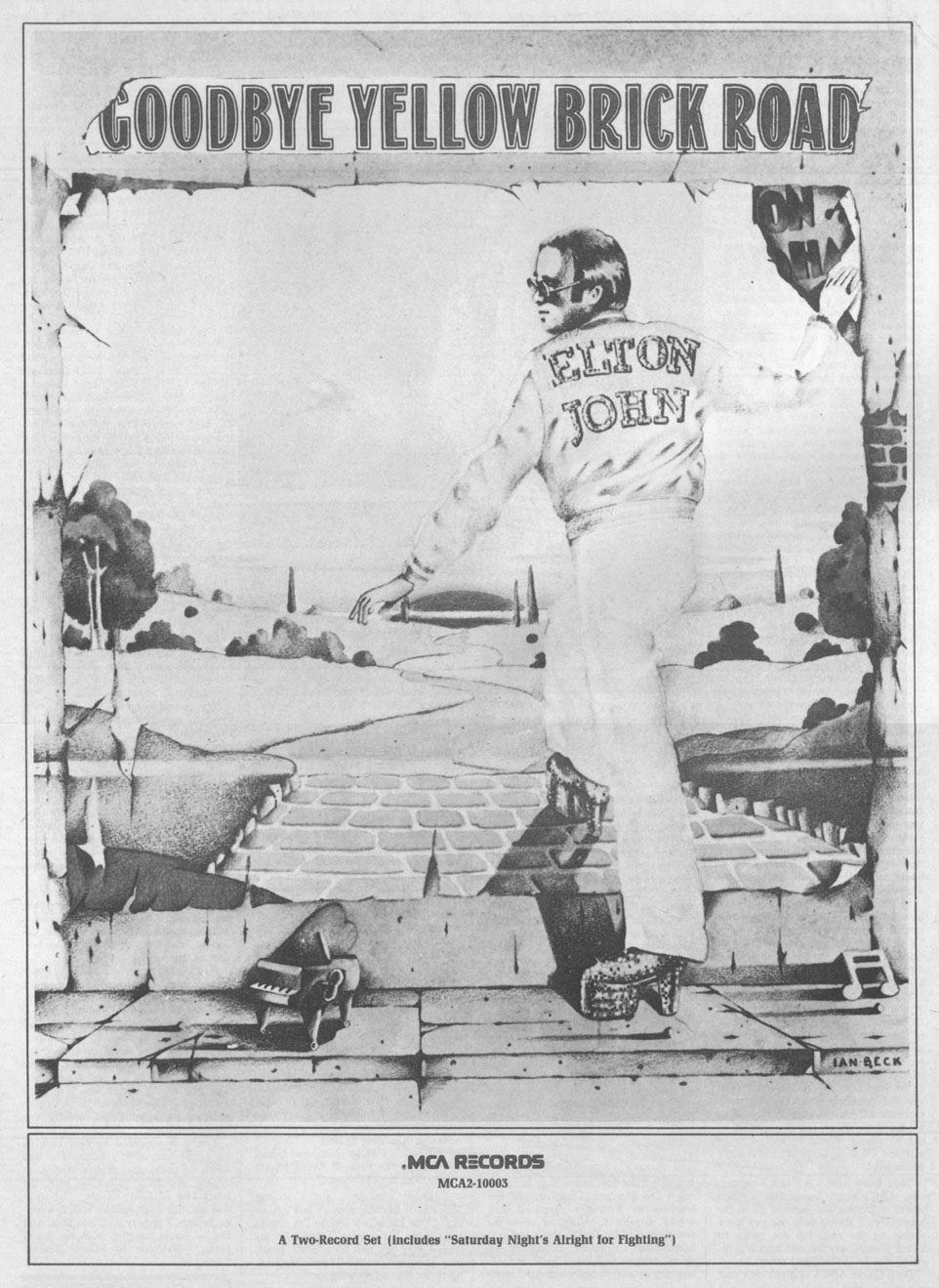 Click image for larger view. |
This new record is a big fruity pie that simply doesn't bake. But, oh lord, how it tries. Elton plays in front of a thoroughly professional and creative instrumental group. Guitarist Davey Johnstone was a rare find when he joined the band a while ago: The guitar lines of the omnipresent AM hit "Saturday Night's Alright for Fighting" ably testify to his power. Producer Dudgeon alternates tasteful and tricky ideas with lank orchestrations that owe more to Richard Perry and Mantovani than to music per se. By and large I can appreciate Bernie's lyrics, though the hatred of women that pervades this cycle of songs is awesome in its rancor -- check the words to "Dirty Little Girl," that make the fabled Jagger-Richard demimonde sweethearts seem more like Karen Carpenter.
The format of Goodbye Yellow Brick Road is straight ultramodern British music hall revue, numerous and largely unconnected musical tableaux accompanied by plenty of rock synthesized flash and the inspection of the inner feelings of several different versions of the Elton John persona.
So there's an eight-minute instrumental prologue featuring grandiose and tasteless typhoon whooshings, booming ecclesiastic organ, some stinging guitar that would be monumental if properly backlit but seems out of context against a lot of bleating. That segues into "Love Lies Bleeding," a rocker with a soaring, handsome chorus. "Candle in the Wind" is the first heavy lyrical fantasy; the tune is prettily solemn and unbelievably corny, a necrophiliac erection for Marilyn Monroe, despite the disclaimer: "Goodbye Norma Jean/From the young man in the 22nd row/Who sees you as something more than sexual/More than just our Marilyn Monroe." Oh, bullshit.
I like the end of the side, "Bennie and the Jets," a wimpy Sgt. Pepperish number (even to the point of dubbed audience noise) about a mythical rock & roll band. Elton's vocal is properly dramatic and funny too. The title tune that starts side two is real wimpy too, dedicated to some poor showbiz shlubbo who the boys say they're not going to have anything to do with in the future.
"This Song Has No Title": and rightly so too; it stinks, from its lyrics that sound like Robert W. Service on Stelazine to the tune that comes over like on of Tom Paxton's fainting spells. "Jamaica Jerk Off" is a dreadful sendup of ethnic reggae that does boast a good chorus. But get back, honky cat. You're good, but on your best day you'd be blown off the stage by Bob Marley and the Wailers, without their amps. So, smile when you sing them songs.
"Grey Seal" is a fine fast number, episodic and brilliantly-produced, one of the few large-production numbers here that succeeds all the way through. "I've Seen That Movie Too" is an excellent if terribly bitter tune. This and "Candle in the Wind" are the slow strengths of this set.
"Movie" is the first of five portraits of women that are almost misanthropic in their anger. "Sweet Painted Lady" is a sudsy music hall song dealing with that most hackneyed of images, the whore with the heart of gold, "getting paid for being laid." Elton and Taupin have an enormous repository of nerve just to record this; amazingly they get away with it.
"All the Girls Love Alice": The boys find themselves in Stones territory, writing about a rich 16-year-old Sapphic who dies young. It's hard rock with a tender bridge, and stands with the stunning "Saturday Night" as the best things to be heard here. (I've been trying to figure if "Saturday Night" was written before or after the boys saw Graffiti.) The fourth side runs downhill: "Roy Rogers" deals with middle-class drudgery -- and misses its mark, the size of the barn door, though Elton's singing is great. "Social Disease" is just another song about being drunk. "Harmony" ends the album on an ambiguous note, nothing special.
What are we going to do with Elton John? He can sing, play, emote and lead a band, but he can't get organized. This would have made a lovely, if slightly brittle, single LP. But the best tunes are obscured by drivel and peculiarly bad feelings. Not all fantasies are so rosy. Ugly ones mar a nice guy's record.
- Stephen Davis, Rolling Stone, 11/22/73.
Elton John's part in this is just dandy, up to a point. The music he wrote for Bernie Taupin's lyrics is much better than they deserve, and Elton's vocals -- on all but a few lost causes -- are that forceful yet delicate nature that first made him attractive. He really can lay the phrasing on you, when he applies himself. But he is ultimately responsible for the lyrics, too -- it is his album and he could have sent Taupin back to the drawing board or, better still, out on a snipe hunt with Lou Reed and Harry Chapin; the lyrics, by and large, are a mess. Taupin ranges far and wide, but always on what he considers the "other" side of the tracks, romanticizing your moderately seamy crowd the way Harry romanticizes the more spectacularly grotesque idiot among us. Bernie takes us into the mind of a tired sort of man who does his living vicariously, via Roy Rogers movies on the telly -- and, as Taupin reports it, there's nothing particularly interesting on that person's mind. He also takes us into bed with a prostitute, where, Taupin profoundly observes, "There's a place in the world for a woman like you." And so on. We could probably settle once and for all who is the most "unorthodox" bubblegum lyricist by having a tennis match between Bernie Taupin and Harry Chapin, with Lou Reed taking Howard Cosell's part. Or maybe not.
Anyway, Elton makes the most of it. "Candle in the Wind" is another of those dopey salutes to Marilyn Monroe as a "real" but tragically misunderstood person, as trite and benign as Taupin's thoughts on foreign aid probably would be, but EJ has giving it such a nice melody and sings it with such emotional credibility that the words actually do begin to mean something. Something similar could be said for the scoring and performance of the title song.The hit, "Saturday Night's Alright for Fighting," leads a small battery of dead cells in which Elton slugs it out with his Fifties rock fixation, and I wish he'd hurry and get that out of his system. "Saturday Night" has its beat screwed up somehow, but straightening that out obviously wasn't necessary for commerce and would be laughable if undertaken for art. The arrangements, when they aren't thick and murky, are simply overblown; when there isn't something else interfering between you and the music, Nigel Olsson contrives to bang the damned cymbals. There are places where an overlay of sheer noise seems to have been dropped on the basic arrangement just for the hell of it. There are a few places, though, where Elton makes sure his piano and vocals are clearly heard, and both are striking in their subtlety, their stylish economy. Once such place is "I've Seen That Movie, Too." The album has some good music on it, enough perhaps for a fairly decent one-disc album. It is, of course, a two-disc album.
- Noel Coppage, Stereo Review, 3/74.
A superb set from the British artist who has not missed yet. As always, Elton John's keyboard playing is superb, and his vocals range from the raucous rock he has often been associated with to extremely pretty ballad material. LP seems fuller in many ways than some previous efforts, with strong guitar work from Davey Johnstone and excellent background vocals from the entire group. John seems able to sing almost any type of material, from rock to county to Jamaican-flavored tunes, and this double set exposes this even more. As usual, fine words from Bernie Taupin. Best cuts: "Goodbye Yellow Brick Road," "Grey Seal," "I've Seen That Movie Too," "The Ballad Of Danny Bailey (1909-34)," "Dirty Little Girl."
- Billboard, 1973.
After many fumbles and a great many more near-misses, Elton John is back and stronger than he's been on record in many a blue moon. This lush two record set moves from mood to mood with no apparent effort and a great sense of timing, class and style.
I've never been one of the people who found "Rocket Man" (a "Space Oddity" rip-off no matter what anybody says) or "Daniel" as fulfilling as "Your Song," "I Need You To Turn To" or "Border Song." So, as the years passed and the man became more and more flamboyant, I kept thinking his music was really suffering from all this adulation. But Elton finally has met his original potential and whether he's singing the delicate and beautiful "Goodbye Yellow Brick Road" or rocking out to "Your Sister Can't Twist (But She can Rock n' Roll)" he always hits the mark rather than scoring a near miss. Bernie Taupin is pursuing the many facets of a dying Hollywood, much in the style Ray Davies did on the Kinks' Everybody's In Showbiz epic, and in many songs, especially "Roy Rogers," he's sentimental and sensitive without ever slipping into that dangerous songwriter's trap of banality. "You draw to the curtains/And one thing's for certain/You're cozy in your little room/The carpet's all paid for/God bless the T.V./Let's go shoot a hole in the moon," Elton sings. When you are not forced to look at Mr. John's ridiculous get-ups it's easy to believe in him once more.
"Harmony" is a change of pace number. Haunting and subtle it has great mid-sixties three-part harmony (natch) with backup vocals compliments of Davey Johnstone and Nigel Olsson. The song sounds as if it might have been recorded for the first or second Bee Gee's LP, way back when they were a great band. "Harmony" may never be a single but it's a star track and a perfect end for a near perfect album.
- Janis Schacht, Circus, 1/74.
Elton John bridges the gap between rock bands and solo acts. He could have gone in either direction but instead chose to go in both at the same time, throwing his version of contemporary vaudeville in for good measure. He has already out-distanced his most pretentious pretender to the throne, David Bowie, as the best of Britain's self-conscious pop stars. He often makes up in breadth what he lacks in depth, touching on many things with sophistication, but rarely getting to the bottom of any one of them. His voice is too limited to do justice to the variety of his material and he often unintentionally levels the differences between songs when he means to explore them. Nonetheless, taken a side at a time, the four-sided Goodbye Yellow Brick Road is thoroughly enjoyable, the rockers moving out with more gusto than those of many bands that work exclusively in that genre, the ballads exploring his and lyricist Bernie Taupin's romanticism without apology. The production (by Gus Dudgeon) and arrangement (by Del Newman) touches are almost always interesting and often engagingly excessive. In fact, no matter how far afield he wanders, I always know Elton John is a rocker because he's so damn brazen.
- John Landau, Rolling Stone, 6/6/74.
Two LPs ago, Bernie Taupin passed on his way from obscure banality to clean, well-lighted banality to write a batch of imaginative lyrics, and set to those lyrics John's music sounded eclectic but not confused. Too often now it seems to chatter on anonymously. The title cut is good, "Bennie and The Jets" is great, side four is good-to-great, and a few other songs here would probably benefit from more exclusive company, but this is one more double album that would make a nifty single. B
- Robert Christgau, Christgau's Record Guide, 1981.
The first flush of EJ's stage flamboyance coincided with his indisputably greatest recording: the Goodbye Yellow Brick Road double album. Only minutes longer than can be accommodated on a single CD, Yellow Brick Road suffers the penalty of the added cost of the double CD format.
While other rock stars cut rambling incoherent album tracks out of self-indulgence, Elton opened this 1973 stunner with the classic 11-minute "Funeral for a Friend" in which he musters and commands every last musical talent and trick. By the time the John/Taupin second track testament to Marilyn Monroe "Candle in the Wind" the listener is already punch drunk. It is these rock ballads that haunt the memory, leaving the rock'n'roll singles hits from this album, "Bennie and the Jets" and "Saturday Night's Alright for Fighting," in the shade.
The Strawberry Studios (France) recording was well ahead of its time and has come up revealed in new light on Compact Disc. Some bass boom is apparent while tracks like "Sweet Painted Lady," already larger than life, have real rip-it-up impact. The pseudo-reggae track "Jamaica Jerk-Off" swings and pounds.
Certain tracks from this album have appeared in remixed form (by producer Gus Dudgeon) on the Superior Sound of... Though individual instrumental lines may be clearer, the overall balance on the remixes favours the beat of bass at the expense of vocals and air.
- David Prakel, Rock 'n' Roll on Compact Disc, 1987.
Edited down to one disc, this would easily be John's recorded pinnacle. Goodbye Yellow Brick Road somehow managed to blend Taupin's lyrical fantasy and Elton's grandiose musical melanges into something greater than the sum of their parts -- the romantic spirit of Seventies pop captured in all its excessive, multicolored glory. The title song, the opening instrumental, "Funeral for a Friend," followed by the vocal "Love Lies Bleeding," and "Candle in the Wind" are the highlights, with the remainder made up of some strong material, as well as some pretty forgettable exercises. The sound of the MCA 2-CD set is a great enhancement over the LP, clear, detailed and dynamic with spatial quality, albeit with a slight tendency to overbrightness. A-
- Bill Shapiro, Rock & Roll Review: A Guide to Good Rock on CD, 1991.
Almost certainly Elton John's biggest seller, save his first greatest hits collection. The hits on this sprawling double-disc set include "Saturday Night's Alright for Fighting," the title track, and "Bennie and the Jets," and the album tracks include "Love Lies Bleeding" and "Candle in the Wind" (which became a hit 15 years later in a live version). * * * *
- William Ruhlmann, The All-Music Guide to Rock, 1995.
The true marvel of Goodbye Yellow Brick Road is that despite a plethora of hits (the title track, "Saturday Night's Alright for Fighting," "Candle in the Wind"), it still functions as an ambitious and coherent double-length album. * * * *
- Simon Glickman, Musichound Rock: The Essential Album Guide, 1996.
In the wake of similarly lengthy excursions by The Beatles and The Rolling Stones, it was deemed necessary for the serious early 70s' artist to produce a double album. Elton John began recording Goodbye Yellow Brick Road in the Chateau d'Hierouville, and attempted to finish it in Jamaica. Too frightened to leave his hotel room (things were volatile...) and holed up in his hotel room with a batch of Bernie Taupin's lyrics, Elton wrote twenty-one songs in three days. Eventually returning to the Chateau (via an equally unsatisfactory spell in New York), he surged through the recordings. No central theme held the songs together, the extraordinary "Saturday Night's Alright For Fighting" (about Bernie Taupin's raucous teenage days) contrasted neatly with "Funeral For a Friend," with its Wagnerian instrumentation. The bouncy "Bennie And The Jets" was a cartoon-like tale of a female sci-fi rock band, while the title track, rather obviously, plundered the magical theme of The Wizard of Oz. Again in sharp contrast, "All The Girls Love Alice" proved to be a ballad of a teenage lesbian. The album's finest moment, "Candle In The Wind," took its title from a newspaper cutting that was about the death of Janis Joplin, but the sentiment was for Marilyn Monroe. Twenty-four years later, of course, it would be rewritten for another tragic blonde.
- Collins Gem Classic Albums, 1999.
Epic is the word to describe this flamboyant tour de force that demonstrates the ease with which John and Taupin could write not only the hit singles, but the outstanding album tracks. Originally a double disc (we listened till the grooves wore down -- remember vinyl?), the stunning song cycle with no filler feels like a mini-movie. It's Elton's "White Album," his commercial and creative apex, and it sure showed what a piano could do to rock music. * * * * *
- Zagat Survey Music Guide - 1,000 Top Albums of All Time, 2003.

Goodbye Yellow Brick Road was chosen as the 91st greatest album of all time by the editors of Rolling Stone magazine in Dec. 2003.
- Rolling Stone, 12/11/03.
Back in the vinyl era, when careers were long and LPs were short, a double album such as 1973's Goodbye Yellow Brick Road signified a Big Statement. The resonance of Elton John's four-sider was less thematic -- it was hardly a concept album -- than visceral, as the flamboyant pianoman and his ace Road crew fashioned John's melodies into a jampacked parade of snazzy hooks and riffs.
On a new, SACD-hybrid reissue, the album's myriad delights -- from the electrifying "Funeral for a Friend/Love Lies Bleeding" to the blistering boys'-night-out "Saturday Night's Alright for Fighting" -- come across with spine-tingling immediacy. The seventeen tracks are spread between two discs, with B sides and an acoustic "reduction" of "Candle in the Wind" tagging the second. While the value of the bonus tracks is minimal, the original LP seems even more monumental thirty years on. * * * * *
- Bud Scoppa, Rolling Stone, 1/22/04.
Originally intended as a single album, by the time Elton John had finished recording tracks for what was to become Goodbye Yellow Brick Road at Chateau D'Hierouville just outside Paris it was clear -- to him at any rate -- that only a double LP would suffice. Yet initially he was concerned that his fans would balk at having to pay more than they were used to in order to hear his music. He needn't have worried; the album topped both US and UK charts and saw four singles taken from it which all hit the upper reaches of both countries' charts too, including a Number One in the US with "Benny And The Jets."
The Parisian studio, where John had also recorded Honky Chateau and Don't Shoot Me, I'm Only The Piano Player, was used only after efforts to get the album completed in Jamaica failed. The sessions were completed inside three weeks. Not only is Goodbye Yellow Brick Road regarded as one of John's finest works with other instant classics such as "Candle In The Wind," "Saturday Night's Alright For Fighting" and the title song, but it proved to be a tour de force for John's writing partner, lyricist Bernie Taupin.
As of 2004, Goodbye Yellow Brick Road was the #24 best-selling album of the 70s.
- Hamish Champ, The 100 Best-Selling Albums of the 70s, 2004.
Three of the first four tracks on this release rank among Elton John's best-loved songs. Apart from "Candle In The Wind," revised from a tribute song for Marilyn Monroe to the funeral theme for Princess Diana, they also include a million-selling U.S. chart-topper in "Bennie And The Jets," which was also the first John/Taupin single to crack the U.S. R&B chart.
Plans for the album, which topped the U.S. chart for eight weeks during a two-year residency, started badly after a studio in Jamaica was found wanting (hence the cod-reggae of "Jamaica Jerk-Off"). Stuck in his hotel room, Elton had nothing else to do but write music for Taupin's lyrics. He wound up with enough songs for a double album (his first), and recorded them at the famous "honky chateau" where his two previous chart-topping albums had been captured.
The duo scored another UK Top 10/U.S. Top 20 single in "Saturday Night...," which Taupin claimed was his attempt to redress the lyrical balance away from his favorite American themes. Other delights include the dynamic instrumental intro on the prog-rock opener. Taupin's lyrics also included possibly the earliest rock song to address lesbianism in "All The Girls Love Alice."
Prog, ballads, straightout rock'n'roll, novelty songs -- such diversity, spread over 17 tracks, makes for an inconsistent set. But the highs -- particularly that stirring title track -- are popcraft at its best.
- John Tobler, 1001 Albums You Must Hear Before You Die, 2005.
Elton John's first double album begins in a dark and stormy mood. The wind is howling. A lone church bell chimes in the distance, ushering in an eleven-minute faux-goth suite, "Funeral for a Friend/Love Lies Bleeding," that's galaxies away from the blithe "Crocodile Rock" or, for that matter, any previous hits. It's as though the prodigiously talented pianist and his longtime lyricist, Bernie Taupin, mean to bust out of the radio-bonbon business. So they've put together a series of willfully weird and wonderful vignettes about biker-bar poseurs and exotic lesbians -- not to forget the heavy-metal groupie immortalized in "Bennie and the Jets," who engages in ritualistic animal sacrifice.
In other words, Goodbye is an Art Statement. Its seventeen selections showcase John's criminally underappreciated band, and are note-for-note more musically ambitious than anything he attempted previously. And despite the extravagant leaps, it's the rare Elton John record (Honky Chateau is another) where the album cuts are as strong or stronger than the singles. Goodbye marks the moment when Taupin's snarling outsider cynicism collides most spectacularly with John's questioning melodies and dizzying étude-book piano arpeggios. It's not a "concept" album in the strictest sense, but Goodbye does have a recurring theme -- disillusionment. The title track tells of a boy stung by the city he once viewed as an Oz. "Candle in the Wind" follows a fan as he tries to reconcile the myths and legends attached to Marilyn Monroe.
While it generated four singles and cemented John's superstar status, Goodbye was an end, of sorts. After it, John zoomed with full ardor toward the flamboyant and the rococo. He contintued to crank out hits -- in fact, he's the only artist to have notched at least one song in the Top 40 every year from 1970 through 1995. But the later ones have all the nuance of the Disney films they sometimes accompany, especially when compared with the phantasmagoric oddities found here, along John's yellow brick road.
- Tom Moon, 1,000 Recordings To Hear Before You Die, 2008.
Elton was at the peak of his powers -- "Candle in the Wind," "Bennie and the Jets," and the title track are all stacked in the first 20 minutes -- on this sprawling opus of an album.
Goodbye Yellow Brick Road was chosen as the 80th greatest album of all time by the editors of Entertainment Weekly in July 2013.
- Entertainment Weekly, 7/5/13.
(40th Anniversary Super Deluxe Box Set) On his milestone seventh album, Elton John left behind his sepia-toned singer-songwriter reality for a far brighter Hollywood-inspired rock & roll fantasy. At times, the diverse but filler-free 1973 double-album's vivid Technicolor tunes -- from the mournful prog-rock opener "Funeral for a Friend" to the sunny, symphonic pop finale "Harmony" -- suggest what the Beatles might have created had they stuck together a few more years.
This welcome five-CD-plus-DVD expansion adds several non-LP singles; a new, nine-cut tribute set featuring contemporary fans from Miguel to Fall Out Boy (John Grant's sighing "Sweet Painted Lady" is the highlight); a vintage documentary about the album's creation; and, best of all, an explosive London concert that demonstrates how hard John and his kickass band could rock between eloquent ballads like "Your Song." Rawer performances flatter his refined melodies: The raucous climax of "The Ballad of Danny Bailey" proves the piano-pounder can wail like a plow through a penthouse. * * * * *
- Barry Walters, Rolling Stone, 4/10/14.
Elton's most grandiose and ridiculous manifesto, a double LP indulging all his kinkiest stylistic whims and decadent fantasies. He goes hard in the 11-minute progfest "Funeral for a Friend/Love Lies Bleeding" and the leather-boy rumble "Saturday Night's Alright for Fighting." And he reaches his gender-bending zenith with "Bennie and the Jets," the b-b-b-brilliant stomp that got him on Soul Train.
- Rob Sheffield, Rolling Stone, 3/23/17.
Everything about Elton John's best record was supersonically huge, from the Wagnerian-opera-like combo of "Funeral for a Friend" and "Love Lies Bleeding" to the electric boots and mohair suit of "Bennie and the Jets" to "Candle in the Wind," a universally beloved tribute to Marilyn Monroe (and later, Princess Diana).
Goodbye Yellow Brick Road was chosen as the 112th greatest album of all time in a Rolling Stone magazine poll of artists, producers, critics and music industry figures in Oct. 2020.
- Rolling Stone, 10/20.
 Reader's Comments
No comments so far, be the first to comment.
 Buying Options





