
   |
Led Zeppelin
(IV)
Atlantic 7208
Released: November 1971
Chart Peak: #2
Weeks Charted: 234
Certified Gold: 11/16/71


 It might seem a bit incongruous to say that Led Zeppelin -- a band never particularly known for its tendency to understate matters -- has produced an album which is remarkable for its low-keyed and tasteful subtely, but that's just the case here. The march of the dinosaurs that broke the ground for their first epic release has apparently vanished, taking along with it the splattering electronics of their second effort and the leaden acoustic moves that seemed to weigh down their third. What's been saved is the pumping adrenalin drive that held the key to such classics as "Communication Breakdown" and "Whole Lotta Love," the incredibly sharp and precise vocal dynamism of Robert Plant, and some of the tightest arranging and producing Jimmy Page has yet seen his way toward doing. If this thing with the semi-metaphysical title isn't quite their best to date, since the very chances that the others took meant they would visit some outrageous highs as well as some overbearing lows, it certainly comes off as their most consistently good.
 Click image for larger view. |
The end of the album is saved for "When The Levee Breaks," strangely credited to all the members of the band plus Memphis Minnie, and it's a dazzler. Basing themselves around one honey of a chord progression, the group constructs an air of tunnel-long depth, full of stunning resolves and a majesty that sets up as a perfect climax. Led Zep have had a lot of imitators over the past few years, but it takes cuts like this to show that most of them have only picked up the style, lacking any real knowledge of the meat underneath.
Uh huh, they got it down all right. And since the latest issue of Cashbox noted that this 'un was a gold disc on its first day of release, I guess they're about to nicely keep it up. Not bad for a pack of Limey lemon squeezers.
- Lenny Kaye, Rolling Stone, 12-23-71.
Bonus Reviews!
Still, excellent rock performances continue to be released. The Who's last album Who's Next proved that, and so does this new recording by Led Zeppelin. And it makes great listening. It received a gold record even before its release, and it is beautifully performed and recorded. But it is not what's happening today. I don't mean that in a cheap sense of what is "in" or "with it," but as having to do with the growth of the genre. Zeppelin does what it does superbly, but in 1972 it hovers always near déjà vu. Although the album is a marked departure from their previous huge concentrations of sound -- everything is quieter, more controlled, and more romantic -- it remains a glorious elaboration on a now fully developed and defined style, in the same way that Puccini's "Turandot" is the one last great spangled fossil of nineteenth-century Italian opera -- written in the Twenties.
Rock, as pop culture, can now only tell us what we were in the Sixties, not what we are today.
- Peter Reilly, Stereo Review, 3/72.
The fourth powerhouse album release for Led Zeppelin offers all the play and sales potency of the other three smash hit packages. Heavy cuts include "Rock and Roll," "Misty Mountain," "Going to California," and "Black Dog," all of which will put the package at the top of the charts.
- Billboard, 1971.
Some rock stars want to do folk. Some folk stars yearn to be rock 'n' rollers. Led Zeppelin seems to want both. So much for the schizoid nature of Led Zeppelin. The group's roots have always been in hard bluesy British rock, and on this LP there are several good examples of this -- the most outstanding is "When The Levee Breaks." But, as with the third album, they have spliced in some folky things and these provide a pleasant contrast. "Going To California" is a dreamlike acoustic piece which segues in and out of the echo chamber. Ex-Fairport Convention lead singer Sandy Denny shows up on "The Battle of Evermore" lending a shimmeringly beautiful voice to what is already a splendid selection. Then, for all the no-nonsense freaks out there, comes "Rock and Roll" -- three minutes and forty of the stuff of which livin' lovin' maids are made. If you don't mind shifting moods suddenly from the heavy to the soft, and vice versa, you should find this a relatively satisfying set.
- Ed Kelleher, Circus, 1-72.
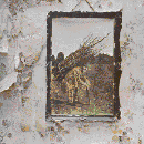
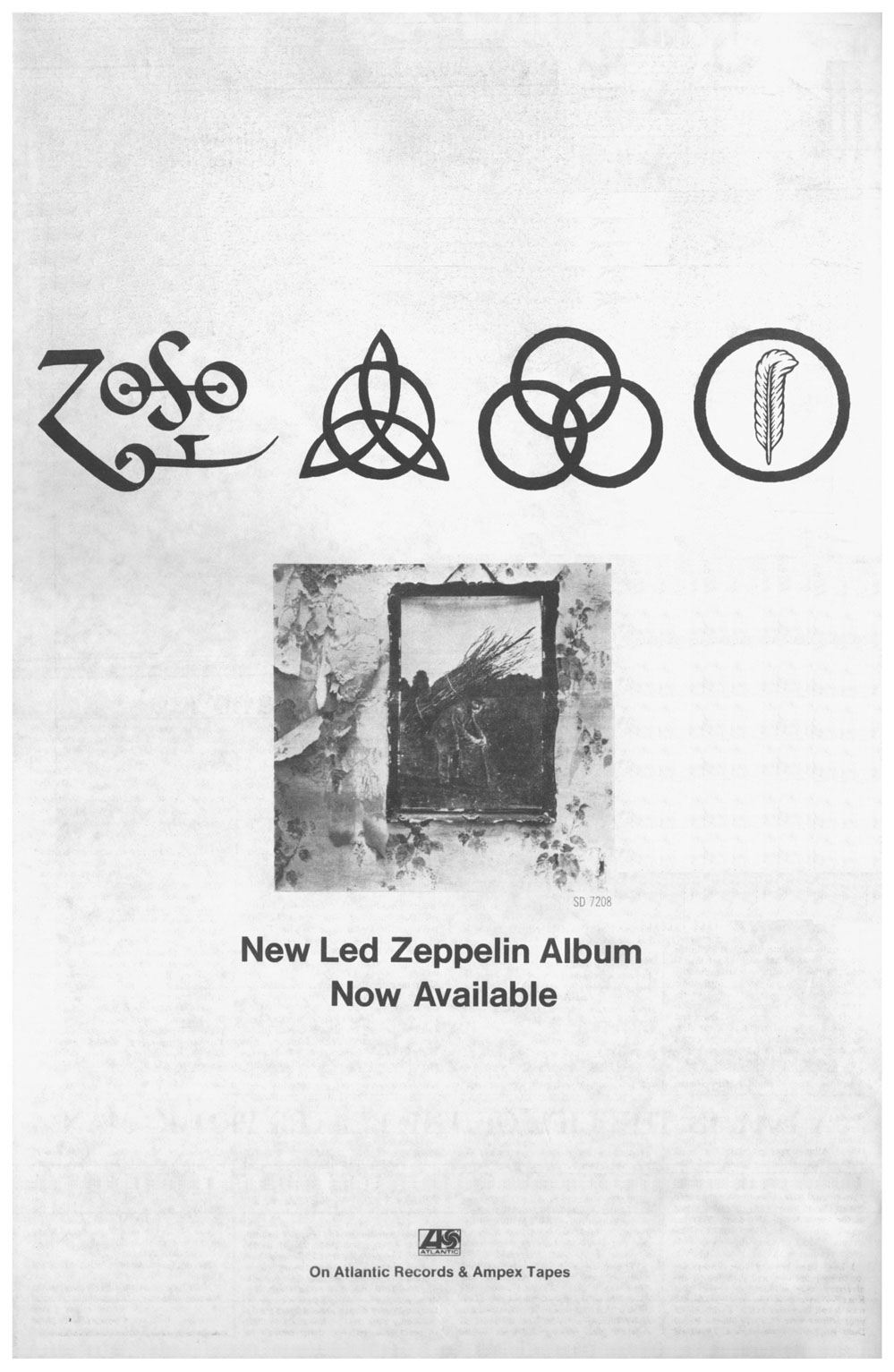
Call it Led Zeppelin IV, since it carries no printed information on its cover, only a picture of a bent old gent bearing a great faggot of sticks. Inside are four arcane-looking symbols that, word has it, are ancient runes that Jimmy Page may have used to represent each of the four members of the group. But the real mystery here is that the old Zepp has become so good. The group finally has made its own brand of high-volume tastelessness into great rock, and not all of it is at high volume, either. Besides the flamboyant Page solos and the typical, heavily layered sounds of tunes such as "Rock and Roll," there are subtle instrumental effects (the dulcimer on "The Battle of Evermore," for example). With "Stairway to Heaven," the group ascends into the realm of seriousness -- getting into madrigals, yet, and quasi-poetry -- and does it without stumbling.
- Playboy, 3-72
At long last Led Zeppelin have produced an album that is a near equivalent of their potential. Their third album was a complete disappointment as it was their first attempt at a somewhat softer sound. The new album seems to be what they were trying to come across with on Led Zeppelin III.
"Black Dog" opens side one in typical Zeppelin style and "The Battle of Evermore" is just another of their increasing songs with hints of J.R.R. Tolkein's three book novel, Lord of the Rings. Although untitled the "theme" seems to be "Stairway To Heaven" which relates directly to the inside cover -- the most fantastic and progressive song they have written. Side two is filled with a number of assorted rockers and an acoustic "Going to California." The album ends with the heavy blues beat of "When the Levee Breaks." If Led Zeppelin disappointed you then their new album will, without a doubt, fill that empty gap to the hilt.
- Woodling, Hit Parader, 7/73.
More than even "Rock and Roll," which led me into the rest of the record (whose real title, as all adepts know, is signified by runes no typewriter can reproduce) months after I'd stupidly dismissed it, or "Stairway to Heaven," the platinum-plated album cut, I think the triumph here is "When the Levee Breaks." As if by sorcery, the quasi-parodic overstatment and oddly cerebral mood of Led Zep's blues recastings is at once transcended (that is, this really sounds like a blues), and apotheosized (that is, it has the grandeur of a symphonic crescendo) while John Bonham, as ham-handed as ever, pounds out a contrapuntal tattoo of heavy rhythm. As always, the band's medievalisms have their limits, but this is the definitive Led Zeppelin and hence heavy metal album. It proves that both are -- or can be -- very much a part of "Rock and Roll." A
- Robert Christgau, Christgau's Record Guide, 1981.
Album IV or Four Symbols (from the runes on the sleeve) contains the monumental rock anthem "Stairway to Heaven." The CD "dusting down" of this favourite justifies the entrance price of this disc alone. The late Sandy Denny's delicious contribution to Page and Plant's Tolkeinesque evocation "The Battle of Evermore" can truly be savoured on Compact Disc.
Reviewed from an early Polygram UK pressing, hiss levels are still quite high for a Seventies recording, marring the fade up to "The Battle of Evermore" for instance. The sound is dry and slightly grainy though more recent Alsdorf pressings of the CD appear to have a more relaxed quality. Though there are odd tape judders, little stands in the way of the enjoyment of this classic.
- David Prakel, Rock 'n' Roll on Compact Disc, 1987.
It all culminates here. Ponderous as it may sometimes be, Led Zep's powerful, mythic thunder is rock & roll (unfortunately, the same can rarely, if ever, be said about their legions of heavy metal successors). This time out they were in full control of their dynamic vision and the end result is an early Seventies classic highlighted by "Black Dog," "Rock and Roll," "When The Levee Breaks," and what became the anthem of the decade, "Stairway to Heaven." Of couse, Zeppelin's music was about much more than bombast; it was music of shading and contrast, of instrumental and production precision, all of which are generally displayed on CD. Its dynamics and clarity will make you a believer. It does have slight flaws, some hiss and some vocal compression, particularly on the Joni Mitchell tribute "Goin' To California," but these are ultimately inconsequential. A
- Bill Shapiro, Rock & Roll Review: A Guide to Good Rock on CD, 1991.

- William Ruhlmann, The All-Music Guide to Rock, 1995.
No Led Zeppelin collection is complete without the untitled fourth album, a uniformly exciting work that's impressive not just for its best-known cuts -- "Stairway to Heaven," "Black Dog," "Rock and Roll" -- but also for the bluesy "When the Levee Breaks" and the folky "Going to California." * * * * *
- Gary Graff, Musichound Rock: The Essential Album Guide, 1996.
This is where the Heavy Metal beast was plucked screaming from the womb of blues and rock'n' roll. It would swiftly grow into a hoary, cliché-ridden monster of course, but at its birth it was almost beautiful. The cover bears no title (there are four runes on the label instead). There's no band photo; the music speaks for itself. "Black Dog" sets Robert Plant's lascivious lyrics against an intricate, inventive riff from Jimmy Page; John Paul Jones and John Bonham provide solide slabs of rhythm. Over chiming mandolins, Plant and ex-Fairport Convention singer Sandy Denny trade vocals and unsettling harmonies for "The Battle of Evermore." Then there's "Stairway to Heaven." Possibly the classic rock anthem of all time, the song is a multi-faceted Zep gem, with its plaintive guitar and medieval recorders, Tolkienesque lyric, versatile drumming and Page's Hendrixian guitar solo (it was wickedly sent up in Spinal Tap but continues to hold a strange charm over impressionable teenagers). Plant's vocal ranges from a whisper to a harpy's screech. "When The Levee Breaks" is an apocalyptic blues workout, powered by Bonham's much-sampled drums. It's epic stuff, and little wonder that the hordes of bored, middle American youth took the band to their hearts. After all, this was before Dungeons & Dragons and Laura Croft.
- Collins Gem Classic Albums, 1999.
Can folk, folklore, R&R and "magick" transport you to the land of hobbits and heavy metal? Hell yeah. Feel the superhero vibe of a confident band that captured rhythm, hook, emotion, technical brilliance and big-room production, conjuring up the mystical best of their best. Full of bombast and inhabiting a world of its own, it's almost a clinic on how to lay down a groove to a hard-rock riff. "Stairway to Heaven" is played to death but you can't overlook its impact. * * * * *
- Zagat Survey Music Guide - 1,000 Top Albums of All Time, 2003.
"I put a lot of work into my lyrics," Robert Plant told Rolling Stone in 1975. "Not all my stuff is meant to be scrutinized, though. Things like "Black Dog" are blatant let's-do-it-in-the-bath-type things, but they make their point just the same." On their towering fourth, rune-titled album, Led Zeppelin match the raunch of "Black Dog" with Plant's most-scrutinized lyrics ever for the epic ballad "Stairway to Heaven," while guitarist Jimmy Page leads Zeppelin from the extreme heaviness of "When the Levee Breaks" to the mandolin-driven "Battle of Evermore." ("It sounded like a dance-around-the-maypole number," Page later confessed).
Led Zeppelin IV was chosen as the 66th greatest album of all time by the editors of Rolling Stone magazine in Dec. 2003.
- Rolling Stone, 12/11/03.
By the time Led Zeppelin recorded "IV" the band was well on the way to becoming the biggest rock and roll outfit in the world. The release of the album, also known as "Four Symbols" or "Zoso," on account of the mystical "runes" adopted by each band member, merely served to confirm the title.
From the opening riff that launches into "Black Dog" and then refuses to let up with the album's second track, "Rock And Roll," the album is a testament to rock music in the early 1970s. But Zeppelin also paid heed to their folk/blues roots, with the Tolkeinesque "Battle For Evermore" featuring English folk diva and Fairport Convention vocalist Sandy Denny, and "Going To California."
The album is perhaps best known for featuring the eight-minute "Stairway To Heaven," one of the few songs of its type to be able to live up to the label "epic"; the track is the most requested song on US rock and roll radio history. Many see the album's closing track, "When The Levee Breaks," as being equally powerful. Sandy Denny, of Fairport Convention fame, contributes the vocals to "The Battle For Evermore."
"IV" topped the album chart in the UK, but could only manage the Number Two spot in the US, the opening track "Black Dog" only reached Number 12 -- bizarre given the album's status as the second best-selling album of the decade and the fourth best-selling album of all time.
As of 2004, "IV" was the #2 best-selling album of the 70s.
- Hamish Champ, The 100 Best-Selling Albums of the 70s, 2004.
Responsible for at least two generations of bedroom air guitarists, Led Zeppelin's ...IV practically defined hard rock and heavy metal. It drew on folk music, the blues, rock 'n' roll, and even psychedelia. But make no mistake, ...IV was the also sound of a band grooming itself for stadium-level success.
Riff-driven cuts like "Black Dog" and "Rock And Roll" are augmented by more spiritual meditations like "Misty Mountain Hop" and "Going To California." "Stairway To Heaven" revealed the group's increased obsession with the occult, religion, and English mythology (rumors even emerged that playing the track backward would reveal Satanic messages). Jimmy Page's performance -- especially the two fiery solos on "Stairway To Heaven" (the most played song of all time on U.S. radio) -- would influence legions of rock groups to follow, including Aerosmith, Metallica, Guns N'Roses, and Tool.
The album's mystique was increased by its cover, which features no group name or album title (hence its alternative monickers, "Four Symbols" and "Zoso," a reference to the runic symbols displayed within).
That said ...IV does suffer, if only occasionally, from overblown pretensions. While its predecessor, the predominantly acoustic ...III, was a more humble affair, ...IV shows Led Zeppelin at its most majestic and indulgent, and its grandiose sound would leave them open to ridicule. Within five years, heavy rock would be superceded by punk rock, which would sound the death knell for groups like Led Zeppelin. But that was all to come. Led Zeppelin IV reveals a group at the height of its powers -- and enjoying itself.
- Burhan Wazir, 1001 Albums You Must Hear Before You Die, 2005.
"Stairway to Heaven." "Black Dog." "When the Levee Breaks." It's been a long time -- been a long time! -- since anyone rock & rolled quite like this.
Led Zeppelin IV was chosen as the 79th greatest album of all time by the editors of Entertainment Weekly in July 2013.
- Entertainment Weekly, 7/5/13.
(2014 Deluxe Edition) Led Zeppelin's fourth record remains their masterpiece because it showcases everything the band did best -- acoustic flourishes, heavy blues, insightful poetry, tawdry catcalls -- in equal measure. This reissue spotlights the album's depth, with illuminative remastering by Jimmy Page, and, on the deluxe edition, alternate mixes of each track. Most notable are a darker-sounding "Stairway to Heaven" and a hypnotic instrumental "The Battle of Evermore." This time, all that glitters surely is gold. * * * * *
- Kory Grow, Rolling Stone, 12/4/14.
On their towering fourth, rune-titled album, Led Zeppelin match the raunch of "Black Dog" with Robert Plant's most poetic lyrics for the inescapable epic ballad "Stairway to Heaven," while guitarist Jimmy Page veers from the blues apocalypse of "When the Levee Breaks" to the mandolin-driven "Battle of Evermore." ("It sounded like a dance-around-the-maypole number," Page later confessed.)
Led Zeppelin IV was chosen as the 58th greatest album of all time in a Rolling Stone magazine poll of artists, producers, critics and music industry figures in Oct. 2020.
- Rolling Stone, 10/20.
 Reader's Comments
No comments so far, be the first to comment.
 Buying Options





