
   |
Who's Next
The Who
Decca 79182
Released: November 1971
Chart Peak: #4
Weeks Charted: 41
Certified Gold: 9/16/71


 Who's Next, regardless of what you may have been led to believe to the contrary, is neither the soundtrack of the realization of Pete Townshend's apparently-aborted Hollywood dream, the greatest live album in the history of the universe, nor a, shudder, rock opera, but rather an old-fashioned long-player containing intelligently-conceived, superbly-performed, brilliantly-produced, and sometimes even exciting rock and roll.
The musicianship is undisputably excellent, with Keith Moon thrashing and bashing more precisely than ever before on record, Entwistle dreaming up all manner of scrumptious melodic and rhythmic flourishes (listen especially to what he plays beneath the chorus of "Won't Get Fooled Again"), and Townshend, be it chunky acoustic rhythm, resounding monster chords of the classic sort, or cogent and lyrical soloes, playing with exemplary efficiency and taste.
As for the album's production, Townshend has, with the able assistance of Glyn Johns in the dual role of engineer and co-producer, come up with one of the most masterfully-recorded rock records in recent memory. Whether so precise a sound as this record's becomes the Who is, at this point, less relevant than the consideration that they've now satisfied their curiosity about whether or not they could be recorded as crisply as, say, Thunderclap Newman.
 Click image for larger view. |
Such dynamics! The beautiful quietly lyrical moments of such selections as "The Song Is Over," "Gettin' In Tune," and "Behind Blue Eyes" are juxtaposed with the thundering rock that is the marrow of those songs so that each is rendered even more poignant.
To further frost the confection, Townshend wrings more than his money's worth out of his £14,000-worth of synthesizers, making, I daresay, shrewder -- at once more adventurous and better-integrated -- use of them than any rock experimenter before him.
In "Baba O'Riley," for instance, he sets the stage for the band's dramatic entrance with a pre-recorded VCS3 part he obtained by programming certain of his vital statistics into a computer hooked up to the synthesizer, then treats the part as a drone while the song's two major chords are transposed over it, and later has the band playing against it (that is, piling a few gigantic chords on it while it keeps going "Meep-meep-meep-meep-meep...") to lead into a solo by guest fiddler Dave Arbus.
Next, on "Bargain," he uses his ARP both as a solo instrument and as a backdrop to his own beautiful guitar solo.
There's just so much to be astonished and delighted by on this album once you get used to its kinda chilly perfection...
There's Roger Daltrey singing, "And I'm gonna 'chune' right in on you," during "Gettin' In Tune," which is so wonderous that it's enough to keep the listener's mind off the possibly unpleasant implications of "the straight and narrow" being what's been gotten in tune to.
There's Imbecile's stupendously catchy and stupid "My Wife," which deals with the danger of being both married and fond of lazing about in the boozer until all hours. (What a pity that The Ox's pleasantly adenoidal voice is all but lost beneath the instruments -- "Can this be a result of jealousy on Townshend's part?" you'll long to know for sure).
And, ultimately, there is "The Song Is Over," one of a few survivors on Next from the recently-aborted Bobby project, an un-utterably beautiful song in which Townshend sings exquisitely over a gentle piano background before and in between Daltrey charging in exhilaratingly over a hard part while breathtaking chord changes in the manner of the "Listening to you I hear the music..." refrain from Tommy. Definitely up there with "Rael" and "Pinball Wizard" and "I'm The Face" among their very best work is this one.
And, just to make it clear to any cretins out there in Radioland that this is just a plain old-fashioned long-player, there are a couple of throwaways: The faintly pretty but negligible "Love Ain't For Keeping" (which most certainly does not deserve to succeed "Heaven And Hell" as the group's stage-opener, unless they play it live about ten trillion times harder than they do on record), and the faintly inane "Goin' Mobile," which celebrates the joys of, ho hum, being free to roam the highways and byways in one's trailer.
And there you have it, chums, an album that, despite a degree of sober calculatedness that would prove fatal to a lesser group, ranks right up there with David Bowie's and Black Oak Arkansas's and Crazy Horse's and Procol Harum's and Alice Cooper's and Christopher Milk's as among the most wondrous of 1971. In view of the fact that Pete's resumed smashing shit out of his guitar at the end of performances and that they've hopefully now resolved all their anxieties about technique, it's eminently reasonable to assume that subsequent Who albums won't be no shrinking violets either.
- John Mendolsohn, Rolling Stone, 9-2-71.
Bonus Reviews!
Even though we may not have tried lighting one up for ourselves lately, I think we all know what a lovely light those two-ended candles can cast. Just look for instance, at the remarkable glow the comes from Who's Next, the Who's latest release from Decca. It is, among other things, a stunning example of a group of artists who are able, through the force of sheer talent, to prolong a style that has pretty much had its day. Much as Sinatra was able to breathe some life back into the already moribund balled form with a string of superior albums in the mid-Sixties, so the Who go right on dancing into the Seventies with that tattered lady known as Rock. No one seems to have told them that her reputation today isn't all it once was -- not, I suppose, that the news would make one bit of difference to them.
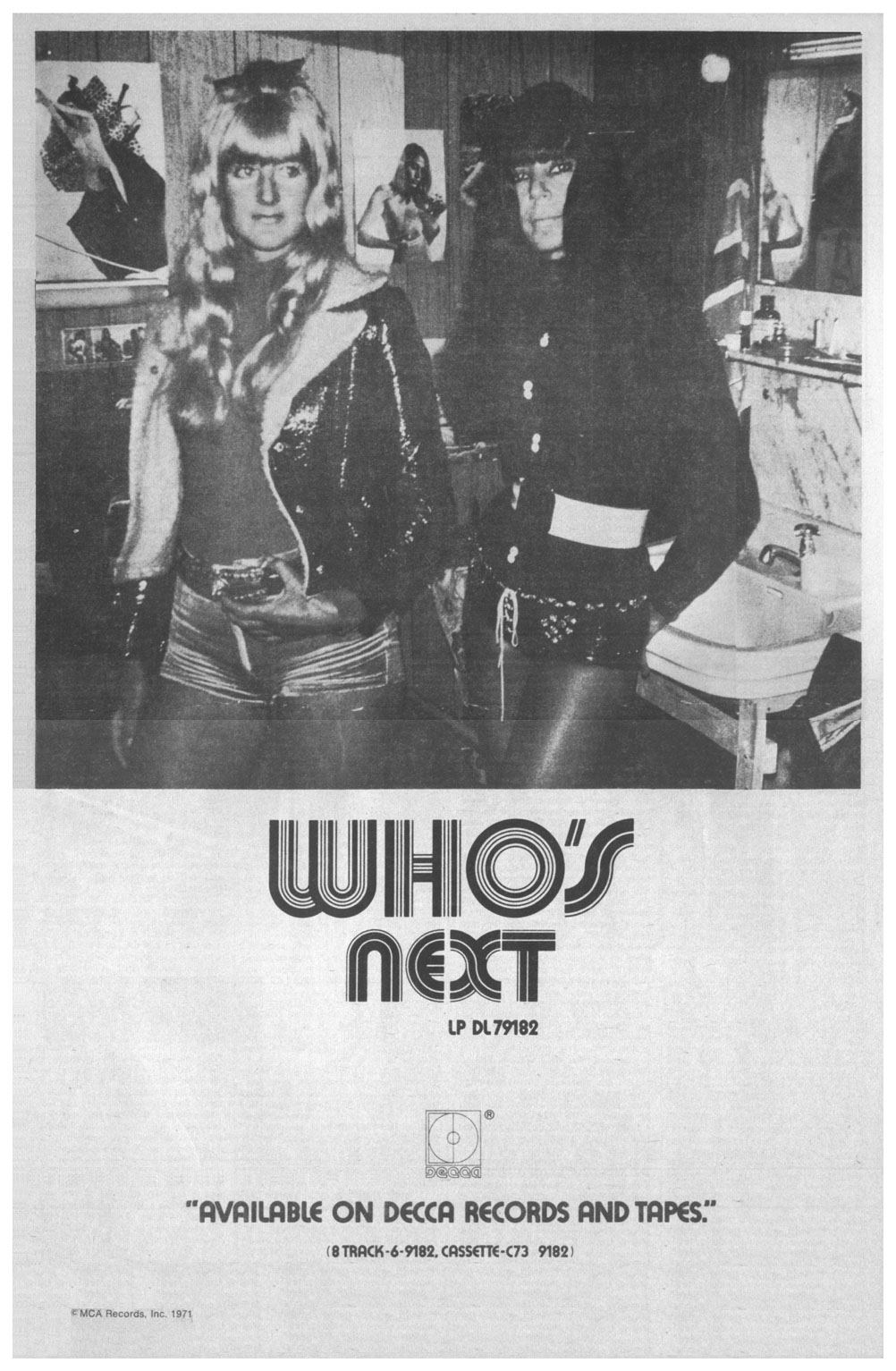
Nevertheless, this is one splendid album, and if there were more like it -- or had been more like it -- then perhaps Rock might still be with us. The biggest single talent here, as fans will know, is Pete Townshend. He has outdone himself this time, writing a collection of songs that perfectly suit the brimstone performances of the group. "Baba O'Riley" (no relation, I believe, to the present writer) is for me the best song on the album, and although it is not quite as raunchy as the jacket photo, nor quite as amusing as the ads Decca is running for the album in the trade papers (two Amazon hookers with only the album title as copy), it is still a very lively track indeed. But then I couldn't find anything in the album that I didn't like. It is a solid job all the way, and the Who remains an intelligent, tremendously vital group that continues to enjoy my respect and merit my admiration.
- Peter Reilly, Stereo Review, 12/71.
The best album by one of the two best rock & roll bands in the world. Dionysian destruction and rage plus Apollonian theory and architecture equal a mature punk's War and Peace. There is nothing about rock & roll that Peter Townshend doesn't understand.
- Paul Nelson, Rolling Stone, 12-15-77.
The quintessential album by the quintessential (i.e., my favorite) rock band.
- Dave Marsh, Rolling Stone, 12-15-77.
With its acoustic guitars and drumless bits, this triumph of hard rock is no more a pure hard rock album than Tommy. It's got more juice than Live at Leeds. And -- are you listening, John Fogerty? -- it uses the sythesizer to vary the power trio format, not to art things up. Given Peter Townshend's sharpness and compassion, even his out-front political disengagement -- "I don't need to fight" -- seems positive. The real theme, I think, is "getting in tune to the straight and narrow," and comes naturally to someone who's devoted a whole LP to the strictures of hit radio. Another sign of growth: love songs. A
- Robert Christgau, Christgau's Record Guide, 1981.
Several of Who's Next's songs were originally intended for Pete Townshend's Lighthouse film, which never materialized. The best known are "Baba O'Riley," named after Townshend's spiritual mentor Meher Baba and the man who interested Pete in electronic music, Terry Riley; "Behind Blue Eyes," an American Top 40 single; and the epic "Won't Get Fooled Again."
In Richard Barnes' The Who Maximum R&B, Townshend says of the latter number, "The first verse sounds like a revolution song and the second like somebody getting tired of it. It's an anti-anti song. A song against the revolution because the revolution is only a revolution and a revolution is not going to change anything in the long run, and a lot of people are going to get hurt."
Townshend's computer programming on "Fooled" and "Baba" showed considerable technical talent as well as musical ability. In 1987, Who's Next was chosen by a panel of rock critics and music broadcasters as the #20 rock album of all time.
- Paul Gambaccini, The Top 100 Rock 'n' Roll Albums of All Time, Harmony Books, 1987.
Who's Next was written in the artistic aftermath of Tommy and was recovered from the wreckage of a stillborn concept album. The album marked a number of important firsts for the band in being the first fruits of collaboration with producer Glyn Johns and also being the first Who album to feature synthesizers (the distinctive sonic "palettes" of early VCS3 and ARP machines).
A scrappy album, Who's Next translates well to CD in sonic terms with the bizarre folksy "Baba O'Riley" and The Who classic "Won't Get Fooled Again" coming over especially effectively. Sound is unexpectedly robust and vigorous for an early Seventies effort, though CD mastering equalisation seems to be giving bass something of a helping hand.
- David Prakel, Rock 'n' Roll on Compact Disc, 1987.
Tommy was the Who album that garnered all the hype (rock opera!) and became a motion picture; but Who's Next is their classic -- the recording by which this powerful band will be measured and remembered. This effort represents the best that each member had to offer, but in the end, it is Daltrey's triumph. His vocals soar over and slice through the dense driven sound of a first-rate rock band at the peak of its power, ultimately capturing the pure animal ecstasy at the heart of great rock & roll. "Baba O'Riley," "Bargain," "My Wife," "Goin' Mobile," "Behind Blue Eyes," and one of rock's all-time great anthems "Won't Get Fooled Again" are the highlights, but there's not a selection on the album which isn't first-rate. The CD's sound is as close to a perfect fit to the material as is likely to be captured -- powerfully dynamic, with wonderful separation and openness, as well as precise individual detailing. Yes, there is occasional audible hiss, but let's not be nitpicking in the face of great rock & roll. A+
- Bill Shapiro, Rock & Roll Review: A Guide to Good Rock on CD, 1991.
The group's magnum opus, a rich, expressive, loud piece of hard rock that summed up the first six years of the band's history. "Won't Get Fooled Again" became a major radio anthem and "Behind Blue Eyes" unexpectedly became a favorite Pete Townshend number as well. Roger Daltrey never sang better, and John Entwistle's bass achieved new heights of prominence, while Keith Moon turned in an explosive performance on drums. * * * * *
- Bruce Eder, The All-Music Guide to Rock, 1995.
Who's Next, with "Baba O'Riley" and "Won't Get Fooled Again," gave the Who rock-radio staying power. * * * * *
- Steve Knopper, Musichound Rock: The Essential Album Guide, 1996.
The apotheosis of adolescent angst mixed with adult wisdom, this straight-out-of-the-box classic created from leftovers from an unfinished rock opera is, ironically, Pete Townshend's greatest achievement. From the opening synth of "Baba O'Riley" to the final power chord of "Won't Get Fooled Again," every epic tune stands on its own, spotlighting lyrics full of primal urgency proving that while they made their big leap to hard R&R they never lost sight of the fundamentals of pop. * * * * *
- Zagat Survey Music Guide - 1,000 Top Albums of All Time, 2003.

Who's Next was voted the 13th greatest album of all time in a VH1 poll of over 700 musicians, songwriters, disc jockeys, radio programmers, and critics in 2003.
- Andrew G. Rosen, VH1's 100 Greatest Albums, 2003.
Pete Townshend suffered a nervous breakdown when his planned follow-up to the rock opera Tommy, the ambitious, theatrical Lifehouse, fell apart. He was also left with an extraordinary cache of songs that the Who pruned down and honed to a beefy sheen on what became their best studio album, Who's Next. "Behind Blue Eyes," "Going Mobile" and "Bargain" all beam with epic majesty, often spiked with synthesizers -- especially "Baba O'Riley," which Townshend partly named after avant-garde composer Terry Riley. "I like synthesizers," Townshend said, "because they bring into my hands things that aren't in my hands: the sound of the orchestra, French horns, strings... You press a switch and it plays it back at double speed."
Who's Next was chosen as the 28th greatest album of all time by the editors of Rolling Stone magazine in Dec. 2003.
- Rolling Stone, 12/11/03.
Although it was originally intended as part of a multi-media conceptual project spearheaded by guitarist and Who lynchpin Pete Townshend (the accompanying screenplay about an apocalyptic world never came to fruition), Who's Next seems a remarkably straightforward rock record when compared to the grandiose musical wanderings of the band's previous studio album, the rock opera Tommy.
The album has, over the years, come to be regarded as one of the band's most respected works. In 1987, a panel of rock critics and broadcasters brought together by Rolling Stone magazine placed Who's Next in their top 20 rock albums of all time. It has also proved to be The Who's most commercially successful record, reaching Number One in the UK album charts and Number Four in the US and spending 41 weeks in the charts.
Who's Next was first showcased informally, with the band playing material at London's Young Vic theatre on three consecutive Mondays during the spring of 1971. Among the tracks are three of the band's most popular songs: "Baba O'Reilly," with its looped synthesizer riff (Townshend was one of the first musicians to use synthesizers and samples in rock), the multi-layered and subversive "Behind Blue Eyes," and what was to become another long-lived concert staple, "Won't Get Fooled Again." For anyone doubting The Who's ability to come up with a subtle, lovelorn tune, "The Song Is Over" says it all.
As of 2004, Who's Next was the #88 best-selling album of the 70s.
- Hamish Champ, The 100 Best-Selling Albums of the 70s, 2004.
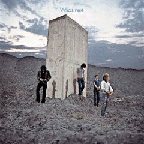
It is The Who's best-selling album -- and, in main man Pete Townshend's view, the finest. But it was born out of a crisis; Lifehouse, the follow-up to The Who's conceptual hit Tommy, had faltered after months of preparation because no one, bar its author, understood it. Ethan A. Russell's cover photo for Who's Next poked fun at 2001: A Space Odyssey, but served equally well as a comment on the band's own more grandiose ambitions (a rejected cover idea featured Keith Moon in a corset, with a riding crop).
Humiliated, Townshend was persuaded to put the best songs on an album that told no story. Some were hard, such as "Bargain"; some were singalongs, such as "Getting In Tune"; and one -- bassist John Entwistle's droll "My Wife" -- was nothing to do with Lifehouse at all (the woman in question, said Entwistle, took it well: she did not come after him -- her lawyers did).
Towering above all the rest were a trio of the finest hard rock anthems that ever erupted. "Baba O'Riley" -- its name a conflation of Townshend's guru Meher Baba and avant-garde composer Terry Riley -- is a sublime blend of synthesizer and slashing guitar. "Behind Blue Eyes" is poetry with an attitude. And "Won't Get Fooled Again" is simply a monster.
All three were part of The Who's performance at the post-9/11 gig at Madison Square Garden, The Concert for New York. The night's most rapturously received set, it proved that the passing decades had diminished neither the singers nor the songs.
- Bruno MacDonald, 1001 Albums You Must Hear Before You Die, 2005.
Take all the gazillions of well-intentioned rock anthems written since this came out in 1971. Load them into boom boxes and press Play at the same time. The mass of sound won't get anywhere near the earth-rattling righteousness of Roger Daltrey singing "Won't Get Fooled Again" with guitarist Pete Townshend, bassist John Entwistle, and drummer Keith Moon clanging mightily behind him.
One of the great rock albums, Who's Next almost didn't happen. Attempting to follow up the band's massive 1969 hit Tommy, Townshend wrote a sprawling suite of somewhat futuristic songs he called Lifehouse, which he intended as another opera. It fell apart. Townshend sufferd a nervous breakdown. When he returned, he revisited a few of the Lifehouse pieces, writing new songs from them. Who's Next is what emerged. It's the moment when Townshend arrived at a balance of brute power and oppositional provocation that was unlike anything in rock before. It was loud and at the same time learned. Its feistiness made it an inspiration for much that followed: Without this, there would be no U2. No Clash. No Pearl Jam.
Every track on Who's Next is its own universe. Starting with the synthesizer-studded "Baba O'Riley," a lament about the "teenage wasteland" that is arguably the greatest album-opener in rock history, the Who charges through a series of amazingly disciplined and totally visceral songs. One, "Love Ain't for Keeping," wrestles with the meaning of commitment. Another, "Behind Blue Eyes," complains about being forever misunderstood. Townshend's focused writing keeps the rhythm section perpetually on the verge of volcanic eruption, while Daltrey, CEO of Indignation Incorporated, stands like a sentry on the precipice, warning the members of his tribe about the perils ahead. No matter how many times you've heard these songs on the radio, it's impossible to listen casually: By the time the final blitzkrieg, "Won't Get Fooled Again," hits, you're part of the army, ready to battle duplicity where it festers.
- Tom Moon, 1,000 Recordings To Hear Before You Die, 2008.
The Who's crowning achievement -- bookended with career bests "Baba O'Riley" and "Won't Get Fooled Again" -- set the stage for the band to become one of the most explosive (and certainly the loudest) arena acts of the decade.
Who's Next was chosen as the 39th greatest album of all time by the editors of Entertainment Weekly in July 2013.
- Entertainment Weekly, 7/5/13.
Pete Townshend suffered a nervous breakdown when the planned follow-up to the rock opera Tommy, his ambitious theatrical project Lifehouse, fell apart. But he was left with an amazing cache of songs the Who honed into their best studio LP. "Won't Get Fooled Again," "Bargain," and "Baba O'Riley" beam with epic majesty, often spiked with synthesizers, Townshend's favorite new tool.
Who's Next was chosen as the 77th greatest album of all time in a Rolling Stone magazine poll of artists, producers, critics and music industry figures in Oct. 2020.
- Rolling Stone, 10/20.
 Reader's Comments
No comments so far, be the first to comment.
 Buying Options





