|
The Who Decca 32846 Aug. 1971 Billboard: #15  
"The change, it had to come. We knew it all along." Although they had been a hugely influential band throughout the revolutionary period of the late '60s, the Who had never really fallen prey to the peace and love crowd. Being a product of England's Mod era, which had to be one of the most narcissistic trends in the history of pop music, the Who tended to be more exclusive than inclusive in their disposition. This lent their music a self-obsessed thrust, which was completely at odds with the "brotherhood of man" approach that was standard currency for the times. For the most part, this added to the Who's unique appeal as a vocal outlet for alienated and frustrated youth. At times, though, they could appear to be outright hostile, so it would have been difficult to deny that the Who was definitely out of touch with the platitudes of the hippie movement. While others were singing "All you need is love," "We can change the world," or "Smile on your brother," the Who railed against conformity by singing "Hope I die before I get old" and "Substitute you for my mum. At least I'll get my washing done," and "It's only a teenage wasteland."
If you ever wondered what could have caused the mind-set of the socially conscious '60s to degenerate into the political indifference of the '70s, then here is where your answer probably lies. If the Nixon/Agnew/Kissinger administration wasn't enough to launch a thorough and permanent counterforce, then it is only fair to say that the agenda of the youth movement failed at its most basic intention. Yes, the war in Vietnam did stumble to an end, mostly due to the efforts of demonstrators, but the quantifiable force of dissension dissipated almost immediately afterward. With no righteous agenda, the movement was dead. Goals that were once lofty became as directionless as the music that was the byproduct of the times. To most people, the failure of the hippie generation to live up to its intentions was a disappointment, but to Townshend the whole thing was an insult to his intelligence -- "Pick up my guitar and play just like yesterday, and then I'll get down on my knees and pray that I won't get fooled again." Townshend had every right to say "I told you so," and that's exactly what he did with "Won't Get Fooled Again." It was easy to fool ourselves into thinking that things were different than they were, and Townshend was annoyed by the proclivity of youth to blindly endorse an agenda that was as rudderless as it was optimistic -- "Cause I know that the hypnotized never lie...do ya?" Worse, he noticed that a healthy portion of these ideals had somehow managed to penetrate his own consciousness, despite his efforts to remain inured, and felt it necessary purge them. Townshend was ready to kick himself for being swayed, and made it his business to let us know that he no longer had "faith in something bigger." In the end, everything changes nothing. "Meet the new boss. Same as the old boss." - Thomas Ryan, American Hit Radio, Prima Entertainment, 1996.
No comments so far, be the first to comment.  |


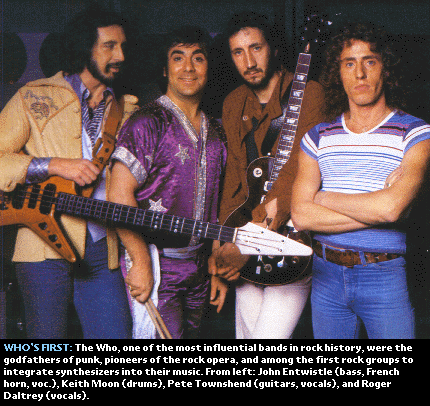
 on't Get Fooled Again" is a great song -- it's astounding, really -- only it belongs on the Top 40 about as much as Homer Simpson belongs at a MENSA convention. Edited to three minutes and change, the 45 version of "Won't Get Fooled Again" is little more than a miniaturization of the full-length masterpiece. As a single, its appeal is minimal, but at its gloriously dynamic full length of 8:31, it is one of the most important songs of the post-'60s generation. Technically, though. it was a hit single, so as I said, here it is.


 Reader's Comments

