
   |

Quadrophenia
The Who
MCA 100004
Released: October 1973
Chart Peak: #2
Weeks Charted: 40
Certified Gold: 10/29/73


 Quadrophenia is the Who at their most symmetrical, their most cinematic, ultimately their most maddening. Captained by Pete Townshend, they have put together a beautifully performed and magnificently recorded essay of a British youth mentality in which they played no little part, lushly endowed with black and white visuals and a heavy sensibility of the wet-suffused air of 1965.
The hero of Quadrophenia is Jimmy, a young motor-scooted Mod in the throes of self-doubt and alienation. Unlike Tommy, to whom he's destined to be inevitably compared, Jimmy is no simplistic parable or convenient symbol. His loner qualities set him apart from both friends and foes, and though he's more than willing to be led, somehow even that security seems to elude him. Torn between identities, Townshend has gifted him with four, all competing for top seed in Jimmy's confused psyche. In one he is forceful and determined, a master of his fate; another finds him full of brazen daring and rollicking jingoism; yet another softens and romaticized his nature, giving him a quiet inner strength; and still another reveals him as insecure, searching, the promise of salvation granted and hovering over the next hillrise.
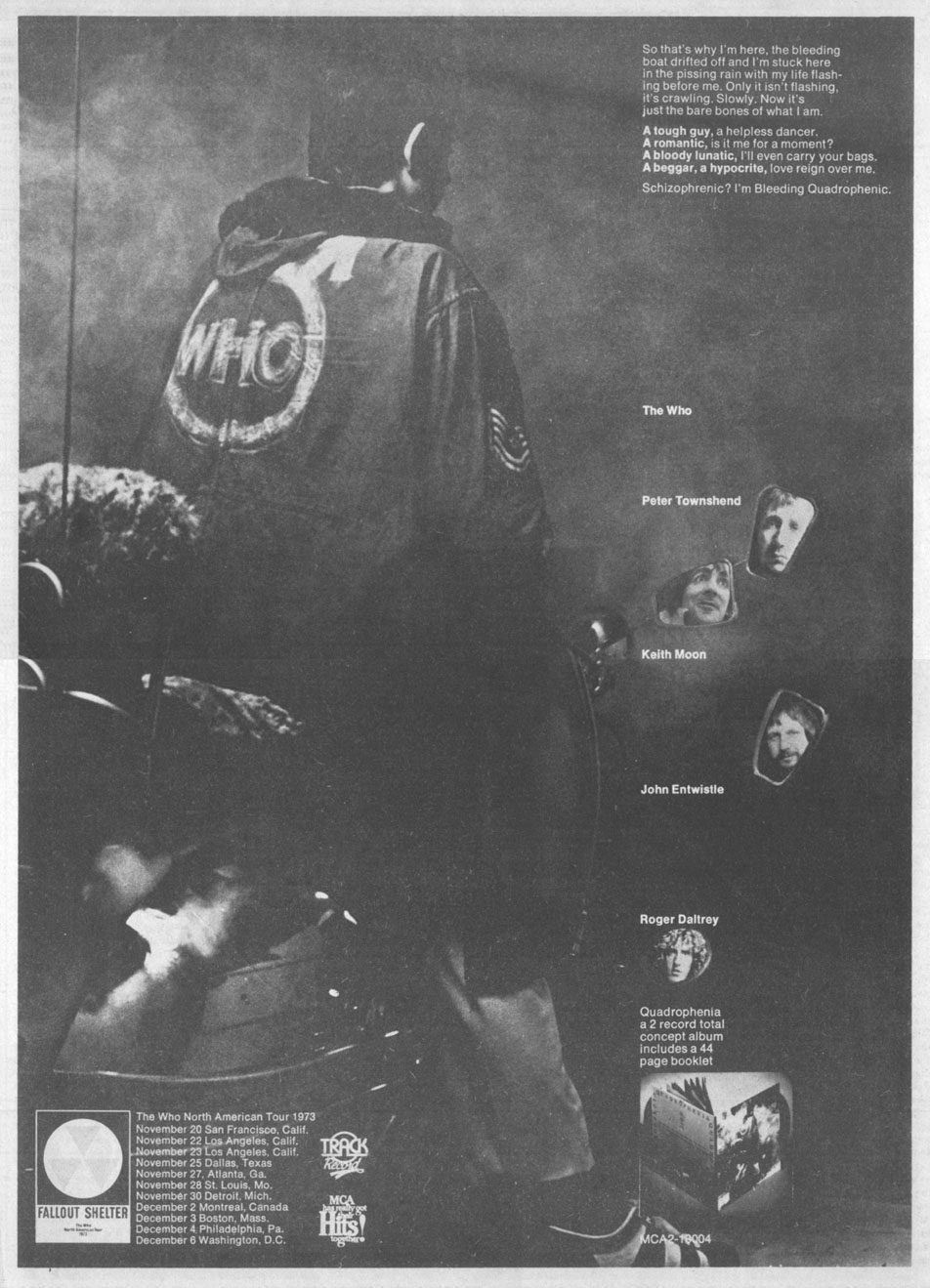 Click image for larger view. |
The interior episodes where all this is hashed out are the most successful on Quadrophenia, impeccably outlined by Townshend and stunningly executed by the Who. Jimmy attempts to mesh with his family, his peer group, his girl, and yet remains an outsider, wondering why in his just-so clothes "the other tickets look much better/Without a penny to spend they dress to the letter." Metting an old idol on the beach, now reduced to subserving as a local hotel bellboy, he is moved to remember: "Ain't you the guy who used to set the paces/Riding up in front of a hundred faces?."
An effective moment, yet when judged against the broader scope of Quadrophenia it seems as if all Townshend has constructed is a series of such effective moments. It is his mastermind that has created the tour-de-force recording breakthroughs of the album, the realistic and panoramic landscape of pre-Carnaby Street England, arranged the setting so that each member of the band could give full vent to his vaunted and highly unique instrumental prowess. Indeed, it might easily be said that the Who as a whole never sounded better, both ensemble and solo, proving unalterable worth and relevance in an age that has long passed others of their band's generation into fragments of history.
But on its own terms, Quadrophenia falls short of the mark. Jimmy Livingston Seagull, adrift on a stormless sea, with only his shattered wings and sharded memories to keep him company -- so close, and yet so far.
- Lenny Kaye, Rolling Stone, 12-20-73.
After the Who began their career in 1965, they've never really looked back since, moving through a series of brilliant albums that feature an endlessly expanding musical palette and a never-ending harvest of thematic grist that took them far from their Mod London street-gang roots through fairy tales, a fascination with Madison Avenue, odd English mores, the miscreant as Messiah, revolutionary sloganeering, rock-and-roll as extended High Art Form, and finally even into the arms of Peter Townshend's personal fave guru, Meher Baba.
The Who's new album, Quadrophenia, represents the first real, sustained backward glance on their part. It traces the picaresque odyssey of a young Mod (circa 1965, and very like themselves as adolescents), and it represents a far more personal statement than their earlier two-record "rock opera," the over-celebrated Tommy. The story of Quadrophenia is as grittily simple as Tommy's was pompously inflated; a working-class British kid declares himself sick of watching Mum and Dad "get pissed" every night, so, with his mates, he flees into a world of psychic energizers and revolt. THe parents send him to a psychiatrist, who diagnoses him as a schizophrenic. Driven by hysteria and despair, he runs away from home and has a series of adventures (including attending a performance by the early Who) whose only constant is violence. He's been taking pills and drinking throughout, so his experiences become increasingly fragmented and hallucinatory. Finally, in a climactic spirit, he steals a boat and sails out to a stark and hazily symbolic rock ("It was sticking up very jagged, very peaceful"). There he finally overdoses on gin and speed, and experiences an epiphany in which he hears the music of heaven in the grindings of the boat's motor. But he unthinkingly switches the motor off, shattering his vision, and crumples to the rock in terminal despair. As the boat drifts away we hear him muttering: "Schizophrenic? I'm a bleeding Quadrophenic."
Of course, it's all just a handy gimmick for Townshend to make a another Big Statement and simultaneously cash in on the burgeoning quadraphonic fad/revolution. But his literary ambitions are much more satisfactorily realized here than in the earlier extravaganza. Quadrophenia's text, printed on the inside liner, bears a strong resemblance to the Angry Young Man strain of British working-class fiction of the late Fifties -- a taste of Room at the Top or perhaps Alan Sillitoe's Loneliness of the Long Distance Runner. Enough substance, in other words, to keep you from squirming.
The music? It's basically the same stuff the Who have been hammering out for several years now -- big, loud, aggressive guitars, thrashing drums, and Roger Daltrey's plaintive, perfect vocals. It has as much excitement as anyone else in the rock establishment is providing right now, but, as with Tommy, you've got to question seriously whether it was an overdose of inspiration or ego that convinced them they needed two whole discs to get it across. All the songs inevitably run together, and there's a cut-to-cut and side-by-side sameness that vitiates the full impact.
In my mind, the real question is still whether we indeed do -- or ever did -- need any such preening innovation as a "rock opera" to keep popular music from becoming a snore. But that's another debate entirely; the important thing is that Quadrophenia is, with minor cavils, a fine, involving, manageably pretentious piece of rock artistry that me be worth your attention even if you hate both noisy guitars and Verdi.
- Lester Bangs, Stereo Review, 2/74.
Despite a succession of mediocre solo albums, the unconscionably long wait since Who's Next, and Townshend's infatuation with Meher Baba (the Silent Cal of the spiritual set), the Who looks, with this album, stronger than ever. Quadrophenia has almost too much going for it -- literary ambitions, sex and drugs, teenage angst, and some of the most incisive playing they've ever done. But if the Who, as Grail Marcus has declared, is the spirit of rock-and-roll, then, on the evidence of this album at least, rock is in better shape than some of us realized.
- Steve Simels, Stereo Review, 2/74.
It's about time! The Who fell into a gaping hole of Calcutta with Tommy, and I never thought that they'd emerge unscathed. Yet here they are with a hot one, plenty of rhythm guitar a la "Baby Don't You Do It" and Keith Moon is at last well-recorded on a fine piece of music. Entwistle plays loud, clean, and well. Daltrey sounds like himself but stronger, Pete's always Pete, and Quadrophenia's almost as good as the Who writing about being horny, but I guess even Mr. Townshend has trouble trying to be a kid again. No matter, this record is the Who's best in practically five years (but nothing will ever top The Who Sell Out), and if you don't own this one, you better just go ahead and trade in your stereo for a bellboy's suit.
- Jon Tiven, Circus Raves, 4-74.
Unlike Tommy, this one really is kind of opera -- first you get to know the music, then you sit down with the libretto and concentrate for eighty minutes. Even with the synopsis (as briliant a piece of writing as Townshend's ever done) and lyrics, it's account of a young Mod's "double schizophrenia" can be pretty confusing, partly because confusion is his subject. The music is cluttered with horns and unnecessarily shrill, so that -- despite its considerable melodic (and motivic, as they say) pizzazz -- you don't play it for fun. But if Townshend's great virtue is compassion, this is his triumph -- Everykid as heroic fuckup, smart enough to have a good idea of what's being done to him and so sensitive he gets pushed right out to the edge anyway. A-
- Robert Christgau, Christgau's Record Guide, 1981.
A far more persuasive "rock opera" than Tommy, Quadrophenia really gained the critical recognition it deserved only during the brief UK Mod revival in the late Seventies. The title refers to the four-way split personality (double schizophrenia) of Jimmy the Mod; each member of the band takes a musical motif and represents one aspect of this classic "mixed up kid."
Sound quality is outstanding, notably the binaural recording of sea and rain which nearly cost the life of a member of the crew during recording. Entwistle's bass and Moon's manic drumming are explosively caught. The CD is particularly good for headphone replay.
The original LP was distinguished by the excellent black and white photo essay which thankfully has been retained.
- David Prakel, Rock 'n' Roll on Compact Disc, 1987.
The group's second rock opera wasn't nearly the success that Tommy had been, but it proved more fertile in other media -- "Love Reign o'er Me" was moderate success as a single but precious little else seemed to register with the public. Ironically, this is a finely produced album, with a sound that is both hard and lush, and Roger Daltrey seemed to achieve a larger-than-life performance as the embattled mod Jimmy. (Mobile Fidelity's gold-disc reissue includes a beautiful, lavishly-produced booklet reproducing the photos and liners from the original LP release in addition to improved sonics.) * * * *
- Bruce Eder, The All-Music Guide to Rock, 1995.
To understand Quadrophenia, it helps to know something about the Mods. A British youth cult in the early-to-mid-sixties, the Mods lived for snappy clothes, Italian motor scooters, amphetamines, and American R&B. Their archrivals were the Rockers -- leather-clad, Harley-driving street toughs -- and the two gangs clashed frequently at seaside resorts on England's south coast. The Who was a Mod band in its formative years, and when, in the early seventies, the group's main songwriter Pete Townshend was searching for a new "rock opera" concept to follow the wildly successful Tommy and the aborted Lifehouse (portions of which were recycled for Who's Next), he found himself drawn to telling a story of that era. In the process, he created a work of art with universal appeal.
Quadrophenia's central character, Jimmy, is a Mod whose life has crumbled around him. He returns to Brighton, scene of one of the great Mod/Rocker riots, only to find that the "ace face" who led the charge is a lowly bellboy at a local hotel. The plot line is even more fragmented than Tommy's and the notion that Jimmy is "quadrophenic," split into four different selves, is poorly developed. But Townshend's gut-wrenching songs -- "The Real Me," "Cut My Hair," "Sea and Sand," "Love, Reign O'er Me" -- make up for these deficiencies. Anyone who's longed to be part of a group, anyone, in short, who's ever been a teenager -- can identify with Quadrophenia's sentiments.
The Who delivers those sentiments with vigor aplenty. Roger Daltrey's snarling vocals, Townshend's fluid guitar and keyboard work, John Entwistle's virtuosic bass and horn playing, and Keith Moon's over-the-top drumming bespeak a band at the height of its powers. Tracks like "5:15" and "Drowned" rock with all the force of a turbo-charged steamroller, while the album's two instrumentals, "Quadrophenia" and "The Rock," blend the four themes representing Jimmy's four personalities with a near-symphonic majesty. Yes, it helps to know something about the Mods to appreciate Quadrophenia, but it's not necessary; when music hits this hard, the difference between a Vespa and a Lambretto fades into insignificance.
Quadrophenia was voted the 86th greatest album of all time in a VH1 poll of over 700 musicians, songwriters, disc jockeys, radio programmers, and critics in 2003.
- Mac Randall, VH1's 100 Greatest Albums, 2003.
The album that brought back Vespa scooters, parkas and uppers: Pete Townshend took a look at the Who's roots in the London mod scene of the early Sixties and composed this expansive, messy rock opera about a lonely teenage boy looking for love in the city. It gets even better when you check out the movie.
Quadrophenia was chosen as the 266th greatest album of all time by the editors of Rolling Stone magazine in Dec. 2003.
- Rolling Stone, 12/11/03.
(2011 Director's Cut Edition) Tommy was first. The Who's 1969 rock opera legitimized the improbable union of rock abandon and extended narrative, and marked guitarist Pete Townshend's great leap forward as a composer and as his band's conceptual general. But Quadrophenia, released in 1973, was a superior tale with more-taut songwriting; it was grounded in Townshend's memories of growing up angry, anguished and mod in the early Sixties, and produced the panoramic tension of Who's Next. Tommy was precedent; Quadrophenia was coherent spectacle. At the time, Roger Daltrey claimed his vocals were too low in the mix. In this remastered edition, when he hits the "Out of my brain" chorus over Keith Moon's runaway drum rolls and John Entwistle's thunderclap bass in "5:15," you clearly hear the singer -- and his lyricist -- going off the rails.
Quadrophenia was the redemption of Townshend's long-form dreams after the collapse of his intended Tommy follow-up, the multimedia beast Lifehouse. Like his deaf, dumb blind kid in Tommy, Townshend's scooter boy Jimmy (a composite of the four personalities of the Who) finds identity, then disappointment in cult life: the top-dog mod reduced to carrying tourists' bags in "Bell Boy."
There is rebirth, too: the final, magisterial cleansing of "Love Reign O'er Me." But where Townshend wrote parts of Tommy in too-literal operatic form, he edited Quadrophenia with a film director's hand, evident in the two CDs of his original demos included in this box set. The tapes are fascinating for their detailed home-studio arrangements; the band replicated most of them with the appropriate fury. The demos also reveal what Townshend left out on the way to the '73 double LP, such as the ill-fitting verse about rock-star anxiety in "The Real Me" and a run of numbers in the first half -- the teen-crush waltz "You Came Back" and an early character sketch, "Joker James" -- that would have slowed down the action. Instead, on the LP, Townshend cut right from the kitchen-table revolt of "Cut My Hair" to the real generations' welfare in "The Punk and the Godfather."
It still sounds like the right decision. Like the subtitle here says, you get the work's birth in full, including an epic prose account by Townshend. But Quadrophenia, as delivered the first time, is still one of his, and the Who's, greatest albums -- and the better opera. * * * * 1/2
- David Fricke, Rolling Stone, 11/24/11.
 Reader's Comments
No comments so far, be the first to comment.
 Buying Options





