
   |
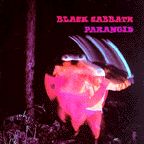
Paranoid
Black Sabbath
Warner Bros. 1887
Released: January 1971
Chart Peak: #12
Weeks Charted: 70
Certified 3x Platinum: 10/13/86


 This is a logical followup to Black Sabbath's first U.S. release, and promises to be as big as the first. The album contains the group's single, "Paranoid," as well as "War Pigs," "Electric Funeral," "Rat Salad" and "Hand of Doom," among others. The group maintains their sound with a few slightly different twists. Their fans will remain faithful to them, without a doubt.
- Billboard, 1971.
Bonus Reviews!
They do take heavy to undreamt-of extremes, and I suppose I could enjoy them as camp, like a horror movie -- the title cut is definitely screamworthy. After all, their audience can't take that Lucifer bit seriously, right? Well, depends on what you mean by serious. Personally, I've always suspected that horror movies catharsized stuff I was too rational to care about in the first place. C
- Robert Christgau, Christgau's Record Guide, 1981.
Even careful disc mastering by Nimbus Records cannot entirely save these densely recorded tracks, now nearly twenty years old, from sonic fuzz and fog. Far from a barrage of sound, the band's live hallmark, the sound from CD lacks real impact, especially the drumming which is both flat and flatulent. The intentionally compressed "block-busting" sound of the title track and songs like "Iron Man" translate poorly to the new medium. Unless the reproduction medium runs into distorting overload there is little of the "head-banging" energy that made live Black Sabbath famous (notorious).

If you did not hear Paranoid the first time around, and have no wish to indulge in a little nostalgia, then you can probably forget this heavy metal classic.
Anyone searching for the classic cuts, including the best from Paranoid, should investigate Castle Records' The Collection. Greatest Hits contains only 10 tracks. Live Sabbath can be found on Live At Last though these performances cannot be fully endorsed.
- David Prakel, Rock 'n' Roll on Compact Disc, 1987.
Paranoid, released in the U.K. in September 1970 and held back from U.S. release until January 1971 to avoid cutting off sales of the still-selling debut LP, became Black Sabbath's best-selling album ever. "Paranoid" and "Iron Man" (the latter released as a single a full year after the album) became Black Sabbath's only U.S. singles chart entries, and the album became their only U.K. chart-topper. Although the album was deplored by critics at the time, the reasons for its success are easy to hear now. Subtle, it ain't (listen to the way Ozzy Osbourne sings note-for-note the same simple melodies Tony Iommi plays), but that's the point. In songs like "Paranoid" and "Iron Man," generations of teenagers heard their own insecurities writ large. * * * * *
- William Ruhlmann, The All-Music Guide to Rock, 1995.
Metal doesn't get more frightening than Paranoid, which features the title track and "Iron Man." * * * * 1/2
- Thor Christensen, Musichound Rock: The Essential Album Guide, 1996.
Spotlighting Tony Iommi's monster riffs and blistering solos, Geezer Butler, the king of bass lines, and vintage Ozzman at his Ozziest, this template for a thousand bands revealed heavy metal at its finest and its first hour. Iconic in the genre, these lads from Birmingham knew how to make noise before thrash and before grunge, creating a dark vision that's never been bested. * * * *
- Zagat Survey Music Guide - 1,000 Top Albums of All Time, 2003.
You think the massive idiot-box success of The Osbournes was a fluke? Try taking a time machine back to the early 1970s and telling rock critics they'd still be around writing about Paranoid in 2003. But nearly every heavy-metal and extreme rock band of the last three decades -- from Metallica and Nirvana to Marilyn Manson, Slipknot and all of those acts lining up each year to play Ozzfest -- owes a debt of worship to Tony Iommi's crushing, granite-fuzz guitar chords, the Visigoth rhythm machine of Bill Ward and Geezer Butler, and Ozzy Osbourne's agonized bray in "Paranoid," "Iron Man" and "War Pigs."

- Rolling Stone, 12/11/03.
Full of dark, brooding -- almost dirge-like -- heavy metal, Paranoid was Sabbath's second album and the record that not only confirmed their commercial status in their UK homeland -- it topped the UK charts within weeks of its release -- but also broke the band in the US, reaching Number 12, bettering their debut's best chart achievement by 11 places. The album was produced by Rodger Bain.
The material is undoubtedly relentless and gloomy, with songs about death, pestilence, war, disease and the hallucinations that result from too much drinking and imbibing too many illegal substances. Tracks such as "War Pigs," "Paranoid" and "Hand Of Doom" all conveyed dark cynicism wrapped in a thundering, driving beat, thanks to Geezer Butler's unique bass style and Bill Ward's no-nonsense drumming. Ozzy's distinctive vocals and Tony Iommi's grinding guitar riffs complement the rhythm section admirably. Sabbath's distinctive sound also owes somthing to gruesome accident: Iommi cut off the tip of his finger before the release of the band's debut, forcing him to tune his guitar down half a step so that it was less painful to play.
The album's title track was an immediate single success in the UK, reaching Number Four. The band called themselves Black Sabbath after a 1935 Boris Karloff movie.
As of 2004, Paranoid was the #63 best-selling album of the 70s.
- Hamish Champ, The 100 Best-Selling Albums of the 70s, 2004.
Black Sabbath had already raised eyebrows in their native England with their self-titled debut: a seismic re-routing of the blues that, along with the first two Led Zeppelin classics, helped give birth to a new form of rock 'n' roll: heavy metal.
In terms of songwriting, the Birmingham quartet's second LP was a quantum leap. Leviathan protest number "War Pigs" is one of the all-time great intros, capturing the embittered mood of Western youth as the U.S. government fought its bloody campaign in Vietnam. All the Sabbath trademarks are here: Ozzy Osbourne's eerie, ominous wail; supple, tempo-shifting dynamics from drummer Bill Ward and bassist/lyricist Geezer Butler; and, most recognizably, the hulking presence of guitar hero and lord of the riff, Tony Iommi.
The iconic title track comes next, a proto-punk blast of alienation that remains Black Sabbath's signature anthem -- Ozzy and Iommi even performed it at Queen Elizabeth II's Golden Jubilee celebrations in London in 2002. Ghostly ballad "Planet Caravan" displays an oft-overlooked tender side, while lumbering sci-fi drama "Iron Man" seems to anticipate the entire grunge movement. The final four tracks are less well known, but just as imposing. Heroin nightmare "Hand Of Doom" is especially apt, helping consolidate Sabbath's position as the darkest force in Seventies music.
Paranoid broke them in America, reaching No. 12 on the U.S. chart. Its songs have been covered by acts as diverse as Pantera and The Cardigans; its influence on the heavier end of the rock spectrum, from Nirvana to Queens Of The Stone Age, is incalculable.
- Manish Agarwal, 1001 Albums You Must Hear Before You Die, 2005.
Before British rock singer Ozzy Osbourne was a one-joke reality TV star, before he allegedly bit the head off a live bat in concert, before he became a caricature of stoned celebrity excesss, he was the first master of rock and roll psychodrama. And this, the second Black Sabbath album, is his Inventory of Primal Fears and Thrilling Nightmares of Great Portent. This stuff is not for the faint of heart: Meet the boy who's shunned by others, trapped in his own paranoid delusions (the title track). Step into the dark half where the "Iron Man" dwells; he's a machine devoid of soul who knows "nobody wants him." (He'd be something to shun where he not powered by one of the most devastating two-measure riffs in all of guitardom.) Shudder at the craven scheming of the "War Pigs." Beware of the "Hand of Doom," with its foreboding fuzztone fingers.
Recorded live in the studio in just three days, Paranoid neatly defines the sound and the philosphical disposition of heavy metal. Its obsessions (hate, the supernatural, war, alienation) became the obsessions of every other band aspiring to hardness. Its basic premise -- that we must atone for the inherent evil of mankind -- became the cornerstone upon which an overwhelming preponderance of heavy metal texts are built.
Running through these eight tunes is a feeling of malevolence waiting just out of sight. The vibe's so thick that Osbourne doesn't have to do much; he bellows a little something about fairies wearing boots, and suddenly it's witching hour. Black Sabbath's original lineup -- Osbourne, guitarist Tony Iommi, bassist Terry "Geezer" Butler, and drummer Bill Ward -- watched what the fast-ascending Led Zeppelin was doing, and realized that blues-rock, then huge in England, could travel down different roads. Zeppelin made it mystical. And Sabbath cranked it up, creating battle music of brute Wagnerian force and Ben Hur scope. This album, the first full realization of Sabbath's power, was a hit almost instantly, but is equally significant for its influence on the hard rock that followed.
- Tom Moon, 1,000 Recordings To Hear Before You Die, 2008.
This is the album where Black Sabbath perfected the demon sludge of Tony Iommi's crushing, granite-fuzz guitar chords, the Visigoth rhythm machine of drummer Bill Ward and bassist Geezer Butler, and frontman Ozzy Osbourne's agonized bray. "Paranoid," "Iron Man," and "War Pigs" are almost a trinity of heavy-metal classics.
Paranoid was chosen as the 139th greatest album of all time in a Rolling Stone magazine poll of artists, producers, critics and music industry figures in Oct. 2020.
- Rolling Stone, 10/20.
 Reader's Comments
No comments so far, be the first to comment.
 Buying Options





