
   |

Station to Station
David Bowie
RCA 1327
Released: January 1976
Chart Peak: #3
Weeks Charted: 32
Certified Gold: 2/26/76
 Station to Station opens with a synthesized train bumping along the ten-minute title track, and the disembodied voice of a romantic Englishman crooning, "the return of the thin white duke." The form is familiar: monster chording, pointed vocals and racing arrangements. The scenario builds until Bowie cuts away to the second phase of the song, a wrenching piece of power rock peppered with questions: "And who will connect me with love?" and "Does my face show some kind of woe?" He may not be seriously committed to rock, but when the mood strikes it all comes flooding back. Always the actor, David Bowie can assume the role of rocker and make it work.
Unfortunately, his devotion to the role isn't unwavering, and on songs like "Word on a Wing," the bloodless angelic choir and childish soul piano cheapen the elegant, vaguely religious passion of the lyrics and lead vocal. Yet more often than not, the material on Station to Station presents the rock Young Americans forced us to believe would never surface again: "TVC 15," which makes the listener lust for a lyric sheet, has the sort of nondisco drive missing from Bowie's music since "Suffragette City." "Transition," Bowie purrs, "transmission," and the beat becomes a series of minor explosions. "Golden Years" has a more appealing surface and its lush R&B smorgasbord of vocal styles, whistles and classic first-line hook ("Don't let me hear you say life's taking you nowhere") make it Bowie's most seductive self-indulgence since Pin Ups.
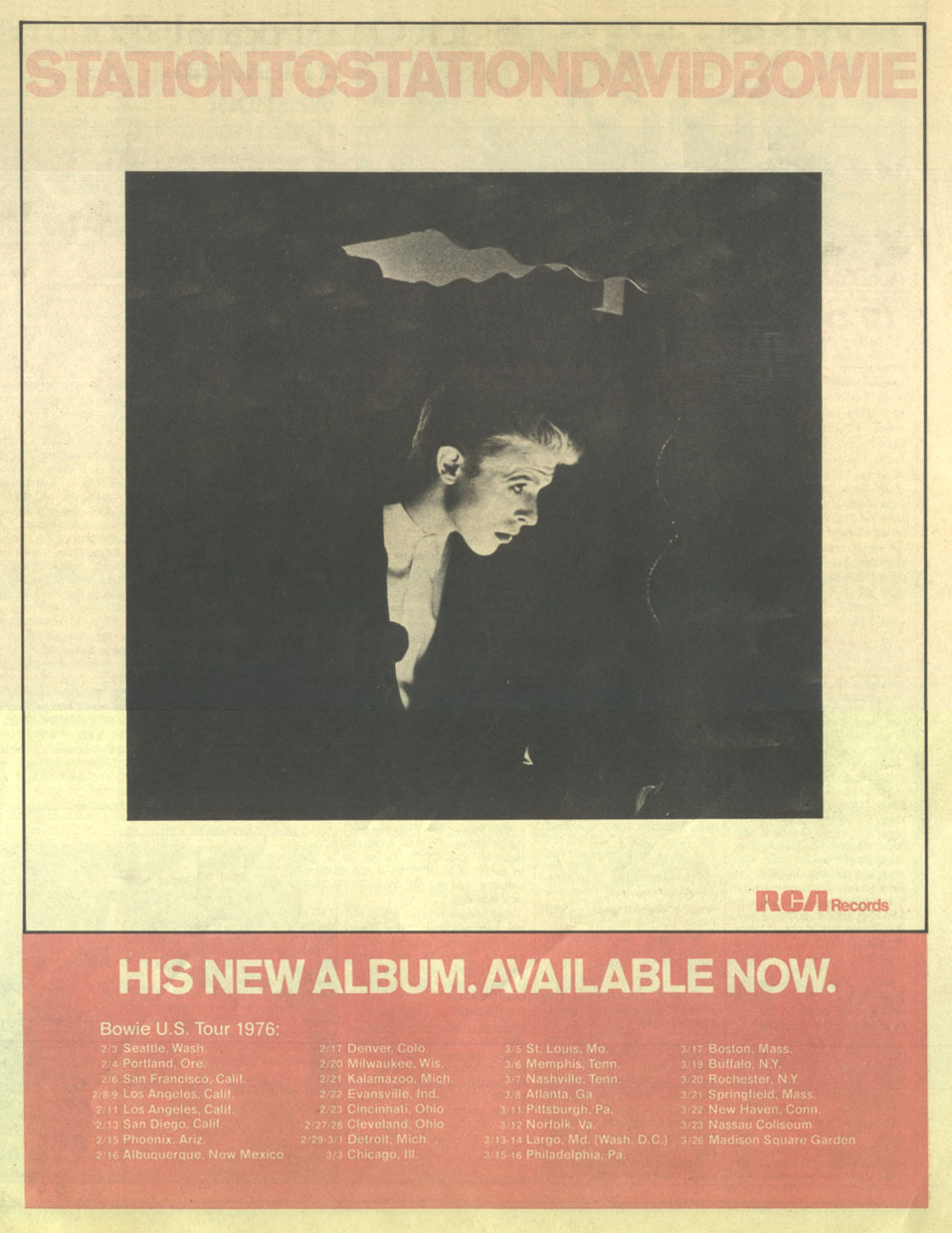 Click image for larger view. |
- Teri Moris, Rolling Stone, 3/25/76.
Bonus Reviews!
I wonder if Bowie didn't wind up with a more general audience than he at first wanted. He seemed for a while to be trying for the respect of (that is, to out-shock) the so-called avant-garde of rock (a contradiction in terms, I realize but not as bad a one as "Army Intelligence"), the John Cale crowd with perhaps some acknowledgment form off to the side from the Yoko Ono types. Ha! He wound up being the cutest outrage of the year in the heart of some wholesome Des Moines teenager, soon replaced there by Alice Cooper. Now he's into movies (The Man Who Fell to Earth) and such, and he still has no real context in which to speak musically; he is, in terms of music, the equivalent of cynical and drunk and boring someone in some café, to borrow Joni Mitchell's phrase. Bowie sold himself to the general audience he's now stuck with by striking a posture everyone knew was make-believe but some were willing to go along with for a while, and he made the mistake of letting it slip that music per se didn't interest him all that much (it was the totality of Bowie that was supposed to get you); now it's the trappings that have worn out from overexposure, and he's stuck with music as well as with an audience that really doesn't have a long-term commitment to esoterica. He's utterly boring in dealing with music alone. As if to demonstrate just how little sense he has of a vocal style, he even tries what you might call crooning here -- and even in that he never homes in on any particular emotion. Is he angry, wistful, sardonic, frustrated? Just how is he dissatisfied when the lyric suggests all is not right with the world? I can't tell, Bowie seems to have about the same relation to a song that a TV weatherman has to the forecast. The specifics of it aren't as important as how impressed you're supposed to be with this guy predicting the future. Bowie has presented himself as Something Else, but he is only something else in the sense that he is not a musician.
- Noel Coppage, Stereo Review, 5/76.
- Billboard, 1976.
Miraculously, Bowie's attraction to black music has matured; even more miraculously, the new relationship seems to have left his hard-and-heavy side untouched. Ziggyphiles can call it robotoid if they want -- I admire the mechanical, fragmented, rather secondhand elegance of Aladdin Sane, and this adds soul. All of the six cuts are too long, I suppose, including the one that originated with Johnny Mathis, and David sounds like he's singing to us via satellite. But spaceyness has always been part of his shtick, and anybody who can merge Lou Reed, disco, and Huey Smith -- the best I can do with the irresistible "TVC 15" -- deserves to keep doing it for 5:29. A
- Robert Christgau, Christgau's Record Guide, 1981.
A transitional effort, it bridges Bowie's clinical pop-disco persona to the icy psychosis and dissonance of this next phase, working with Brian Eno. Almost as ill formed as Diamond Dogs (particularly the title track), but it includes the Top Ten hit "Golden Years" and "TVC15" are highlights. * * * *
- Rick Clark, The All-Music Guide to Rock, 1995.
To get a better taste of Bowie's experimental side, Station to Station is a vital beginning, marking Bowie's first real attempts at deconstructionism -- which, in turn, led to the Bowie/Brian Eno collaborative trilogy of Low, Heroes, and Lodger, though it also included ace pop tunes like "Golden Years" and "Wild is the Wind." * * * * *
- Aidin Vaziri, Musichound Rock: The Essential Album Guide, 1996.
A very early expedition into cold techno-rock territory, this crushingly dramatic album reveals emotional confusion sublimely rendered. Disquieting and intense, with production that's beyond words, it chronicles Bowie's tranformation from R&R singer to cocaine-fueled robot or, according to others, smooth crooner during the peak of his cool, detached LA phase -- wow, paranoid never sounded so good! * * * * *
- Zagat Survey Music Guide - 1,000 Top Albums of All Time, 2003.
In 1976, David Bowie's personal life was in chaos. His open marriage with Angie Bowie had collapsed and he was trying to cope with cocaine and alcohol addiction. Increasingly paranoid, he had become obsessed with UFO's, occultism, and Adolf Hitler.
With guitarists Carlos Alomar and Earl Slick, and drummer Dennis Davies who had worked on Young Americans, work began on the provisionally titled Thin White Duke, a soul record "devoid of soul." The opening title track was a brooding, cocaine paranoia epic, influenced by Bowie's interest in the German avant-garde rock of Can, Neu!, and Kraftwerk, and introduced Bowie's Thin White Duke, whose white tuxedo and slicked back hair recalled his character in The Man Who Fell To Earth, whom he stars as on the album's sleeve.
Hit single "Golden Years" lifts the numbing intensity with slick funk guitar and its sleazy groove. The theme of paranoia dominated the record, delivered in a cold, clinical croon -- most effectively on "TVC 15," where it was beautifully complemented by Davies' acrobatic drumming. By the time we reach the closing track, "Wild Is The Wind," Bowie's voice has transformed, sounding as vulnerable as it is heartbreaking.
The album was a transition both artistically (moving from plastic soul toward electronic minimalism) and personally (inspiring Bowie to clean up his addictions before relocating to Berlin). An inspiration to the British post-punk and New Romantic scenes, it remains one of Bowie's most accomplished and enduring works.
- Chris Shade, 1001 Albums You Must Hear Before You Die, 2005.
(2010 3-CD Special Edition) The whole sordid story of Seventies rock is in the grooves of Station to Station: London's prettiest pop star moves to L.A., samples the local chemicals, loses what's left of his mind and starts calling himself the Thin White Duke. He ends up on Soul Train fumbling the words to "Golden Years." This zonked-out space-funk epic could be Bowie's greatest album, even if he can barely remember making it. The reissue adds the legendary Nassau Coliseum show of March 1976. When Bowie covers the Velvet Underground's "I'm Waiting for the Man" and yelps about "$26 in my hand," you know that wouldn't cover his drug budget for the next five minutes. But he still sounds unstoppable.
- Rob Sheffield, Rolling Stone, 9/30/10.
Like all 1970s rock stars, Bowie was required to troop out to L.A. and spend a year or two face-down in a punch bowl of Peruvian flake. Yet unlike most of them, he actually made a great album this way. Station to Station has his trippiest epic in the title song, a 10-minute occult robot-funk groove. "TVC15" pairs metal-machine guitars with the piano strut of the E Street Band's Roy Bittan. For the finale, "Wild Is the Wind," he nicks a Fifties movie theme he learned from Nina Simone and makes it his own. Bowie confessed he could barely remember making Station to Station -- but given the dark mental state it depicts, that was probably a lucky break.
- Rob Sheffield, Rolling Stone, 8/25/16.
The title track is where David Bowie proclaims himself the Thin White Duke. Thin he was -- Station to Station was recorded in a blizzard of cocaine in Los Angeles. The manic mood fueled an album that was futuristic but accessible: "TCV 15" is New Orleans R&B as robotic funk; "Golden Years" is James Brown from outer space, with Bowie's amazing falsetto.
Station to Station was chosen as the 52nd greatest album of all time in a Rolling Stone magazine poll of artists, producers, critics and music industry figures in Oct. 2020.
- Rolling Stone, 10/20.
50 years ago this week, Jan. 23, 1976, David Bowie released his 10th album, Station to Station. It solidified the singer's Thin White Duke persona -- and was made in the throes of a cocaine addiction so demanding the rocker, who died in 2016, later said he hardly remembered making it. Still, critics raved, thanks to songs like "Golden Years" and "Stay."
- Rachel DeSantis, People, 2/2/26.
 Reader's Comments
No comments so far, be the first to comment.
 Buying Options





