
   |
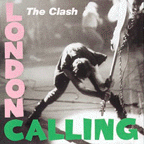
London Calling
The Clash
Epic 36328
Released (US): January 1980
Chart Peak: #27
Weeks Charted: 33


 The Ramones waste no time in getting down to business on their new album End of the Century with its very first track, "Do You Remember Rock 'n' Roll Radio?," and neither do the Clash on their latest, London Calling. It is obvious right off, with the title song, how much the Clash's rhythm section has tightened up; bassist Paul Simonon and drummer Topper Headon pound this one home, the doomsday bass complementing Mick Jones' menacing guitar.
From the raw rage of their epochal first album to the fiery precision of this third one, the evolution of the Clash has been one of the most engrossing spectacles in recent pop music. All along they have been voraciously absorbing old styles and techniques and appropriating new ones. Although nothing on London Calling quite comes up to the three British singles (particularly "Complete Control") the group released between their first two albums, it would take a real nit-picker to find much wrong with this two-disc set.
The Clash's new producer, Guy Stevens, makes a difference here, as do the accompanying horns and keyboards, but most of the progress can be attributed directly to the band. Jones has become one of our most powerful hard-rock guitarists, and lead singer Joe Strummer, though he can still shout with the best of them, is continually developing new shadings in his vocals ("Jimmy Jazz" here is his most effectively under-stated performance yet.) As a songwriting team, the two are unwaveringly inventive, capable of pouring lots of detail into a song without slowing its pace.
The Clash draws on nearly everything that has come before them, but without really aping anything. Reggae, which they have always worked with so knowingly, is represented here by "Rudie Can't Fail," "Lover's Rock," and "Revolution Rock." But, on both "Jimmy Jazz" and "Wrong 'Em Boyo," they also dig back into the r-&-b that helped shape reggae. "Boyo" is a classy piece of rock phrasemaking as good as the title song; it gives a new twist to the Stagger Lee legend, a New Orleans musical staple, and supports it with horn charts drawn from Frankie Ford's "Sea Cruise." "Brand New Cadillac" is updated rockabilly, and the music (though not the lyrics) of "I'm Not Down" sounds like it could have been written by Jimi Hendrix. On "The Card Cheat" the group takes a few tips from Phil Spector. Yet, despite all these easily traceable influences, the Clash still sounds like no one else.
Call it "punk" if you must, or just call it contemporary rock. The Clash has built convincingly on its original premise and has managed to reach its audience without compromising. The continuing vitality of the Clash proves what their early fans knew all along: this group was built to last.
- John Morthland, Stereo Review, 6/80.
Bonus Reviews!
As much as I like and admire the Clash, London Calling leaves me caught in a dilemma that I'm not at all pleased to be in. The problems that I have with the two-record set actually lie somewhat to be outside of the LPs themselves and, because of that, it's probably better to first discuss the work itself and then get on to what seem to be the more important questions raised by it in regard to the Clash's self-pledged role in the world.
If it seemed to some that all the musical growth so evident in those absolutely amazing singles which followed the Clash's debut album (in particular, the "Clash City Rockers" and "Hammersmith Palais" singles, and both sides of each as well) was stunted by te somewhat overbearing metalloid tendencies of producer Sandy Pearlman on "Give 'Em Enough Rope," then London Calling is a fine re-affirmation of the unbridled adventurousness and progress that the Clash are capable of. The band, with the considerable aid of long-lost Mott the Hoople producer Guy Stevens, touch the kind of bases that one used to expect, but now hardly ever sees from one, let along two albums (if Tusk is F. Mac's "White" album, I'm J. Lennon's monkey's uncle). The approaches here range from all-out sonic attacks (the title cut, which I'll have more to say about later, is so powerful that one is utterly drained physically by the end as the Morse Code S.O.S. fades with Joe Strummer's wails) to souped-up rockabilly ("Brand New Cadillac") to free-wheelin' r 'n' b ("Lover's Rock," "Wrong 'em Boyo," the later featuring some swift "Stagger Lee" into "Sea Cruise" horn swings) to suds 'n' sods pub croons ("Jimmy Jazz") to Spectorial/Springsteen melodrama ("The Card Cheat").
In short, everything that is around now musically meanders in for the ride somewhere along the line, and just about all of it does sound of a piece. Stevens has deftly brought out the best of this band, in particular the unfailing intimacy of Joe Strummer's vocals and the constant supportive interplay between Strummer's voice and Mick Jones' chip-ins, both in his own singing and more importantly, in his gut-wrenching guitar playing. And the sheer strength of the Clash's energy is used deftly here, bursting forth at times and riding under the current at others. Stevens has managed to give the Clash the same kind of wonderful edge that he gave Ian Hunter and Mott, and it sure makes sense when you hear the almost Dylanesque way Strummer shouts "You can go it alone" on "London Calling" and "That's just Montgomery Clift, honey!" on "The Right Profile," a song that could very well have been found somewhere on the Basement Tapes. In these days of Chapman explicitness, it's a treat to hear such un-overly-conscious production values.
But like I said, I don't find London Calling an easy album to handle, and when I stated previously that my problems lay somewhat outside the work itself, you'll notice that I haven't mentioned many of the lyrics. That's because the unavoidable fact of London Calling is that that very first track almost makes the rest of the two records immaterial. So explosive is it in its depiction of apocalypse now, so strong is its message, so challenging is its putting forth of all the questions and abhorrences that are flying through all of our lives at the present time, that the rest of the album's lyrics just seem to be a weak addendum to a case already stated as well as it can be.
Which is something that I can't help thinking about. For, having been attacked rather idiotically for the one instance so far where they've managed to forget about the world's troubles and their fist in the air righteousness -- namely the light and buoyant "1-2-Gotta Crush on You," they seem almost too self-consciously on the offensive here, and with this much room to spread out, I was praying that there'd be a little more light shed on what, if anything, the Clash can see on the other side. And if that light just isn't there for them, then it is indeed some kind of vast wasteland they find themselves in. I guess perhaps that's why those startling singles throughout '78 meant so much, for they just seemed to spring up and grab you, shake you and hold you for three minutes and then release you, to mull it over. Here, though, the absence of relief is wearisome, and since there is no turf here that hasn't been mentioned in some shape or form beforehand on earlier Clash efforts (war, oppression, racism, sexism) I'm just kind of ambivalently perplexed. Because by now, we all should be hopefully well aware of all the dangers that the various political and social systems that be are placing us in and under. But it's hard for me to believe that's all that runs through Jones' and Strummer's heads, hearts and veins 24 hours a day. Which is not to say that all I want is a worldful of numbed Mr. Joyboys. But that rough mix between politics and music, one which heretofore the Clash had managed to incorporate into everything they did better than anyone else has ever done -- because they are such a phenomenal group -- is getting a little messy. Even the MC-5, at their most blatant, still tossed in "Looking at You" on Back in the U.S.A. without it interfering with the overall message. The four sides of London Calling have me feeling like I've been levelled by the weight of the world. Which very well may be the Clash's intent. But I'm not sure if that sticker that's mentioned elsewhere in this section is really what I want as a sum total of my feeling about the Clash.
- Billy Altman, Creem, 4/80.
The third album by the Clash, Britain's premier new wave act, is a double-album set, selling at a lower price. The music the four-man band plays is still angry political rock, but now it is much more carefully wrought and realized, making it more palatable to American radio and mass tastes. The songs are performed at less than breakneck speed, horns are used to fill out the sound and singer Joe Strummer works harder at making the words easier to understand. LP is getting great initial critical response. Best cuts: "Wrong 'Em Boyo," "London Calling," "Lost In The Supermarket," "Koka Kola," "Revolution Rock."
- Billboard, 1980.
Here's where they start showing off. If "Lost in the Supermarket," for instance, is just another alienated-consumption song, it leaps instantly to the head of the genre on the empathy of Mick Jones's vocal. And so it goes. Complaints about "slick" production are absurd -- Guy Stevens slick? -- and insofar as the purity of the guitar attack is impinged upon by brass, pianner, and shuffle, this is an expansion, not a compromise. A gratifyingly loose Joe Strummer makes virtuoso use of his four-note range, and Paul Simonon has obviously been studying his reggae records. Warm, angry, and thoughtful, confident, melodic, and hard-rocking, this is the best double LP since Exile on Main Street. And it's selling for about $7.50. A+
- Robert Christgau, Creem, 4/80.
This double album is filled to bursting with expressions of the energies of the Clash at their peak. The title tune was their biggest hit single at home. "Train In Vain (Stand By Me)" was their first US success. Ironically, it wasn't listed on UK labels in the interests of retaining street credibility.
"The Right Profile" touchingly saluted the troubled actor Montgomery Clift. It also included what must be the most difficult printed lyric any aspiring cover artist could have to tackle, Joe Strummer's "Arrrghhhgorra buh bhuh do arrrrggghhhhnnnn!!!!"
In 1987, London Calling was chosen by a panel of rock critics and music broadcasters as the #40 rock album of all time.
- Paul Gambaccini, The Top 100 Rock 'n' Roll Albums of All Time, Harmony Books, 1987.
The Clash were already the best rock-and-roll band in the world -- the Rolling Stones had long since peaked -- when they recorded London Calling. Their homonymous debut album (worth owning in both its overlapping U.S. and U.K. configurations) made the Sex Pistols sound gutless in comparison (the Clash's anger had an end beyond its means), and in songs like "White Man in Hammersmith Palais" and Junior Murvin's "Police and Thieves," they expanded even the most optimistic notions of what punk could include without selling out. "We're a garage band/We come from Garageland," sneered singer Joe Strummer, but from the start they were much more. Mick Jones was that rare guitarist who didn't turn dull as his technical expertise blossomed (that is, he didn't succumb to Eric Clapton Disease), and the open songs he and Strummer hammered out made the nihilism of their fellow punks sound silly. From the beginning they were pushing limits.
What remains most amazing about London Calling, a sixty-six-minute double-album, is its breadth. I don't mean this only lyrically, though any record that seeks to explain Spanish imperialists in Central America, the death of Montgomery Clift, American everymalls, nineteenth-century poker games, and the mean streets of Brixton screams ambition at every turn. Musically, the Clash use London Calling as a springboard away from punk in all directions -- basic rock and roll, mainstream rock, reggae, New Orleans-style rhythm and blues, calypso, even big-production pop -- although the punk ideal always holds sway. On London Calling, the Clash wanted to define an entire world just prior to blowing it up. Among double-albums, only Exile on Main Street covers more territory.
Yet these nineteen songs cohere magnificently. One of the numbers, "Train in Vain," isn't even listed on the sleeve. In a scenario typical of the Clash's wary/incompetent approach to commercial necessities, the song no one could find turned out to be their first hit single in America. Some of the tracks meander a bit before they fade and some of the lyrics devolve into Dylan-derived dirty doggerel ("I believe in this and it's been tested by research/That he who fucks nuns will later join the church"), but aside from those few flaws to remind you that these guys aren't perfect -- in fact, the group's inevitable self-destruction began almost immediately after the recording of London Calling -- every moment on London Calling is as brazen and ultimately true as any rock and roll ever made.
London Calling earns these accolades not because the band so fervently believes what they are saying (hell, Styx and Kansas believe in the mush they emit), but because their music backs up even their wildest assertions. Whether juggling lyrics in the anthemic "Spanish Bombs," offering themselves as house band anywhere in the hilarious "Revolution Rock" (the same song in which Strummer claims, "I'm so pilled up that I r-r-rattle"), finding a middle ground between satire and declamation in "Lover's Rock," or damning American consumerism in "Lost in the Supermarket" and "Koka Kola," the music, recorded in appropriately dirty-clean fashion by producer Guy Stevens and engineer Bill Price, is terse and direct, as in-your-face as the Clash's previous records, but with more breathing room. The music for the songs that are most explicitly about the band -- "Death or Glory" and "Four Horsemen" -- is muscular and trustworthy enough to justify the bravado of the lyrics.
The Clash didn't stop here. Their next album, Sandinista!, was a sprawling mess, three albums of ooze that were even more wide-ranging, though not quite as consistent. Over repeated listenings, even the songs that were considered filler -- dub versions of songs on the albums, children's-chorus versions of songs from earlier albums -- gain weight. Sandinista! was the only studio triple-album in rock and roll worth the time or monetary investment.
One of my greatest thrills as a rock-and-roll fan was in 1982, at a stadium concert in Philadelphia, when the Clash (opening for the Who, in the first of what will no doubt be several dozen farewell tours) kicked off their avalanche of a set with "London Calling" and Strummer punched the air to the beat. This commercially marginal band had gotten over to the masses without compromise. Ninety thousand hot, thirsty fans joined Strummer in motion. I knew at the time that it was an empty gesture, and probably a manipulative one to boot. It didn't matter.
- Jimmy Guterman, The Best Rock 'n' Roll Records of All Time, 1992.
What are we gonna do now?" asks Joe Strummer at the start of "Clampdown," one of this album's songs. But by the time you get to that track, it's already clear that the Clash have solved that problem by taking a giant step toward making craftsmanlike rock without sacrificing the urgency that made them punk leaders. From the title track through the reggae, rock, and pop tracks that follow, this is one of the premier albums of its time. * * * * *
- William Ruhlmann, The All-Music Guide to Rock, 1995.
London Calling is the band's masterpiece, balancing high energy punk efficiency with forays into roots rock, blues and reggae. Less intense than its debut, but also more accessible, this is simply a great collection of songs. * * * * 1/2
- Alan Paul, Musichound Rock: The Essential Album Guide, 1996.
The Clash staked their claim as rock 'n' roll icons with London Calling, starting with the sleeve -- a pastiche of Elvis's debut album cover. Spiky guitars and a bass fanfare announce "London Calling." Over a nagging rhythm, past heroes are torched; the yowls, feedback and Strummer's hoarse vocal produce a truly apocalyptic vision. London Calling reveals the Clash as musical magpies. Vince Taylor's "Brand New Cadillac" is sleazy rockabilly, while "Wrong 'Em Boyo," featuring a sassy sax, revisits the Stagger Lee myth. "Hateful" features a shuffling Bo Diddley rhythm (he supported them on their first U.S. tour). Paul Simonon's "The Guns Of Brixton" is a confrontational rallying cry, mixing brooding reggae with a classic bass riff. On "Koka Kola" and "Lost In The Supermarket" advertising is rubbished, while "Spanish Bombs" praises the heroism of republicans in the Spanish Civil War. "The Right Profile," a snapshot of the tragic actor Montgomery Clift, features bright horns, choppy guitars and emotional vocals from Strummer; the driving "Clampdown" rails against a conformist lifestyle with true punk vitriol. For sheer ambition, eclecticism and heart, London Calling wiped the floor with the Clash's punk peers. At the end of the '80s, Rolling Stone magazine voted it the album of the decade -- and it had been released there in January, 1980.
- Collins Gem Classic Albums, 1999.
A revolutionary album that proved to be the voice of a generation, this sonic potpourri of rock, rockabilly, reggae and dub defines an era, yet remains relevant today. The UK godfathers of punk cast their jaundiced eye on politics, pop, consumer culture and, surprisingly, love on this staggering achievement-cum-encyclopedia for questioning authority and laid down the law -- which side are you on? This landmark screamed, making people want to dance, shout and incite riots. * * * * *
- Zagat Survey Music Guide - 1,000 Top Albums of All Time, 2003.
Recorded in 1979 in London, which was then wrenched by surging unemployment and drug addiction, and released in America in January 1980, the dawn of an uncertain decade, London Calling is nineteen songs of apocalypse fueled by an unbending faith in rock & roll to beat back the darkness. Produced with no-surrender energy by legendary Sixties studio madman Guy Stevens, the Clash's third album sounds like a free-form radio broadcast from the end of the world, skidding from bleak punk ("London Calling") to rampaging ska ("Wrong 'Em Boyo") and disco resignation ("Lost in the Supermarket"). The album was made in dire straits, too. The band was heavily in debt; singer-guitarists Joe Strummer and Mick Jones, the Clash's Lennon and McCartney, wrote together in Jones' grandmother's flat, where he was living for lack of dough. But the Clash also cranked up the hope. The album ends with "Train in Vain," a rousing song of fidelity (originally unlisted on the back cover) that became the sound of triumph: the Clash's first Top Thirty single in the U.S.
London Calling was chosen as the 8th greatest album of all time by the editors of Rolling Stone magazine in Dec. 2003.
- Rolling Stone, 12/11/03.
(2004 Legacy Edition) In 1979, London Calling was sold with a sticker declaring that the Clash were "THE ONLY BAND THAT MATTERS," and they acted as if they believed their own hype. Broadcasting from the middle of the wild-eyed mess that was English punk rock, a milieu that often dismissed idealism as a liability, the band was criticized as being too serious, even too nice, while its peers, the Sex Pistols, were uniformly regarded as the real thing. Twenty-five years later, Sony has expanded this reissue of the group's third album with some raw demo recordings and a DVD of documentary films, even as the basic political nightmares the Clash ripped into on the album have expanded exponentially. Then as now, it would seem that idealism was underrated.
London Calling is indeed a serious, ridiculously ambitious punk album that resonates within a largely American history of rebellion -- the lyrics invoke anti-heroes from tough-guy actor Robert Mitchum to gangsta legend Stagga Lee. It was originally underestimated as simply a bridge to reggae, classic rock & roll and pop radio. True, "Lover's Rock" is a jubilant rush of electric guitar and piano that breathlessly evokes the tenderness of reggae without becoming reggae. And the shuddering unforgettable "Train in Vain," which broke the band commercially in the States, is that rarest of hits: The band claps and harmonica sound vaguely prefabricated, but Mick Jones' wounded vocal feels utterly genuine, and the tune stays with you like a black eye.
The "lost" Clash songs unearthed for this release were lost for a reason: "Heart and Mind" is an anthemic throwaway, and "Lonesome Me," had it been released, would have killed cowpunk before it was invented. But London Calling proper sounds crucial right now because of righteous blasts such as the title track, which wails like a hundred car alarms. "The Guns of Brixton" is a dread-sick skank, a reggae song that evinces punk's political violence. The most astonishing number is "Clampdown," which burns through the middle of the album with kneecap-cracking beats and a heroic three-note guitar solo. It may be the most defiant rock song ever committed to plastic. (An early version, "Working and Waiting," is also here.) Feeling resigned to another four years of the Bush administration? Listen to London Calling and flame on, brothers and sisters. * * * * *
- Pat Blashill, Rolling Stone, 10/14/04.
They may be accused of watering down punk rock with stylistic digressions, and spouting off about politics without really knowing about it, but a quarter of a century after the recording of The Clash's masterpiece London Calling, it still stands as the work that offered a vital exit from punk's solipsism.
London Calling was the definitive Clash statement after the punk manifesto of their first album and the States-friendly production of Give 'Em Enough Rope. The songwriting partnership of Joe Strummer and Mick Jones now embraced other influences apart form punk and reggae, including rockabilly ("Brand New Cadillac"), pop ("Lost In The Supermarket"), and R&B ("I'm Not Down"), though Simonon provided the dark anthem "Guns Of Brixton." "Spanish Bombs" was a genuinely stirring political hymn, while the loping bassline, slicing guitar, and throat-shredding vocal of the title track gave them their biggest hit single to date.
 Further reading on Super Seventies RockSite!: Album Review: Seventies' Greatest |
The cover knowingly referenced that of Elvis' first album, though Pennie Smith's iconic photo of Simonon on the point of smashing his bass guitar was pure punk. One of those rare records that both defines the time and reveals the creators coming to terms with their own art.
- Ignacio Julià, 1001 Albums You Must Hear Before You Die, 2005.
Punk in late '70s London is often portrayed as an all-stops housecleaning in which everything venerable and old gets the heave-ho. The Clash is usually held up as a prime mover of this insurrectionist moment -- the title track of this classic, a thrumming military march with a bad attitude, proclaims, "London calling, now don't look to us, all that phony Beatlemania has bitten the dust."
Yet these four working-class kids didn't loathe that old-time rock and roll. Like other bands associated with the revolution of 1977, the Clash revered the trailblazers of early rock, R&B and reggae, and for this third album, the band repurposed stray sparks from vintage records into a roiling, careening sound that enchanted safety-pin-sporting punk scenesters as well as those too old for the mosh pit. Songwriters Joe Strummer and Mick Jones conjured clever tunes based on creepy-crawly "Monster Mash" rhythms. They rejiggered the blues ("Brand New Cadillac"), built a jangling classic out of old Buddy Holly scraps ("Train in Vain"), and cast the jitters of ska in a new light ("Lover's Rock"). Even the cover of London Calling -- which borrows the cover of Elvis Presley's first long-player -- reflects an awareness of history. It's as though somebody dared to open a window in the House of Punk, letting in bits of the outside world for the first time in too long.
These scavengings provide the perfect springboard for front man Strummer, whose caustic, ever-skeptical perspective gives London Calling -- the rare double album sold for a single-album price -- its rebel edge. Strummer's a classic crank: As he rails against entrenched powers and decries poverty and the evil doings of the British government, he comes across not as a narcissitic punk, but an engaged citizen who actually cares about what's happening. This riled-up idealism is a Clash trademark; it's in full cry here and on the subsequent ¡Sandinista! When they really get on the high horse, Strummer and his mates -- blistering guitarist Jones, bassist Paul Simonon, and drummer Topper Headon -- can make you believe they've gathered all the outrage ever expressed in the name of rock and roll, and are, right at this instant, fomenting a new revolution with it.
- Tom Moon, 1,000 Recordings To Hear Before You Die, 2008.
A lot of punks sneered about rebellion back then, but these boyos gave 'em a real revolution -- musical and political -- with the eternally urgent, genre-defying document that earned them the sobriquet the Only Band That Matters.
London Calling was chosen as the 5th greatest album of all time by the editors of Entertainment Weekly in July 2013.
- Entertainment Weekly, 7/5/13.
Recorded in 1979 in London, which was then wrenched by surging unemployment and drug addiction, London Calling is 19 songs of apocalypse fueled by an unbending faith in rock & roll to beat back the darkness -- skidding from bleak punk ("London Calling") to rampaging ska ("Wrong 'Em Boyo") and disco resignation ("Lost in the Supermarket"). Singer-guitarists Joe Strummer and Mick Jones, the Clash's Lennon and McCartney, wrote together in Jones' grandmother's flat, where Jones was living for lack of money. "Joe, once he learned how to type, would bang the lyrics out at a high rate of good stuff," Jones noted. "Then I'd be able to bang out some music while he was hitting the typewriter." The album ends with "Train in Vain," a rousing song of fidelity (originally unlisted on the back cover) that became the sound of triumph: the Clash's first Top 30 single in the United States.
London Calling was chosen as the 16th greatest album of all time in a Rolling Stone magazine poll of artists, producers, critics and music industry figures in Oct. 2020.
- Rolling Stone, 10/20.
 Reader's Comments
No comments so far, be the first to comment.
 Buying Options





