
   |

Blood on the Tracks
Bob Dylan
Columbia PC 33235
Released: January 1975
Chart Peak: #1
Weeks Charted: 24
Certified Platinum: 8/9/89
 Bob Dylan may be the Charlie Chaplin of rock & roll. Both men are regarded as geniuses by their entire audience. Both were proclaimed revolutionaries for their early work and subjected to exhaustive attack when later works were thought to be inferior. Both developed their art without so much as a nodding glance toward their peers. Both are multitalented: Chaplin as a director, actor, writer and musician; Dylan as a recording artist, singer, songwriter, prose writer and poet. Both superimposed their personalities over the techniques of their art forms. They rejected the peculiarly 20th century notion that confuses the advancement of the techniques and mechanics of an art form with the growth of art itself. They have stood alone.
When Charlie Chaplin was criticized, it was for his direction, especially in the seemingly lethargic later movies. When I criticize Dylan now, it's not for his abilities as a singer or songwriter, which are extraordinary, but for his shortcomings as a record maker. Part of me believes that the completed record is the final measure of a pop musician's accomplishment, just as the completed film is the final measure of a film artist's accomplishments. It doesn't matter how an artist gets there -- Robert Johnson, Woody Guthrie (and Dylan himself upon occasion) did it with just a voice, a song and a guitar, while Phil Spector did it with orchestras, studios and borrowed voices. But I don't believe that by the normal criteria for judging records -- the mixture of sound playing, singing and words -- that Dylan has gotten there often enough or consistently enough.
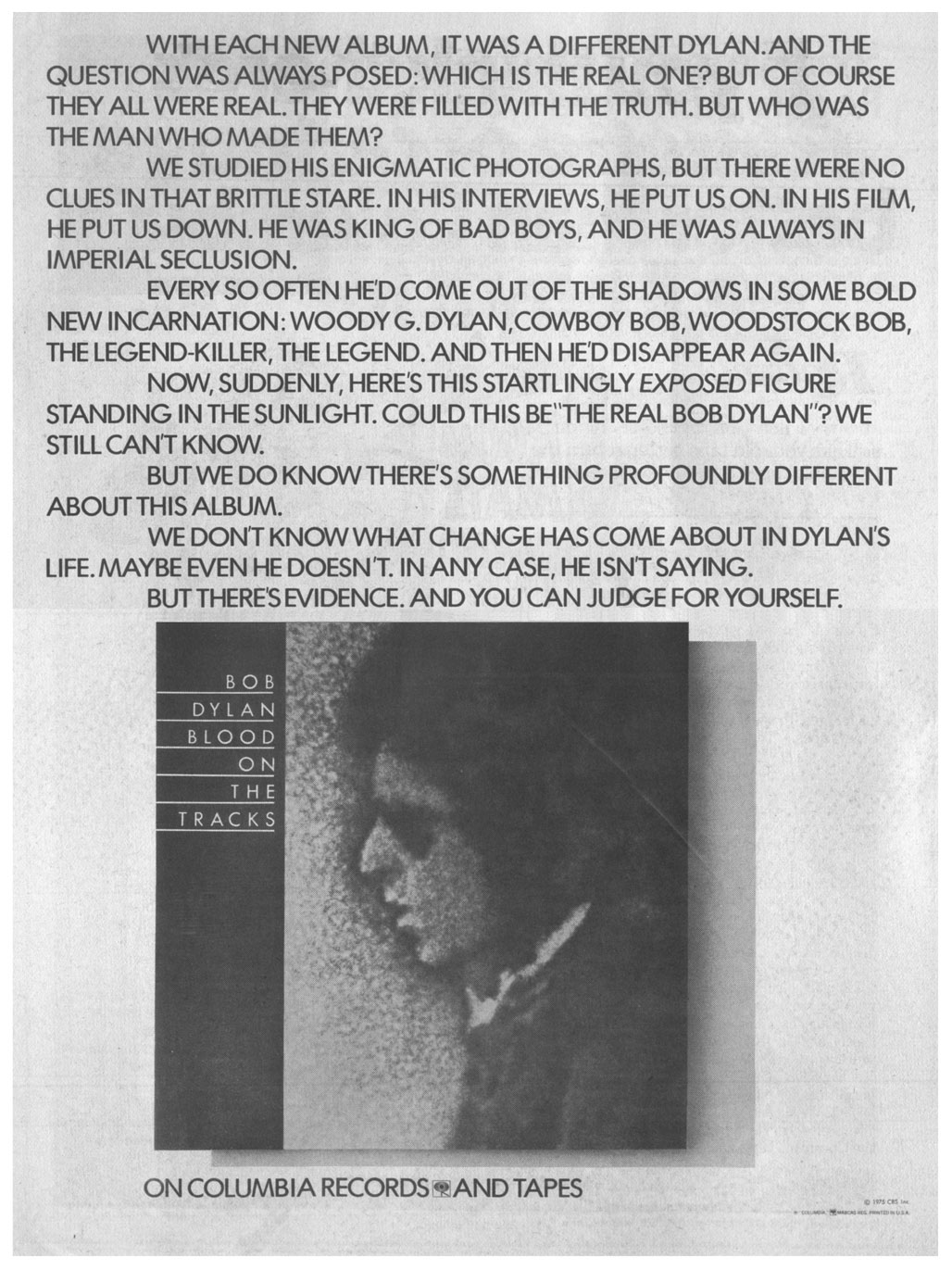 Click image for larger view. |
If Dylan isn't a great rock artist per se, his is a great artist, period. He has transcended his limitations more successfully than anyone else in rock. He succeeded in making himself indispensable. The records may be indispensable in only the first moments in which they are perceived, but they can transmit as much force in those moments as others do in hours, days and years.
Much of the critical enthusiasm for Blood on the Tracks is really a sigh of relief that he's shaken off the role of contentment that never rang true. But in returning to his role as disturber of the peace, Dylan hasn't revived any specific phase from the past, only a style that lets his emotions speak more freely and the state of mind in which he no longer denies the fires that are still raging within him and us. He is using elements of his past to make an album about his past.
The record itself has been made with typical shoddiness. The accompanying musicians have never sounded more indifferent. The sound is generally no more than what Greil Marcus calls "functional," a neutral environment from which Dylan emerges.
But the singing is much better than on any recent album. He turns up with beautiful phrasing on "Tangled Up in Blue," "You're a Big Girl Now," "Shelter from the Storm" and "Buckets of Rain" (but the snarl he resurrects from "Like a Rolling Stone" in order to sing "Idiot Wind" sounds like a shadow of his former self).
If in Dylan's world of extremes there's room for a middle ground, that's where I place Blood on the Tracks. It's his best album since Blonde on Blonde, but not nearly as good. If it contains nothing so bad as the second version of "Forever Young," only "Tangled Up in Blue" comes even close to "One of Us Must Know (Sooner or Later)." To compare the new album to Blonde on Blonde at all is to imply that people will treasure it as deeply and for as long. They won't.
But, for the moment, which is when this record was made for, I like everything about it; the good, the bad and the ugly. It all matters: the title "Tangled Up in Blue"; and the way that song propels itself relentlessly forward (even though it is about the past) and always winds up leaving Dylan and us standing in the same place; the lines, "I helped her out of a jam, I guess/But I used a little too much force"; the way that song sounds so right for the Byrds of 1965; the compassion, not rage, of "You're a Big Girl Now"; the lines "I can make it through/You can make it too"; the innocence and unqualified beauty of Dylan's reprise of his folk music roots on "Buckets of Rain"; the awkwardness of the music for "If You See Her, Say Hello"; the childishness (without any redeeming childlike wonder) of so much of "Idiot Wind"; the holiness of the last verse of "Shelter from the Storm"; the extension of the apocalyptic mood of his earlier work into something still forceful, but mellower, more understanding, more tolerant and more self-critical; the indifference to the subject of women as a generality and his involvement with women and love as something specific, and above all, the arrogance -- that defiant indifference to whatever it is others think he ought to be doing. He still stands alone.
Blood on the Tracks will only sound like a great album for a while. Like most of Dylan, it is impermanent. But like the man who made it, the album answers to no one and was made for everyone. It is the work of someone who is not just seeing through himself, but looking through us -- and still making us see things that we haven't seen before.
- Jon Landau, Rolling Stone, 3/13/75.
Bonus Reviews!
Bob Dylan, his marriage rumored troubled, his recent tour and albums treated somewhat indifferently by a less-than-worshipful press, seems haunted and uncertain again, and that may be very good news. If meant Ironically, such a statement would be both cheap and cruel, but I don't think that irony has much to do with Dylan's current marital situation, however it may turn out, or with the near-total success of Blood on the Tracks, his best LP in perhaps a decade.
If subterranean tension won out over an overwrought tenderness in Planet Waves, wherein Dylan seemed almost to turn himself inside out in an agonizing and futile effort to convince both himself and us how incredibly content he was, the reverse holds true in Blood on the Tracks. There is a great deal of personal pain here, and second thoughts about ("I can change, I swear"), but everything seems deliberately cushioned by myth, distanced by meditative rumination and artful overview of the lifetimes of ritual staying, leaving, or being told to go which all of us inevitably experience and re-experience. This is the way it is for me now, Dylan appears to by saying in these new songs (specific), and this is the way it has and will be again for both of us (universal): something lost, something gained. "Tangled Up in Blue" seems an appropriate phrase for this cyclical myth, the parted lovers forever joined by thought, while one of them, "still on the road/ Headed for a different joint," can remember "We always did feel the same/ We just saw it from a different point of view/ Tangled up," as we both are and shall always be, "in blue." In "Simple Twist of Fate," one lover says to the other, "I still believe she was my twin/ But I lost the ring," after confessing his ambivalence: "She looked at him and he felt a spark/ Tingle to his bones/ 'Twas then he felt alone." Similar ambiguities, combined with or disguised as playful sexual innuendoes, can be found in the album's two indescribably love blues sons, "Meet Me in the Morning" (not unlike "It Takes a Lot to Laugh, It Takes a Train to Cry") and "Buckets of Rain." Consider the singer's idiosyncratic reading of "Try imagining a place that's always safe and warm" in "Shelter from the Storm," a song which closes with these lines:
- Well, I'm living in a foreign country, but I'm bound to cross the line
- Beauty walks a razor's edge, someday I'll make it mine
- If I could only turn back the clock to when God and her were born
- Come in, she said, I'll give you shelter from the storm.
- Beauty walks a razor's edge, someday I'll make it mine
Unquestionably, much of Blood on the Tracks reflects Dylan's feelings about his wife Sarah and their possible separation, but much of it doesn't. "Tangled Up in Blue," "Simple Twist of Fate," the good-humored "You're Gonna Make Me Lonesome When You Go," "Meet Me in the Morning," "Lily, Rosemary and the Jack of Hearts" (a rollicking nine-minute Western-caper movie), and "Buckets of Rain," while undoubtedly containing some Sarah-lore, seem more magnanimously metaphorical than maliciously matter-of-fact. The artist's remembrance of things past, surely one of the album's principal themes, can hardly fail to rekindle other romances, and I would bet my life that "If You See Her, Say Hello" is about one of them. Suze Rotolo, the heroine of many of his early love songs, including "Ballad in Plain D" and "Boots of Spanish Leather." Dylan's singing here is heartbreaking and unforgettable:
- I see a lot of people as I make the rounds
- And I hear her name here and there as I go from town to town
- And I've never gotten used to it, I've just learned to turn it off
- Either I'm too sensitive or else I'm getting soft.
- And I hear her name here and there as I go from town to town
It would be difficult, if not impossible, to separate Bob and Sarah Dylan's recent marital problems from "You're a Big Girl Now" and "Idiot Wind," although the latter certainly encompasses also the larger subject of a strong anti-media, anti-Watergate stance as well. In "You're a Big Girl Now," the singer hears the bad news ("Our conversation was short and sweet/ It nearly swept me off my feet/ And I'm back in the ring...") and wants a reconciliation: "I can change, I swear." In "Idiot Wind," which follows immediately, Dylan strikes out with accumulated anger at everything connected with an intolerable situation, making some telling observations along the way: "It was gravity which pulled us down/ And destiny which broke us apart/ You tamed the lion in my cage/ But it just wasn't enough to change my heart." This song, which is plainly and simply a masterpiece, seems a combination of "Ballad in Plain D," "Like a Rolling Stone," "Positively 4th Street," "Sad Eyed Lady of the Lowlands," and "One of Us Must Know (Sooner or Later)." Although not entirely free of paranoia, childishness, and self-pity, it works, as Stephen Holden has pointed out, because of an not in spite of these qualities, and it achieves an anthem-like power that is overwhelming.
Although Blood on the Tracks is aptly named, it is hardly the bleak, desolate wasteland of pessimism and self-hatred that some critics, notably Paul Cowan in the Village Voice, have claimed. Far from it. Dylan's subtlety, intelligence, depth of feeling, and overall artistry have created something more flexible and complex, somehow fusing an elegiac tone with a most muscular, confident style. His imagery and his singing, moreover, have never been stronger or more expressive. This album is (pace Cowan) vital and alive, its despair tempered throughout with the joy of being a survivor, all senses intact. Bob Dylan's dreams are still made of iron and steel, and now is not the time for our tears.
- Paul Nelson, Stereo Review, 4/75.
Dylan's return to Columbia is marked by what is probably his best LP in five years, mixing the vocal styles of the "Mr. Tambourine Man" and "John Wesley Harding" days with reasonably simple instrumental backing and material that stands as poetry as well as songs. A number of love and story songs highlight the LP, ranging from the raspy, jump Dylan that is familiar to all, to some smooth ballads. Subject matter varies from some superb love songs to some fine narratives. All the songs, however, are of a very powerful nature. Like the best of previous LPs there is an underlying sense of tension that makes the listener quite aware he is hearing something other than your average singer but does nothing to interfere with the enjoyment of the album. Other songs include some country oriented things and some of the AAB blues Dylan has always done so well. There's even an 8-minute cut that is not a "Desolation Row" but is quite enjoyable. If you're looking for deep meanings in this LP, they are more than likely there. If not, simply enjoy the album. Best cuts: "Tangled Up In Blue," "Simple Twist Of Fate," "Idiot Wind," "Lily, Rosemary And The Jack Of Hearts," "If You See Her, Say Hello," "Shelter From The Storm," "Buckets Of Rain."
- Billboard, 1975.
Dylan's "soulful, bounding leap" into the world of memory and pain. The Jack of Broken Hearts, tangled up in blue (love as allusion, the Seventies as illusion), arriving at the haunting and haunted realization of "Simple Twist of Fate."
- Jonathan Cott, Rolling Stone, 12/15/77.
The first version of this album struck me as a sellout to the memory of Dylan's pre-electric period; this remix, utilizing unknown Minneapolis studio musicians who impose nothing beyond a certain anonymous brightness on the proceedings, recapitulates the strengths of that period. Dylan's new stance is as disconcerting as all the previous ones, but the quickest and deepest surprise is in the music itself. By second hearing its loveliness is almost literally haunting, an aural déjà vu. There are moments of anger that seem callow, and the prevailing theme of interrupted love recalls adolescent woes, but on the whole this is the man's most mature and assured record. A
- Robert Christgau, Christgau's Record Guide, 1981.
Blood on these tracks, indeed. "Blood on the Tracks remains the most scarifyingly acute dissection of marital breakdown ever committed to vinyl," writes Niall Stokes of this Dylan number one. "It is a monumental achievement, cinematic in scope and epic in its proportions. There isn't a weak moment and in 'Idiot Wind,' 'Lily, Rosemary and the Jack of Hearts' and, in particular, 'Tangled Up in Blue,' Bob Dylan redefines the potential of the popular song.
"Dylan is capable of making you laugh, of transfixing you with his anger, of filling you with awe at the resourcefulness of his language, at the originality of his imagery. Blood on the Tracks, a magnificently titled record, does all of these and more. It chills me to the marrow, makes me cry and makes me feel absurdly good at the same time. Ultimately the sheer quality of art, the mastery of the medium, the magic of the music is a supremely uplifting experience."
Stokes writes eloquently of this masterpiece. Pete Hamill need not be asked for further comment, since his liner notes on the back cover were so lengthy they had to be reproduced in tiny print. He won the 1975 Annotator's Grammy for his efforts, which were removed from and then restored to the jacket, creating two different versions of Blood on the Tracks.
In 1987, Blood on the Tracks was chosen by a panel of rock critics and music broadcasters as the #25 rock album of all time.
- Paul Gambaccini, The Top 100 Rock 'n' Roll Albums of All Time, Harmony Books, 1987.
Planet Waves was recorded after the expiry of Dylan's initial contract with CBS but he returned to the label to record Blood on the Tracks which taps a reservoir of vitriol and bile, the backlog of bitterness from his broken marriage to Sara Lowndes. The inspiration may be negative but the album marks a return to form and a shift away from the soft-centered, though both content and delivery are a little relentless.
Again, as with Highway 61 Revisited, the CD issue lacks the expected directness and immediacy sounding much like an excellent copy of a second rate copy master tape. The natural edge is missing from Dylan's voice and though well recorded, well separated, the overall sound is slightly veiled ("You're Gonna Make Me Lonesome" etc. suffers particularly). "Jack O'Hearts" shines through though even here Dylan's voice seems limited and rolled-off in recording. Compact Disc however brings the benefit of a deeper bass.
- David Prakel, Rock 'n' Roll on Compact Disc, 1987.
The snarl was still there, but the shift in Dylan's attitude was marked and perceptible. The spotlight is completely on Dylan here, because the backup musicians added nothing but the briefest sort of filler sound. Dylan filled that spotlight with the best songwriting he'd done in years -- honest, poetic, the voice of a survivor hopefully headed for less traumatic times, but carrying the scars and bitterness of savaged love. The music is lilting and haunting, making this Dylan's best release of the decade (acknowledging that the Basement Tapes were really sixties material, release date notwithstanding). His singing is stunningly honest, which adds dimension to his most mature musings about love lost and a time gone by -- too quickly. It's folkish sound hearkens back to the sixties; its heart is the perspective it places on times recently past, irrevocably gone. The sound on this disc is wonderful, open, and full. It does have a few moments of overbrightness and slight compression is perceptible, but the vocal detail is greatly enhanced. A+
- Bill Shapiro, Rock & Roll Review: A Guide to Good Rock on CD, 1991.
A stunning, mature statement in which the songwriter faced the conflicting elements of his life, the uncertainties of life in general, and the virtues of kindness and generosity. Incidentally, he also invented new songwriting structures and composed some of the most appealing music of his career. Still perhaps Dylan's most listenable and compelling album, this best represents his post-'60s work. * * * * *
- William Ruhlmann, The All-Music Guide to Rock, 1995.
Although Dylan's creative output peaked with 1966's Blonde on Blonde, nine years later he shocked everyone with the brilliance of Blood On The Tracks. As his marriage started to crumble, Dylan wrote and sang songs like "Tangled Up in Blue" and "Idiot Wind" from the soul, causing critics everywhere to pull out and dust off the "masterpiece" moniker once again. * * * * *
- Pete Howard, Musichound Rock: The Essential Album Guide, 1996.
On this phenomenal comeback of poetic beauty after five years of nondescript releases, America's greatest bard's failing marriage inspired a flawless string of songs that demonstrate his suffering in every line. His meditation on lost love covers every feeling, going from his most caustic ("Idiot Wind"), to lamentative ("Simple Twist of Fate") to romantic ("You're Gonna Make Me Lonesome"). Voted this survey's No. 1 for songwriting, it's venom and heartbreak perfected, and it's quite amazing. * * * * *
- Zagat Survey Music Guide - 1,000 Top Albums of All Time, 2003.
Among Dylan fans, Blood on the Tracks has a reputation as "the divorce album." (It was, in fact, written and recorded while Dylan was still married to first wife Sara Lowndes -- which may mean that cause and effect have been reckoned exactly backward.) It is a work that is steeped in raw-throated, searing loss. Love is everywhere in these songs but seldom in the present. It drifts on the currents of the past, to wash inexorably on the shores of the present. The album can make you feel morbidly good about feeling bad. Not surprisingly, it is the perfect soundtrack to a breakup. Its particular brand of sadness primes the wounded heart for another giddy flight -- and for another exquisite spiral earthward. It's an album that transforms the soul's cruelest tortures into magnificent art, and that's the sort of thing that can set you out in search of "a Dylan girl" (my idea of a tall, shapely woman who manages to exemplify the essentially bittersweet character of love) however bad an idea that is in practice.

- Eric Wybenga, VH1's 100 Greatest Albums, 2003.
Bob Dylan once introduced this album's opening song, "Tangled Up in Blue," onstage as taking him ten years to live and two years to write. It was, for him, a pointed reference to the personal crisis -- the collapse of his marriage to Sara Lowndes -- that at least partly inspired the album, Dylan's best of the 1970s. In fact, he wrote all of these lyrically piercing, gingerly majestic folk-pop songs in two months, in mid-1974. He was so proud of them that he privately auditioned almost all of the album, from start to finish, for pals and peers including Mike Bloomfield, David Crosby and Graham Nash before cutting them in September -- in just a week with members of the bluegrass band Deliverance. But in December, Dylan played the record for his brother David in Minneapolis, who suggested recutting some songs with local musicians. The final Blood was a mix of New York and Minneapolis tapes; Dylanologists still debate the merits of the two sessions. Yet no one disputes the album's luxuriant tangle of guitars, the gritty directness in Dylan's voice and the magnificent confessional force of his writing: in the existentialist jewel "Simple Twist of Fate," the wrung-dry goodbye of "If You See Her, Say Hello" and the sharp-tongued opprobrium of "Idiot Wind," his greatest put-down song since "Like a Rolling Stone."
Blood on the Tracks was chosen as the 16th greatest album of all time by the editors of Rolling Stone magazine in Dec. 2003.
- Rolling Stone, 12/11/03.
An intensely touching album from an artist at the height of his powers, Blood On The Tracks is essentially about a marriage breakdown, in this case that of Dylan's own to his wife, Sara. Songs such as "You're Gonna Make Me Lonesome When You Go," "You're A Big Girl" and "If You See Her Say Hello" speak for themselves in terms of lamenting regret and love lost, while "Buckets Of Rain" is a bittersweet love song. Throughout the album the perfect cadence of Dylan's poetry barely disguise his rage -- anger that really comes to the fore in songs such as "Idiot Wind." Dylan also manages to weave examples of his trademark epic folk stories into his songs, as evidenced on the relatively upbeat "Lily, Rosemary & The Jack Of Hearts."
The album is also notable for having been almost completed over a series of recording sessions that were subsequently scrapped by Dylan in favour of re-recording with a different group of backing musicians.
Blood On The Tracks topped the US charts and managed a Number Four placing in the UK, in the "Tangled Up In Blue" it also gave Dylan his biggest US single hit since "Knockin' On Heaven's Door," two years earlier.
As of 2004, Blood On The Tracks was the #96 best-selling album of the 70s.
- Hamish Champ, The 100 Best-Selling Albums of the 70s, 2004.
The wordy whining, the wheezy harmonica -- we won't lie to you, they're here. But so too are some of the brightest songs in a career not short of sparklers.
The omens were not brilliant. Dylan spent the early 1970s making scrappy records (Planet Waves? Yes, please. Pat Garrett And Billy The Kid? No, thanks), leaping from label to label and generally suggesting that he was not adapting too well to the new decade. To complete the chorus, his marriage was unraveling. You could expect only maudlin musings on love lost.
Instead, you get the lovely "Tangled Up In Blue" (even the title is fantastic), the sneering "Idiot Wind" (you're an eeeediot, babe"), the beautiful "Simple Twist Of Fate," and the breathless "Lily, Rosemary And The Jack Of Hearts," which drags not once in a running time of nearly nine minutes. "Shelter From The Storm" is an expression of gratitude that any world-oppressed, beleaguered male will understand.
The music touches on blues, folk, and proto-Dire Straitisms without dwelling on any style long enough for its appeal to pall. This diversity is due in part to Dylan having revamped the album after a test pressing was issued in November 1974 (making that Christmas the best ever for bootleggers). Unsatisfied with recordings made in New York, he re-cut "Tangled Up In Blue," "You're A Big Girl Now," "Idiot Wind," "Lily, Rosemary And The Jack Of Hearts," and "If You See Her, Say Hello" with musicians in his native Minnesota -- resultng in his second consecutive U.S. No. 1.
If you listen to only one Dylan album, or you want something to blame for Dire Straits, this is it.
- Bruno MacDonald, 1001 Albums You Must Hear Before You Die, 2005.
Shortly after initial test pressings of this album began to circulate in November 1974, Bob Dylan had a change of heart. The sessions, which took place in New York in September, had been arranged quickly, and in characteristic fashion, Dylan gave the musicians (from Eric Weissberg's band, Deliverance) little instruction. The singer and songwriter expected them to simply follow what he was doing. Listening to the results, Dylan decided that several of the key songs -- including "Tangled Up in Blue," "Idiot Wind" -- needed more. He hastily assembled a band in his native Minnesota, and over two days in late December recorded versions that were more to his liking. The originals became a bootlegger's bonanza -- a few of them were eventually released on Volume 3 of the authorized Bootleg Series. Meanwhile, the sleeve notes printed at the time of the initial pressings refer to several lines that Dylan excised in rerecording.
There's nothing wrong with the originals, of course. These songs of disillusionment, many inspired by the rocky end of Dylan's marriage to Sara Lownds, are sturdy enough to withstand all sorts of interpretation. But in the rerecording, Dylan summons a raw, overtly wounded tone that magnifies the feeling behind the words; there's no misunderstanding the vulnerability that saturates "Tangled Up in Blue," or the veiled fondness behind "If You See Her, Say Hello."
And really, the slightly desperate shouts of the Minnesota versions help make Blood on the Tracks an ultimate breakup album. Though it's filled with allegories and cryptic riddles, somehow the basic plotline -- she's gone, he's overcome with sadness -- is inescapable. Virtually everything has that energy: The nine-minute odyssey "Lily, Rosemary, and the Jack of Hearts" and the feral rant "Idiot Wind" form an eerie self-portrait of a man who's been blindsided, knocked flat by that "Simple Twist of Fate," and is gradually beginning to apprehend where, exactly, he stands.
- Tom Moon, 1,000 Recordings To Hear Before You Die, 2008.
Supposedly inspired by the collapse of his marriage, Dylan's 15th album is a mellow-dude detonation of anger, regret, and acceptance that features some of his most soulful singing and enduring melodies. "It's hard for me to relate to... people enjoying that type of pain," he later said in an interview. But it's harder to imagine anyone not geting swept up in this masterpiece of deeply emotional songwriting.
Blood on the Tracks was chosen as the 6th greatest album of all time by the editors of Entertainment Weekly in July 2013.
- Entertainment Weekly, 7/5/13.
Bob Dylan once introduced this album's opening song, "Tangled Up in Blue," onstage as taking him 10 years to live and two years to write. It was, for him, a pointed reference to the personal crisis -- the collapse of his marriage to Sara Lowndes -- that at least partly inspired Blood on the Tracks, Dylan's best work of the 1970s.
In fact, he wrote all of these lyrically piercing, gingerly majestic folk-pop songs in two months, in mid-1974. He was so proud of them that he privately auditioned almost all of the LP, from start to finish, for pals and peers, including Mike Bloomfield, David Crosby, and Graham Nash, before cutting them in September -- in just a week, with members of the bluegrass band Deliverance.
But in December, Dylan played the record for his brother, David, in Minneapolis, who suggested Dylan might get fuller versions of the songs if he recut some of them with local musicians. "The reality of having Bob Dylan walk in the room was pretty shocking," guitarist Kevin Odegard told Rolling Stone decades later. "There are two Bobs -- Bob Dylan, the rock star, and Robert Zimmerman, the Minnesotan guy, who just hangs out. And that's who we got." The final Blood was a mix of New York and Minneapolis tapes; the New York versions are slower, more pensive, while the Minneapolis versions are faster and wilder. Together, they frame the gritty anguish in Dylan's vocals, as he rages through some of his most passionate, confessional songs -- from adult breakup ballads like "You're a Big Girl Now" and "If You See Her, Say Hello" to the sharp-tongued opprobrium of "Idiot Wind," his greatest put-down song since "Like a Rolling Stone."
"A lot of people tell me they enjoyed that album," Dylan said soon after it became a commercial and critical success. "It's hard for me to relate to that -- I mean people enjoying that type of pain." Yet Dylan had never turned so much pain into so much musical splendor.
Blood on the Tracks was chosen as the 9th greatest album of all time in a Rolling Stone magazine poll of artists, producers, critics and music industry figures in Oct. 2020.
- Rolling Stone, 10/20.
 Reader's Comments
No comments so far, be the first to comment.
 Buying Options





