
   |

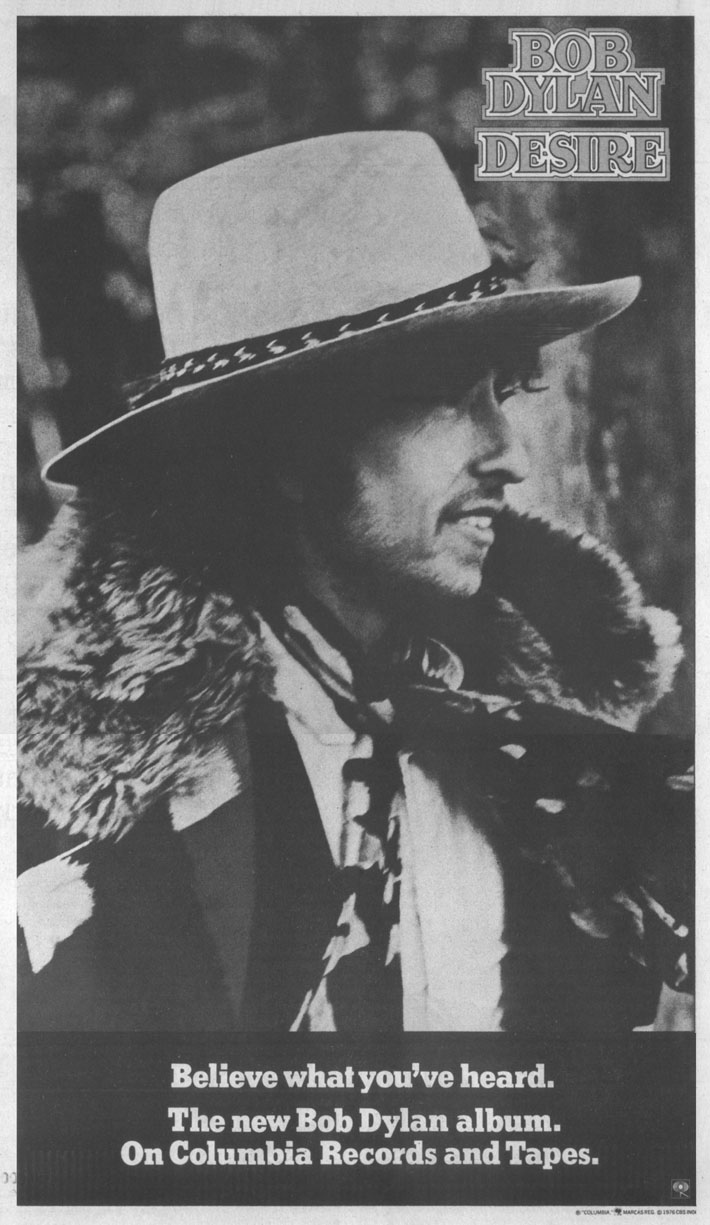
Desire
Bob Dylan
Columbia PC 33893
Released: January 1976
Chart Peak: #1
Weeks Charted: 35
Certified Platinum: 3/4/76

Apathy has all but supplanted enthusiasm throughout our society, particularly among the generation most deeply involved with, and affected by, the myth and music of Bob Dylan. I wish I understood this phenomenon more fully. I can't quite convince myself that it's merely the result of that creeping inertia and conservatism which seem to come as one grows older, nor can I believe that everything is a plot (by the Russians, the Arabs, the Government, the Venutians, or what have you) designed to render us all passive and mindless, ripe for easy conquest.
Throughout Desire, Dylan does seem at least cognizant of our (and his own?) acute apathy. In "Hurricane" he seeks to arouse our indignation over yet another Great American Injustice, though for my part I find the tone in it too earnest and preachy, the narrative too flat for the song to have much emotional impact. Somehow, Rubin Carter never seems like a real, much less sympathetic or heroic, character to me, and I think that's mostly because the language use is so ordinary, almost hackneyed. Perhaps this was done deliberately for effect, but it weakens what might otherwise have been as poignant and powerful as, say, Dylan's earlier "Percy's Song," which always leaves me railing at the Fates and the impersonal, inexorable forces of Justice. But "Hurricane" only makes me wonder why, if the case was so flagrantly misconducted, the press and the civil liberties people haven't made such a stink that, in this post-Watergate era of hypersensitivity to corruption anywhere in government, they'd be forced to straighten the mess out posthaste.
 Click image for larger view. |
- It seems there was an earthquake that
- Left nothing but a Panama hat and a pair of old Greek shoes.
- It didn't seem like much was happening,
- Running into the sun but I'm running behind.
- So I turned it off and went to grab another beer.
- Seems like every time you turn around.
- There's another hard luck story that you're gonna hear.
- Left nothing but a Panama hat and a pair of old Greek shoes.
Storytelling, rather than songwriting as such, seems to be Dylan's strongest point these days -- perhaps it always was. Dylan's melodies have never been anything special; either they work in context or they don't, and that's that. The one thing he has been constantly good at is the manipulation of language, his unusual, occasionally interesting, use of words. At least for me, that element is messing in much of this album: several of the lyrics are borderline clichés, in fact. The one song I can't fault on this count is "Joey," a biography in song of a gangster. The line "Always on the outside/ Of whatever there was" strikes me as one of the better descriptions of how it feels to be a misfit. Strangely enough, Joey Gallo, a man who surely broke many of the laws of our land, here becomes a far more likable character than the putatively blameless Rubin Carter. Quite simply, Joey's story is recounted more effectively, and with rather more understanding and compassion, than Rubin's.
The other songs don't work quite so well. "Isis" seems mostly an exotic fantasy, filled with grave-robbing and icebound pyramids. "Mozambique" is a musical picture postcard, and there's an odd, ominous feel to "One More Cup of Coffee" that's never really developed. According to Allen Ginsberg's incoherent liner notes, "Oh Sister" may, or may not, be addressed to all of us "good citizen sisters" too busing exploring our new-found independence to meet the emotional needs of others. It is not only sloppy but sappy: "Oh sister am I not a brother to you/ And one deserving of affection?' And is our purpose not the same on this Earth/ To love and follow his direction?" Whose? Where? Too mystical for a literalist like me. "Romance in Durango" has a nicely evocative arrangement and rather reminds me of Marty Robbins' old, best-forgotten "El Paso" in its gaudy Southwestern trappings and tragic romanticism.
That leaves us with "Sara," which I think may have been a mistake for Dylan. A fair amount of his success has been a result of his ability to keep people guessing and wondering about him, after all. Only a fool tells all he knows or feels, and Dylan has never been that, but he may well have revealed more of himself here than was either necessary or wise. I can think of nothing more boring than omniscience.
All things considered, Desire isn't nearly as bad as I'd expected, but then you'll have gathered that I had no great expectations. The production is a vast improvement over Blood on the Tracks, as is the instrumental work. Far be it from me to disparage competent musicianship; frankly, I think Dylan's voice and guitar can use all the assistance they can get. Howard Wyeth's drumming is particularly commendable. The violin doesn't always fit into the arrangements, but it salvages at least one song from total forgettability. Emmylou Harris' backing vocals don't sound as good on record as they do in theory; her voice just doesn't seem to blend all that well with Dylan's. More's the pity. And so, the Second Coming this isn't, thank the Lord, but at least it's not trying to be. Who ever wanted that to begin with except those lunatics panting for the Last Judgement?
- Linda Frederick, Stereo Review, 4/76.
Bonus Reviews!
One of the world's finest songwriters has surfaced for the New Year with perhaps his greatest album to date. Not only is he writing better than ever, but his songs seem to reflect a new Dylan. Whether he's writing about a sensitive Joey Gallo or a falsely-imprisoned Rubin "Hurricane" Carter or a lamenting love ballad to his wife Sarah, Dylan is at his best. Underscoring the success of each narrative song is the amazingly tight instrumental work of the Rolling Thunder featuring Scarlett Rivera on violin, Rob Stoner on bass, Howie Wyeth on drums and Emmylou Harris on background vocals. On "Hurricane," this quartet is joined by Ronee Blakley and Steve Soles on background vocals, and Luther Rix on congas. Each of these musicians is an asset to the new sound of Dylan. Ms. Rivera's musicianship is a fine discovery since she can underscore a Dylan phrase with unmatched intensity or romance, while Stoner and Wyeth offer one of the strongest rhythm sections in music. As for Dylan, his harmonica, acoustic guitar, piano and especially his vocals sound better than ever. Another plus factor is packaging, with its striking cover shot and liner photos. Also the inside liner notes are by Allen Ginsberg, and they reflect the mood of the recent Rolling Thunder Revue tour of the Northeast. Best cuts: "Hurricane," "Isis," "One More Cup Of Coffee," "Oh, Sister," "Joey," "Romance In Durango," "Sara."
- Billboard, 1976.
In the great tradition of Grand Funk Railroad, Dylan has made an album beloved by tour devotees -- including those who were shut out of Rolling Thunder's pseudo-communitarian grooviness except the press. It is not beloved by me. Although the candid propaganda and wily musicality of "Hurricane" delighted me for a long time, the deceitful bathos of its companion piece, "Joey," tempts me to quistion the unsullied innocence of Rubin Carter himself. These are not protest songs, folks, not in the little-people tradition of "Hattie Carroll"; their beneficiaries are (theoretically) wronged heroes, oppressed overdogs not unlike our beleaguered superstar himself. And despite his show of openness, our superstar may be feeling oppressed. His voice sounds viscous and so do his rhymes, while sisters Ronnee and Emmylou sound distinctly kid, following the leader as if they're holding onto his index finger. More genuinely fraternal (and redeeming) are the pained, passionate marital tributes, "Sara" and "Isis." B-
- Robert Christgau, Christgau's Record Guide, 1981.
A return to topicality and a movement away from the more personal stance of Blood on the Tracks. While it is a quality work of ambitious scope, it somehow has an unfinished quality about it; probably attributable to the less than polished instrumental "assistance" that lends little of positive value to the proceedings. Still, one of his better offerings of the seventies due to the inclusion of some fine material, "Hurricane," "Isis," and "Sara" being the highlights. The sound is overbright to the point of harshness on some of the vocal and harmonica tracks, a distinct comedown from the high quality of Blood on the Tracks. B
- Bill Shapiro, Rock & Roll Review: A Guide to Good Rock on CD, 1991.
A rough-and-tumble collection cut with a band Dylan was assembling for the Rolling Thunder tour. "Hurricane" recounts the tale of an unjustly imprisoned boxer, "Romance in Durango" and "Black Diamond Bay" are short stories in song, and "Sara" is a last plaintive plea from the singer to his wife. * * * *
- William Ruhlmann, The All-Music Guide to Rock, 1995.
Soon after completing Blood on the Tracks, Dylan started work on Desire, with lyrical input form collaborator Jacques Levy. In typical Dylan style, the recording was mostly bashed out in one all-night New York session, fueled in part by tequila. Guest singer Emmylou Harris didn't even get to rehearse her harmony vocals. The most intense moment came at the end, when Dylan struck up a new song he hadn't sung for the band before. As his wife, Sara, sat listening in the studio, Dylan sang "Sara," his heartbroken account of their crumbling marriage. It was the first time she heard the song -- and that take ended up on the album.
Desire was chosen as the 174th greatest album of all time by the editors of Rolling Stone magazine in Dec. 2003.
- Rolling Stone, 12/11/03.
The sense of injustice that had fired up the young Bob Dylan in the 1960s was suddenly reborn on 1976's Desire where he rediscovers his hunger to champion the underdog.
Released at the end of a purple period for the artist that had produced Planet Waves and his divorce album Blood On The Tracks, Desire finds Dylan the acute topical observer on life, albeit in a musically haphazard way.
The eight-and-a-half-minute opening track "Hurricane" illustrated his political awareness was still fully intact, rallying against what he saw as the unjust life sentence handed down to former middleweight boxer Rubin "Hurricane" Carter for triple murder. It was one of seven tracks on the album with lyrics co-written by playwright Jacques Levy whom Dylan had met seven years earlier through Roger McGuinn and whose presence here gives the songs a narrative feel. Among the two individually penned tracks is "Sara," Dylan's last plea to his wife whom he had savagely torn into on number of tracks on his 1975 album Blood On The Tracks.
Including Eric Clapton on guitar and Emmylou Harris on backing vocals, the album became only Dylan's second to top the chart on both sides of the Atlantic, spending a career-best five weeks at Number One in the US from February 1976.
As of 2004, Desire was the #94 best-selling album of the 70s.
- Hamish Champ, The 100 Best-Selling Albums of the 70s, 2004.
 Reader's Comments
No comments so far, be the first to comment.
 Buying Options





